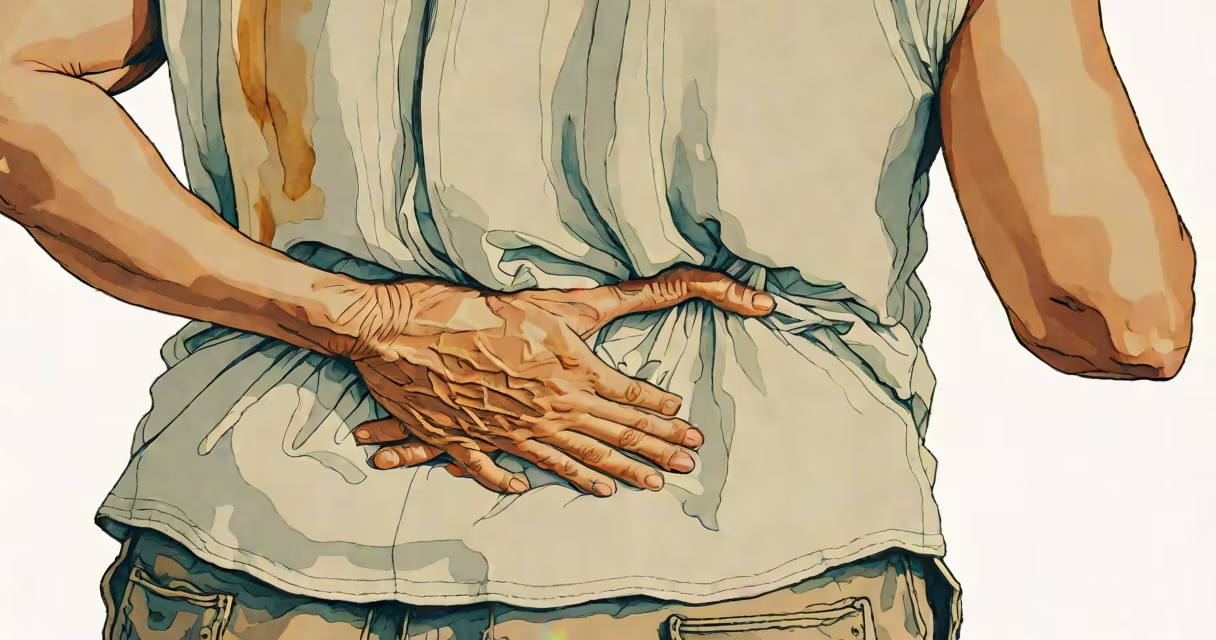
Bulging disc back pain occurs when a spinal disc protrudes into the spinal canal, compressing nearby nerves and causing localized or radiating pain. This condition often affects the lower back and may trigger numbness, tingling, or weakness in the legs. It is distinct from muscle strain and typically develops gradually due to wear, injury, or poor posture.
Spinal discs act as cushions between vertebrae. Each disc has a soft inner core (nucleus pulposus) surrounded by a tough outer ring (annulus fibrosus). A bulging disc happens when the outer layer weakens and pushes outward, though the inner material does not rupture. This pressure on spinal nerves leads to pain, especially during bending, lifting, or prolonged sitting. The most common sites are the lumbar (lower back) and cervical (neck) regions.
According to the American Academy of Orthopaedic Surgeons (AAOS), approximately 1 in 10 adults experiences symptoms related to a bulging disc at some point. Most cases resolve within six weeks with conservative treatment. However, persistent pain or neurological deficits require medical evaluation to rule out more serious conditions like cauda equina syndrome, which demands urgent intervention.
A bulging disc forms when repetitive stress or sudden trauma damages the annulus fibrosus. Over time, aging reduces disc hydration, making them less resilient. Factors increasing risk include heavy lifting, prolonged sitting, obesity, and smoking. A 2021 study in Spine Journal found that smokers have a 60% higher incidence of disc degeneration compared to non-smokers.
Unlike a herniated disc-where the nucleus ruptures through the outer layer-a bulging disc remains contained. But both can cause similar symptoms. The difference lies in imaging: MRI scans show a bulge as a broad extension beyond the disc's normal boundary, while a herniation appears as a focal mass pushing into the spinal canal.
For example, a 42-year-old office worker developed lower back pain after lifting boxes at work. The pain radiated down the left leg, worsening when standing. An MRI confirmed a L4-L5 bulging disc compressing the exiting nerve root. After four weeks of physical therapy and NSAIDs, pain decreased by 70%, with full recovery in eight weeks.
Bulging disc back pain is often mistaken for muscle strain or sciatica. While sciatica describes pain along the sciatic nerve-typically from disc compression-it is a symptom, not a diagnosis. Not all sciatica stems from disc issues; piriformis syndrome or spinal stenosis can mimic it.
Another error is assuming all back pain requires surgery. The North American Spine Society reports that 90% of bulging disc cases improve without surgical intervention. Surgery is reserved for cases with progressive weakness, bowel/bladder dysfunction, or failure of six months of nonoperative care.
Some patients believe imaging is always necessary. However, guidelines from the American College of Physicians recommend against routine MRI for uncomplicated back pain unless red flags appear-such as unexplained weight loss, fever, or neurological decline.
The spine has 23 discs: 6 in the neck (cervical), 12 in the mid-back (thoracic), and 5 in the lower back (lumbar). Lumbar discs are most prone to bulging due to high load-bearing demands. Cervical disc bulges affect the neck and arms.
| Spinal Region | Typical Symptoms | Common Causes |
|---|---|---|
| Lumbar (lower back) | Pain radiating down one leg, foot drop, numbness in foot | Heavy lifting, prolonged sitting, degenerative changes |
| Cervical (neck) | Neck pain, arm numbness, shoulder stiffness | Repetitive strain, whiplash, aging |
| Thoracic (mid-back) | Mid-back pain, rib tenderness, rare nerve involvement | Postural strain, trauma, rarely degeneration |
Discs in the thoracic region are less likely to bulge due to limited motion and strong rib support. When they do, symptoms are often misdiagnosed as heart-related pain, leading to unnecessary cardiac testing.
Seek care if pain lasts longer than six weeks, worsens despite rest, or includes neurological signs. These include difficulty walking, loss of bladder control, or progressive leg weakness. A 2022 review in Journal of Neurosurgery: Spine found that delayed treatment increases the risk of chronic pain by 40%.
For instance, a 55-year-old man experienced worsening lower back pain and noticed he was dragging his left foot. He had ignored it for three months. MRI revealed a large L5-S1 bulging disc compressing the S1 nerve root. After epidural steroid injections and rehabilitation, strength returned within four weeks.
Diagnosis begins with a physical exam assessing reflexes, muscle strength, and sensation. Imaging-usually MRI-is used only if symptoms persist or neurological findings exist. CT scans and EMG may be ordered if nerve damage is suspected.
Treatment focuses on reducing inflammation and improving function. First-line options include NSAIDs, physical therapy targeting core stability, and activity modification. A 2020 Cochrane review concluded that supervised exercise programs reduce pain by 30% more effectively than home exercises alone.
Injections such as epidural steroids provide short-term relief for severe pain. Surgery-like microdiscectomy-is considered only when conservative care fails after six months. Success rates exceed 85% in properly selected patients, according to AAOS data.
Prevention involves maintaining good posture, strengthening core muscles, and avoiding prolonged sitting. A 2019 study in Occupational & Environmental Medicine showed that workers using sit-stand desks reported 32% less back pain over 12 months.
Bulging disc back pain is a mechanical issue rooted in spinal anatomy. It is not a sign of weakness or poor fitness. With accurate diagnosis and targeted care, most people return to normal activities without long-term complications.