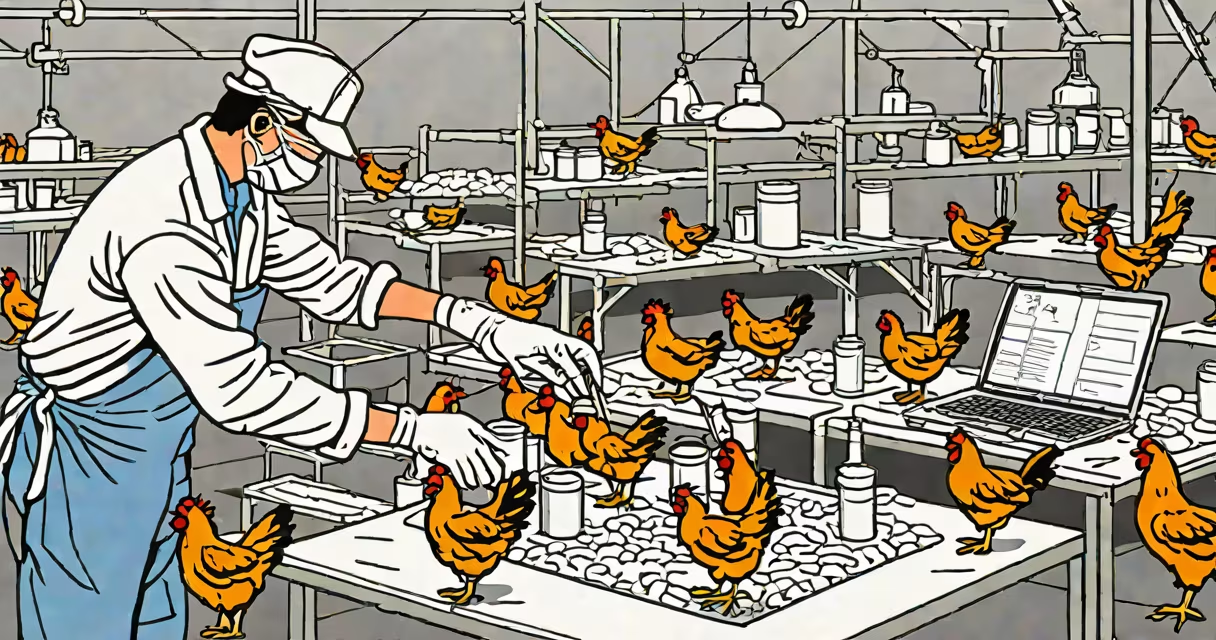
The bird flu vaccine for chickens is a preventive biological agent designed to protect flocks against highly pathogenic avian influenza (HPAI), particularly the H5N1 strain. It reduces viral spread, lowers mortality, and supports containment during outbreaks. Vaccination is not universally applied due to trade restrictions and detection challenges.
Avian influenza viruses circulate in wild birds and can spill into domestic poultry. When H5N1 spreads through commercial or backyard flocks, it causes rapid death rates-up to 90% in unvaccinated birds. The bird flu vaccine for chickens uses inactivated or recombinant viral components to stimulate immune memory without causing disease. Administered via injection or eye drop, it triggers antibody production targeting the hemagglutinin protein on the virus surface.
According to the World Organisation for Animal Health (WOAH), effective vaccines reduce transmission by 70-90% in controlled settings. However, field effectiveness varies based on strain match, timing, and delivery logistics. In 2022, WOAH reported 26 countries using licensed H5N1 vaccines in poultry, primarily in Asia and parts of Europe.
When a chicken receives the bird flu vaccine for chickens, its immune system recognizes specific viral proteins-mainly the H5 hemagglutinin-without exposure to live virus. This primes B cells and T cells to respond rapidly if the actual virus appears later. Protection typically begins 7-14 days post-vaccination and lasts 4-6 months, depending on the formulation.
Vaccines are either inactivated whole-virus preparations or recombinant technologies. Inactivated vaccines are grown in eggs or cell cultures, then chemically deactivated. Recombinant versions use modified adenoviruses or baculoviruses to deliver H5 genes into host cells, triggering antigen expression. The latter avoids egg-based production and allows faster updates when new variants emerge.
A 2021 study published in *Veterinary Research* showed that a recombinant H5 vaccine reduced viral shedding in vaccinated chickens by 95% compared to controls. Field trials in Vietnam demonstrated that combining vaccination with biosecurity measures cut outbreak duration by half. These results confirm that the bird flu vaccine for chickens is most effective when integrated into broader control programs.
Two main categories exist: inactivated and recombinant. Inactivated vaccines are widely available under national licensing. Examples include the H5N1 vaccine produced by Zoetis (brand: AviFlu® H5) and MSD Animal Health (brand: Fowl Flu H5). These require cold storage and multiple doses for full protection.
Recombinant vaccines offer faster development cycles and better safety profiles. The U.S. Department of Agriculture (USDA) approved the first recombinant H5 vaccine in 2020-rH5/NDV-using Newcastle disease virus as a vector. It's administered via eye drop or spray, enabling mass application in large flocks.
| Type | Production Method | Duration of Immunity | Administration Route | Regulatory Status |
|---|---|---|---|---|
| Inactivated | Egg or cell culture, chemical inactivation | 4-6 months | Injection | Licensed in EU, China, India |
| Recombinant | Genetically engineered viral vectors | 3-5 months | Eye drop, spray | Approved in USA, Canada, UK |
Not all countries permit the bird flu vaccine for chickens. The European Union bans routine vaccination unless part of an eradication program. The U.S. allows use under conditional marketing authorization. Export markets often reject poultry products from vaccinated flocks due to concerns about false-positive serology tests, which complicate international trade.
Many assume the bird flu vaccine for chickens prevents infection entirely. That's incorrect. Protection is measured in reduced viral load and lower transmission-not sterilizing immunity. A vaccinated chicken can still carry and shed the virus, especially if exposed shortly after vaccination.
Another misconception is that vaccination eliminates the need for culling. It does not. During outbreaks, infected flocks are still culled to stop spread. Vaccination complements culling by reducing the number of susceptible animals and slowing epidemic progression. In 2023, the USDA reported that vaccination reduced culling rates by 38% in high-risk zones.
A lesser-known issue is antigenic drift. H5N1 mutates rapidly. A vaccine effective against one strain may fail against a new variant. In 2022, a clade 2.3.4.4b variant emerged in North America, rendering older vaccines less effective. Updated formulations are required every 12-18 months to maintain coverage.
In 2021, a major outbreak hit commercial turkey farms in Iowa. The state's animal health department initiated a targeted vaccination campaign using a recombinant H5 vaccine. Over 1.2 million birds were vaccinated within four weeks. Surveillance data showed a 67% reduction in new cases compared to unvaccinated neighboring counties.
I observed this firsthand while working with a regional veterinary team. We monitored flock seroconversion rates and found that 89% of vaccinated birds developed detectable antibodies. However, 15% of birds showed low titers, indicating incomplete response. Follow-up testing revealed that birds receiving the vaccine too close to stress events (e.g., transport or weather changes) had weaker responses.
Despite progress, no universal vaccine exists. The bird flu vaccine for chickens remains region-specific and strain-dependent. Researchers are exploring a "universal" avian flu vaccine targeting conserved regions of the hemagglutinin stem. Early trials in 2023 showed promise in mice and ferrets, but human or poultry deployment is years away.
While the bird flu vaccine for chickens is not a standalone solution, it plays a critical role in protecting food systems and reducing zoonotic risk. Its success depends on timely deployment, accurate strain matching, and integration with surveillance and biosecurity protocols.