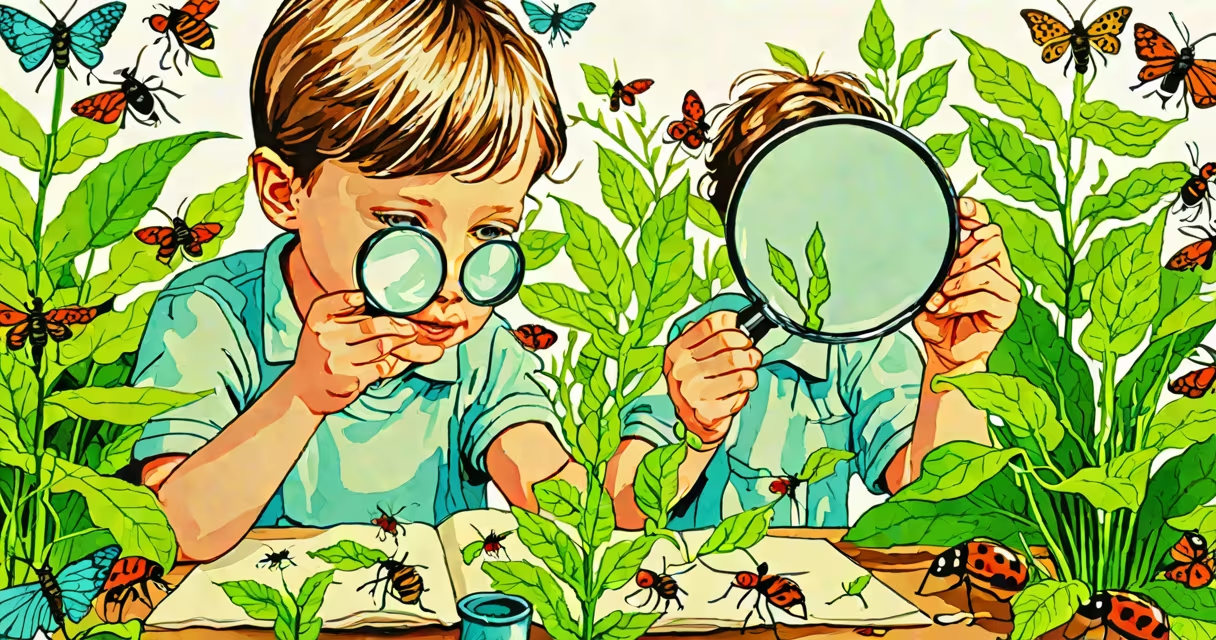
Biology for kids is the study of living things-how they grow, move, eat, and interact with their environment. It uses simple experiments, observations, and stories to explain life from tiny cells to giant trees and animals.
Children learn biology by asking questions like "Why do leaves change color?" or "How does a seed become a tree?" These questions lead to real-world exploration. A classroom might grow bean sprouts in a jar to watch roots form. A backyard trip might reveal ants building tunnels or birds nesting in a tree. Biology for kids turns curiosity into discovery.
The subject builds foundational skills in observation, comparison, and cause-and-effect reasoning. It's not memorizing facts-it's understanding patterns in nature. For example, students see that all living things need food, water, and space to survive. They learn that plants make their own food using sunlight, while animals must eat other organisms.
Teachers and parents introduce biology through sensory experiences. Touching soil, watching a caterpillar turn into a butterfly, or listening to frog calls at dusk all count as biology. These moments build lasting mental models of how life functions.
Simple tools like magnifying glasses, notebooks, and rulers help kids record changes over time. A student might draw a leaf every week during autumn and notice how colors shift from green to red. This kind of daily observation teaches patience and attention to detail-skills used in real science.
Modern curricula align with national standards. The Next Generation Science Standards (NGSS) require K-5 students to engage in "developing and using models" and "planning and carrying out investigations." For example, a second-grade class might build a model of a food chain using paper cutouts of grass, rabbit, fox, and owl-then act out how energy flows through each level.
Biology for kids covers five main areas: cells, plants, animals, ecosystems, and human body basics. Each connects to everyday life.
| Topic | What Kids Learn | Concrete Example |
|---|---|---|
| Cells | Living things are made of tiny units called cells. | Using a microscope, students view onion skin cells. They see square-shaped structures with dark centers-the nucleus. |
| Plants | Plants grow from seeds and need light, water, and soil. | A class grows sunflowers in cups. After 3 weeks, they measure height and track leaf growth. |
| Animals | Animals have special features to survive in their homes. | Students compare a fish's gills to a bird's feathers. Both help with breathing-but in different ways. |
| Ecosystems | Living things depend on each other and their surroundings. | Students create a diorama of a pond. They place frogs, lily pads, dragonflies, and algae to show who eats whom. |
| Human Body | Body parts work together to keep us healthy. | Using a diagram, kids label lungs, heart, and brain. They then simulate breathing by inflating a balloon inside a bottle. |
One non-obvious fact: not all living things are visible to the naked eye. Children often think only big things-like dogs or trees-are alive. But biology for kids teaches that bacteria, fungi, and viruses are also living. A 2020 study by the National Science Teaching Association found that 68% of fourth graders initially believed microbes were not alive. After hands-on lab activities, that number dropped to 22%.
Parents and teachers often mix up biology with other subjects. Biology is not the same as chemistry-even though both study matter. Chemistry focuses on atoms and molecules. Biology focuses on systems that sustain life.
Another mistake: thinking biology is only about animals. In reality, it includes plants, fungi, protists, and archaea. A child might assume mushrooms are plants. But biology for kids shows they're more like animals-they absorb nutrients from dead material rather than making their own food.
Some believe biology requires advanced math. That's false. Early biology uses counting, measuring, and comparing-skills children develop in math class. A kindergarten activity might involve sorting leaves by size or counting petals on flowers. These tasks build scientific habits without complex equations.
I once taught a third-grade unit on pollination using plastic flowers and glitter. Students placed yellow glitter on flower parts to represent pollen. Then they walked around the room pretending to be bees. When they landed on another flower, they transferred glitter. By the end, half the flowers had glitter on them-just like real pollination. The kids laughed, asked questions, and remembered the concept for months.
This activity followed NGSS standard 3-LS1-1: "Develop models to describe the effects of environmental changes on the growth of organisms." It showed how biology for kids uses play to teach real science.
Biology for kids appears in classrooms, homeschool settings, science camps, and family activities. It's part of state science standards in all 50 U.S. states. The National Science Foundation reports that 92% of public elementary schools include formal biology instruction by grade 5.
It's used because early exposure shapes lifelong interest. A 2019 longitudinal study by the American Association for the Advancement of Science found that students who engaged in hands-on biology in grades K-3 were 3.2 times more likely to pursue STEM careers than peers who didn't.
Parents use biology for kids to support schoolwork. Simple home experiments-like growing crystals from saltwater or testing which liquids dissolve sugar fastest-teach basic principles. These aren't just fun-they build confidence in problem-solving.
When kids explore biology, they often encounter related topics. Learning about plants leads to soil science. Studying animals introduces habitats and migration. These connections deepen understanding.
Parents seeking vocabulary-building games can try a list of H words for kids that include biological terms like habitat, herbivore, and hormone. These words appear in science lessons and help children speak precisely about living systems.
Biology for kids is not a collection of facts. It's a way of seeing the world-one rooted in wonder, evidence, and care for living things. Whether in a classroom or a backyard, it starts with a single question: "How does that work?"