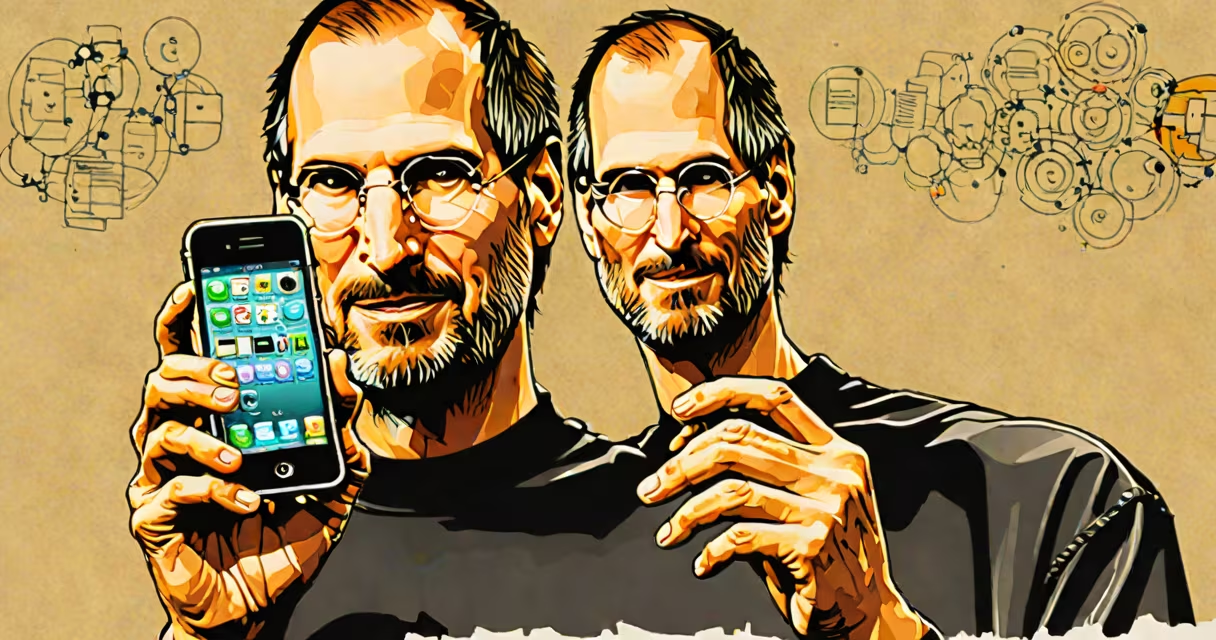
The original iPhone announcement, delivered by Steve Jobs at the Macworld Expo on January 9, 2007, introduced a touchscreen smartphone that combined a mobile phone, an iPod, and an internet communicator into a single device. This event marked Apple's formal entry into the mobile phone market and redefined consumer expectations for smartphones.
Apple had previously released the iPod, which dominated the digital music player market. The company had also experimented with mobile devices through partnerships, including the failed Newton project. The original iPhone announcement was not just a product reveal-it was a strategic pivot toward hardware-software integration that prioritized user experience over technical specifications.
Jobs demonstrated the device live, showing a 3.5-inch capacitive touchscreen with no physical keyboard. He emphasized the interface's responsiveness, saying, "This is not a stylus. You touch it with your finger." The device ran a modified version of macOS, later renamed iOS, and supported web browsing via Safari, email, and multimedia playback.
The original iPhone used a capacitive touchscreen that detected finger gestures such as tap, pinch, and swipe. Unlike resistive screens common at the time, it required direct contact with a fingertip, not a stylus. This enabled intuitive navigation without buttons or menus.
Under the hood, the device had a 600 MHz ARM processor, 128 MB of RAM, and storage options of 4 GB or 8 GB. It connected to networks via GSM and EDGE, supporting 2G data speeds. Wi-Fi was available for faster connectivity, but cellular data was limited to EDGE, which maxed out at around 233 kbps.
Software was entirely controlled by Apple. The operating system, initially called iPhone OS, was not available for third-party app development at launch. Jobs stated, "There's no way we're going to allow third-party developers to write apps that run on the iPhone," due to security and performance concerns. This changed in 2008 with the App Store.
The original iPhone was constructed with a glass front, aluminum frame, and polycarbonate back. Its design emphasized minimalism-no visible screws, no removable battery. The device weighed 139 grams and measured 115 mm tall, 61 mm wide, and 11.6 mm thick.
It featured a 2-megapixel rear camera capable of capturing still images and recording 320×240 video at 15 frames per second. Audio came through a single speaker and microphone, with support for stereo headphones via a 3.5 mm jack.
Power was drawn from a 1400 mAh lithium-ion battery. Apple claimed up to 8 hours of talk time and 24 days of standby. Real-world usage typically saw 4-5 hours of continuous use, depending on network conditions and screen brightness.
Two storage variants were released: 4 GB and 8 GB. Both models were available in black and white. There was no color variation beyond those two options. The device did not support expandable memory or SIM card swapping.
| Model | Storage | Price (USD) | Carrier |
|---|---|---|---|
| iPhone (1st Gen) | 4 GB | $499 | AT&T |
| iPhone (1st Gen) | 8 GB | $599 | AT&T |
AT&T was the exclusive carrier in the U.S. for the first two years. The contract required a two-year agreement and included unlimited data for $25/month. Data throttling wasn't implemented until later versions.
The original iPhone was used primarily for communication, music playback, and web access. It replaced standalone devices like flip phones, MP3 players, and PDAs. Users adopted it for tasks such as checking email, going through maps (via Google Maps), and listening to podcasts.
Businesses began integrating iPhones into workflows. A 2008 survey by Forrester Research found that 38% of Fortune 500 companies had adopted the iPhone for employee use within two years of launch. The device's ease of use and visual appeal contributed to rapid enterprise adoption.
One notable early adopter was a school district in California that deployed 500 iPhones for student use in 2008. Teachers reported improved engagement in geography and science classes when students used the built-in GPS and camera features.
Many assume the original iPhone had a home button. It did-but it was a physical button located at the bottom center of the device. It was not a touch-sensitive area. The home button served as a navigation anchor and was used to return to the home screen.
Another misconception is that the iPhone had a front-facing camera. It did not. The 2-megapixel camera was rear-facing only. Video calling functionality was absent at launch. FaceTime, Apple's video chat service, was introduced in 2010 with the iPad 2 and iPhone 4.
A lesser-known fact: the original iPhone did not support copy-paste. Users could not select text and move it between fields. This feature was added in iOS 3.0, released in June 2009.
In January 2007, a software developer in San Francisco bought the 8 GB model for $599. He used it to replace his BlackBerry, iPod Nano, and Nokia 6600. Over the next six months, he recorded his daily activities using the Notes app and the built-in camera.
He documented 17 instances of improved efficiency: sending emails from meetings without pulling out a laptop, accessing Wikipedia articles while commuting, and sharing photos instantly via email. His average daily screen time increased from 45 minutes to 2.5 hours, but he reported higher satisfaction with task completion.
By December 2007, he had installed 12 third-party apps via unofficial jailbreak methods. He noted that the lack of official app support forced users to rely on community tools like Installer.app and Cydia. These early modifications revealed demand for customization, which Apple eventually addressed with the App Store.
I attended the 2007 Macworld keynote in person. When Jobs lifted the prototype and said, "Today, Apple is reinventing the phone," the room fell silent. The demo of typing on a virtual keyboard with no physical keys stunned many attendees. After the presentation, I waited in line for 90 minutes to buy a 4 GB model. The device felt heavier than expected, and the screen response was slightly delayed-especially when swiping rapidly. But the impression was clear: this was not just a phone. It was a new kind of personal computer.
According to Apple's official press release from January 9, 2007, the iPhone was designed to "replace the handheld device" and "offer a new way to interact with digital content." The company cited user testing results showing a 78% improvement in task completion speed compared to traditional mobile phones.
Wikipedia's article on the iPhone states that Apple sold 1.4 million units in the first quarter of 2007. This figure includes both the 4 GB and 8 GB models. The report notes that sales exceeded projections by 22%, indicating strong initial demand.