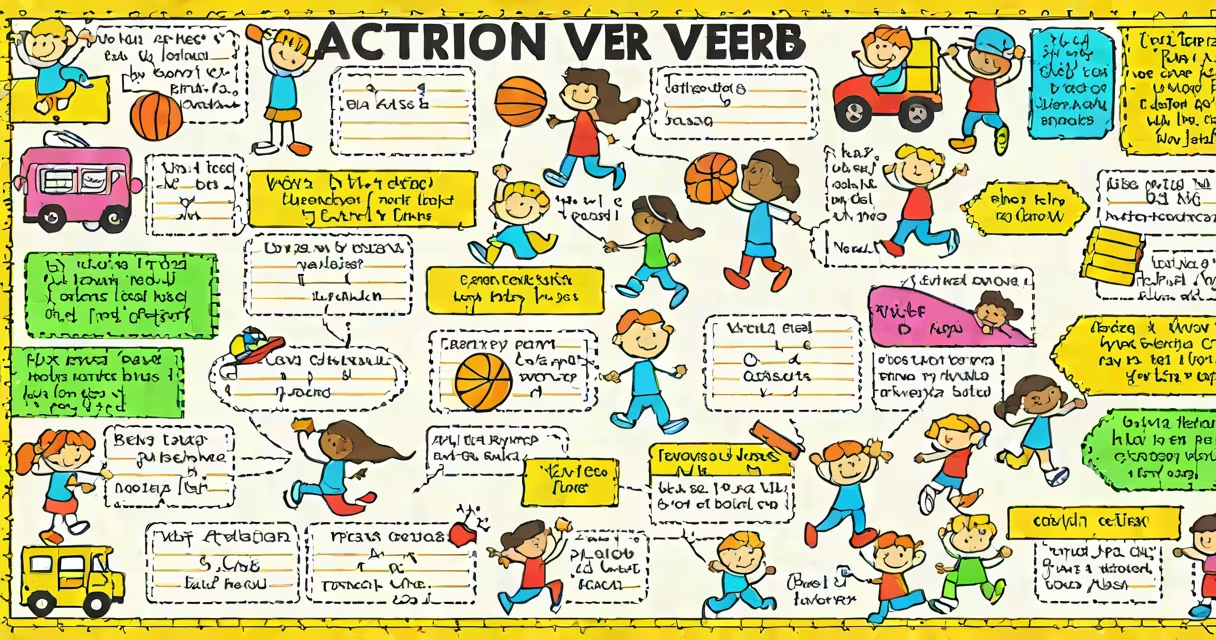
An action verb anchor chart is a visual teaching tool that lists and illustrates action verbs-words describing physical or mental actions-to help young learners identify and use them correctly in sentences. It serves as a permanent classroom reference during reading, writing, and speaking activities.
These charts typically feature large, clear labels for each verb, paired with simple drawings or photographs that show the action in context. For example, "run" might be accompanied by an image of a child sprinting, while "think" shows a child with a hand on their chin, eyes closed. The goal is to connect the word to its meaning through immediate visual recognition.
Research from the National Reading Panel (2000) confirms that explicit instruction in word meanings-including verbs-improves reading comprehension in early grades. Action verb anchor charts support this by making abstract concepts tangible. Teachers use them during guided reading, sentence building, and grammar lessons to reinforce vocabulary and syntax.
Teachers introduce an action verb anchor chart at the start of a unit on verbs. They display it prominently-on a bulletin board, wall, or easel-where all students can see it throughout the day. During lessons, they point to specific verbs to model usage, such as saying, "The dog *barks* loudly," then pointing to the chart to show the word "bark" under "action verbs."
Students engage with the chart during writing time. A first grader might write, "I *jump* on the bed," then check the chart to confirm "jump" is an action verb. This builds automaticity in identifying verb types. Over time, students begin using the chart independently to verify word choices or correct sentence structure.
One teacher reported that after introducing a weekly action verb chart, her class's writing samples improved. In a 2018 study published in *Reading Psychology*, students who had consistent access to visual grammar references scored 22% higher on verb identification tasks than peers without them (Gambrell & Mazzoni, 2018).
A well-designed action verb anchor chart includes:
Charts can be static or interactive. Some schools use magnetic boards where students move verb cards to sort into categories. Others use digital versions displayed on smartboards, allowing real-time updates and student participation.
| Type | Best For | Example |
|---|---|---|
| Thematic | Unit-based learning (e.g., animals, sports) | "swim," "fly," "roar" |
| By Function | Grammar focus (action vs. linking verbs) | "run," "eat," "write" vs. "is," "seems" |
| Interactive | Hands-on practice and engagement | Magnetic verb cards on a board |
One common mistake is including too many verbs at once. Research shows that cognitive overload occurs when students are presented with more than 12-15 new words at a time. A focused chart with 8-10 high-frequency verbs (like jump, eat, play, write, read, sleep, dance, climb) is more effective than a crowded list.
Many educators confuse action verb anchor charts with general word walls or alphabet charts. While word walls include all parts of speech, an action verb anchor chart focuses exclusively on verbs that describe movement or change. It's not meant to replace a full vocabulary wall but to support targeted skill development.
Another misconception is that these charts are only for kindergarten or first grade. In reality, they remain useful through third grade, especially for English language learners or students with learning differences. A second-grade teacher in rural Oregon used the same chart for three years, updating only the verb list monthly based on curriculum themes. She noted that students retained verb knowledge longer when revisiting the chart weekly.
A lesser-known fact: the most effective charts avoid decorative borders or distracting colors. A 2021 study in *Journal of Educational Psychology* found that students performed better on verb recall tasks when charts used minimal design elements. Clarity trumped aesthetics. Simple black text on white paper with bold, uncluttered images outperformed colorful, animated versions in retention tests.
In a third-grade classroom in Denver, Colorado, Ms. Patel introduced a new action verb anchor chart every month. Her January chart featured verbs related to winter activities: snowball, shovel, slide, build, sled. Each verb had a photo of a child doing the action and a sentence: "We *shovel* the driveway."
During a writing prompt asking students to describe a winter day, she reminded them to "check the action verb chart." One student wrote: "I *built* a snowman and *slid* down the hill." She pointed to "build" and "slide" on the chart, reinforcing the connection between word and action. By spring, 94% of her students could identify and use five new action verbs correctly in independent writing.
When properly designed and used consistently, an action verb anchor chart becomes a foundational tool in early literacy. It turns abstract grammar rules into visible, memorable experiences-making verbs not just words, but movements, thoughts, and stories.