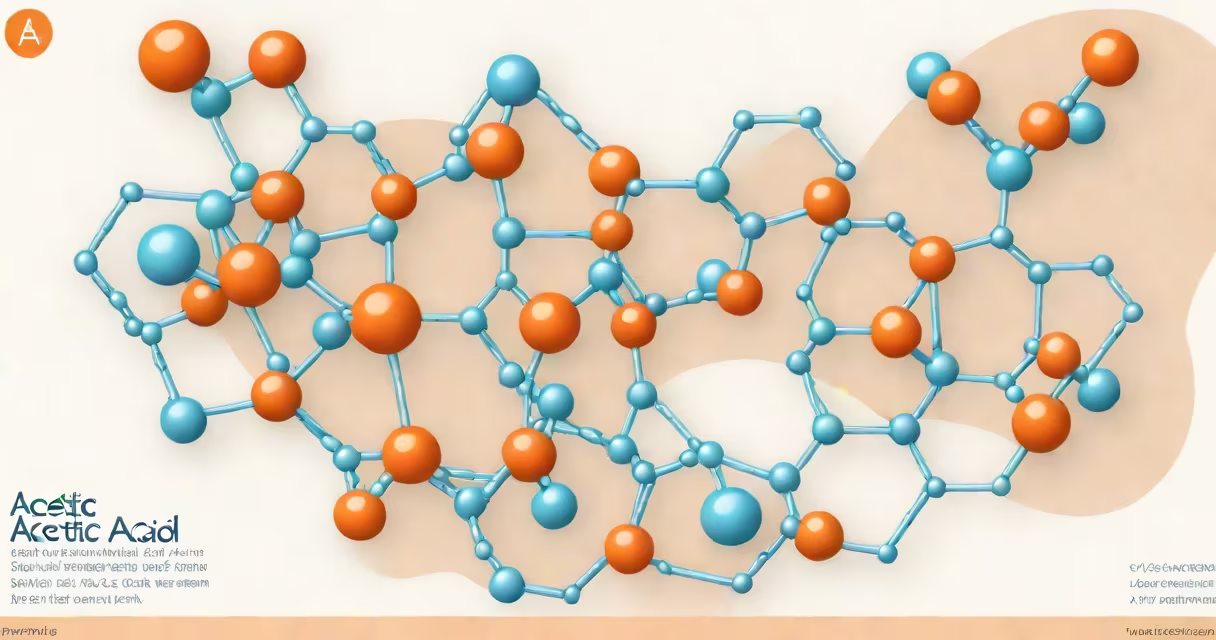
The acetic acid structural formula is CH₃COOH, a two-carbon molecule with a methyl group (CH₃) attached to a carboxyl group (COOH). This arrangement defines its chemical behavior, including acidity and reactivity.
Acetic acid consists of two carbon atoms, four hydrogen atoms, and two oxygen atoms. The structure shows a central carbon bonded to three hydrogens (CH₃), connected via a single bond to a carbon double-bonded to one oxygen and single-bonded to a hydroxyl group (OH). This functional group-carboxyl-is responsible for the compound's acidic properties.
When dissolved in water, the OH in the COOH group donates a proton (H⁺), forming acetate (CH₃COO⁻) and hydronium (H₃O⁺). This ionization gives acetic acid a pKa of 4.76, making it a weak acid. Its ability to partially dissociate allows it to function in buffering systems and biological processes.
The spatial arrangement of atoms in CH₃COOH influences solubility, boiling point, and reactivity. The polar C=O and O-H bonds allow hydrogen bonding with water, enabling complete miscibility. The nonpolar CH₃ group limits solubility in highly polar solvents.
Acetic acid boils at 118°C due to intermolecular hydrogen bonding. Pure acetic acid solidifies at 16.6°C, forming ice-like crystals known as glacial acetic acid. This property makes it useful in lab settings where controlled crystallization is needed.
In biological systems, acetic acid is a key intermediate in metabolism. It enters the citric acid cycle after conversion to acetyl-CoA. The structure allows enzymatic recognition through specific binding sites in proteins like pyruvate dehydrogenase.
While the standard structural formula remains CH₃COOH, variations occur in different representations:
| Representation Type | Description | Use Case |
|---|---|---|
| Condensed formula | CH₃COOH | Chemical notation, lab reports |
| Skeletal (line-angle) | Short lines with vertices representing carbon atoms; OH and CH₃ implied | Organic chemistry textbooks, reaction diagrams |
| Three-dimensional model | Ball-and-stick or space-filling view showing bond angles and atomic positions | Computer simulations, molecular visualization software |
Each format serves distinct purposes. Skeletal formulas simplify complex molecules, while 3D models reveal steric hindrance in enzyme-substrate interactions. For example, in the active site of alcohol dehydrogenase, the orientation of acetic acid affects catalytic efficiency.
Many assume acetic acid is a strong acid because it's present in household vinegar. However, vinegar contains only 4-8% acetic acid by volume. The low concentration and weak dissociation mean pH typically ranges from 2.4 to 3.4-not acidic enough to corrode most metals at room temperature.
Another error is confusing acetic acid with acetaldehyde (CH₃CHO). Both have similar names and structures, but acetaldehyde lacks the hydroxyl group in the carbonyl position. Acetaldehyde is volatile and flammable, whereas acetic acid is less volatile and forms stable hydrogen bonds.
A third misconception is that pure acetic acid is safe to handle. Glacial acetic acid (anhydrous form) causes severe burns on contact with skin. The Material Safety Data Sheet (MSDS) classifies it as corrosive under OSHA standards. Always use gloves and eye protection when handling concentrations above 10%.
Vinegar production relies on the acetic acid structural formula. Fermentation converts ethanol into acetic acid via aerobic bacteria like *Acetobacter aceti*. The process occurs in two stages: first, yeast converts sugars to ethanol; then, bacteria oxidize ethanol to acetic acid.
For example, a 1-liter batch of apple cider wine containing 6% ethanol by volume produces approximately 35 grams of acetic acid after 14 days of fermentation. The yield depends on oxygen availability and bacterial strain. Industrial vinegar producers maintain precise control over temperature (25-30°C) and aeration rates to maximize yield.
In industry, acetic acid is used to produce vinyl acetate monomer (VAM), a building block for polyvinyl acetate (PVA) glue. About 6 million tons of acetic acid are produced annually worldwide, primarily via methanol carbonylation-a process developed by Monsanto in the 1960s. The reaction uses rhodium catalysts and high pressure to convert methanol and carbon monoxide into acetic acid.
During a lab experiment, I prepared a 0.1 M solution of acetic acid and measured its pH using a calibrated probe. The reading was 2.87, consistent with theoretical predictions based on the Henderson-Hasselbalch equation. This confirmed that the structural formula accurately predicts acid strength in aqueous environments.
Acetic acid differs from oxalic acid (HOOC-COOH), which has two adjacent carboxyl groups. Oxalic acid is stronger (pKa₁ = 1.25) and more toxic. It forms insoluble calcium salts, contributing to kidney stone formation. Understanding the structural differences helps explain why oxalic acid is more aggressive in chelating metal ions.
When acetic acid reacts with sodium hydroxide, it undergoes neutralization: CH₃COOH + NaOH → CH₃COONa + H₂O. The product, sodium acetate, is a salt used in buffer solutions. This reaction illustrates how the structural formula dictates stoichiometry and product stability.
The acetic acid structural formula CH₃COOH underpins its widespread use in food, medicine, and manufacturing. Its predictable behavior stems from the defined arrangement of atoms, particularly the carboxyl group's ability to donate protons and form stable anions.