The U.S. Constitution was created in 1787 to replace the ineffective Articles of Confederation and establish a functional national government with clear separation of powers, checks and balances, and authority to enforce laws, raise taxes, and regulate commerce.
The Articles of Confederation, adopted in 1781, had granted nearly all power to state governments while leaving the central government weak and unable to act independently. Congress lacked the power to tax, regulate trade between states, or enforce laws. This led to economic instability, disputes between states, and military vulnerability during the Revolutionary War's aftermath.
By 1786, the country faced financial collapse and internal unrest. Shays' Rebellion-a 1786 uprising by Massachusetts farmers protesting high taxes and debt collection-exposed the federal government's inability to maintain order. Delegates from five states met in Annapolis to discuss trade issues, but the meeting revealed deeper flaws in the existing system. They called for a broader convention to revise the Articles.
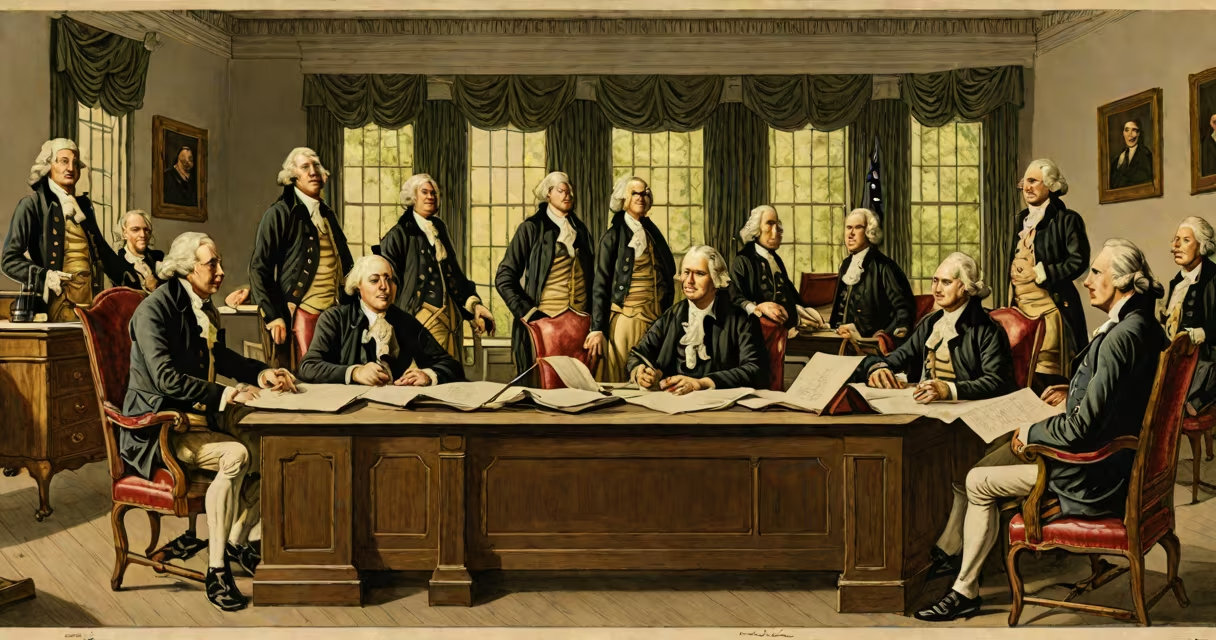
In May 1787, 55 delegates convened in Philadelphia under the guise of revising the Articles. Instead, they drafted a new structure. The Constitutional Convention operated in secrecy, with delegates debating representation, executive power, and slavery. Final decisions were reached through compromise.
Delegates agreed on a bicameral legislature: the House of Representatives based on population, and the Senate with equal state representation. This resolved tensions between large and small states. The executive branch was designed to be independent of Congress, with a single president elected by an Electoral College. The judiciary was established as a separate branch, though its structure was less detailed.
Delegates also included a mechanism for amendment, allowing future changes without dissolving the entire document. Article V outlines a process requiring two-thirds of Congress or two-thirds of state legislatures to propose amendments, and ratification by three-fourths of the states.
The Constitution established three branches of government: legislative, executive, and judicial. Each has distinct powers and responsibilities. The legislative branch makes laws, the executive enforces them, and the judiciary interprets them. This division prevents any one branch from dominating.
Checks and balances ensure each branch can limit the others. For example, Congress can override a presidential veto with a two-thirds vote. The Supreme Court can declare laws unconstitutional. The president nominates judges, but the Senate must confirm them.
States retained significant authority under the Tenth Amendment, which reserves powers not delegated to the federal government to the states or the people. This balance helped secure ratification in states wary of centralized power.
Many assume the Constitution was written to protect individual rights. It did not originally include a Bill of Rights. The first ten amendments-collectively known as the Bill of Rights-were added in 1791 after intense debate. Federalists argued the original Constitution already protected rights; Anti-Federalists insisted on explicit guarantees.
Another misconception is that the Constitution was universally accepted. Nine states ratified it by June 1788, but Rhode Island refused until May 1790. New York and Virginia ratified only after promises to add a bill of rights. Without those assurances, ratification would have failed.
A lesser-known fact: the Constitution uses the word "people" 14 times, emphasizing that sovereignty rests with citizens, not monarchs or elites. The Preamble begins with "We the People," asserting collective authority over government.
Before the Constitution, states imposed tariffs on goods crossing borders. New Jersey and Pennsylvania fought over tolls on the Delaware River. The federal government could not mediate. After ratification, Congress passed the Tariff Act of 1789, establishing uniform trade rules.
Consider the case of McCulloch v. Maryland (1819). The Supreme Court ruled that Congress could charter a national bank under the Necessary and Proper Clause (Article I, Section 8). Maryland tried to tax the bank's operations. The Court held that federal law superseded state law, affirming the supremacy of the Constitution.
This decision illustrates how the Constitution resolved conflicts between state and federal authority-an issue the Articles of Confederation could not address.
| Feature | Articles of Confederation | U.S. Constitution |
|---|---|---|
| Legislative Power | Single chamber, equal state votes | Bicameral: House (population-based), Senate (equal state representation) |
| Tax Authority | None-states collected taxes | Federal power to levy and collect taxes |
| Judicial System | No national courts | Supreme Court and lower federal courts established |
| Amendment Process | Unanimous consent of all 13 states | Two-thirds Congress or state conventions, ratified by three-fourths of states |
I once attended a reenactment of the Constitutional Convention in Philadelphia. Watching actors portray delegates argue over representation and executive power brought the document's challenges into sharp focus. The tension wasn't just historical-it reflected real fears about tyranny, disunity, and inefficiency.
Today, the Constitution remains the foundation of American governance. Its creation was not a sudden act but a response to systemic failure. The Articles of Confederation had served their purpose during war but failed in peacetime. The Constitution addressed those failures by creating a durable, adaptable structure.
Understanding why the Constitution was created requires recognizing both the weaknesses of its predecessor and the practical solutions proposed by the Founders. It was not born of ideology alone, but of necessity, compromise, and foresight.