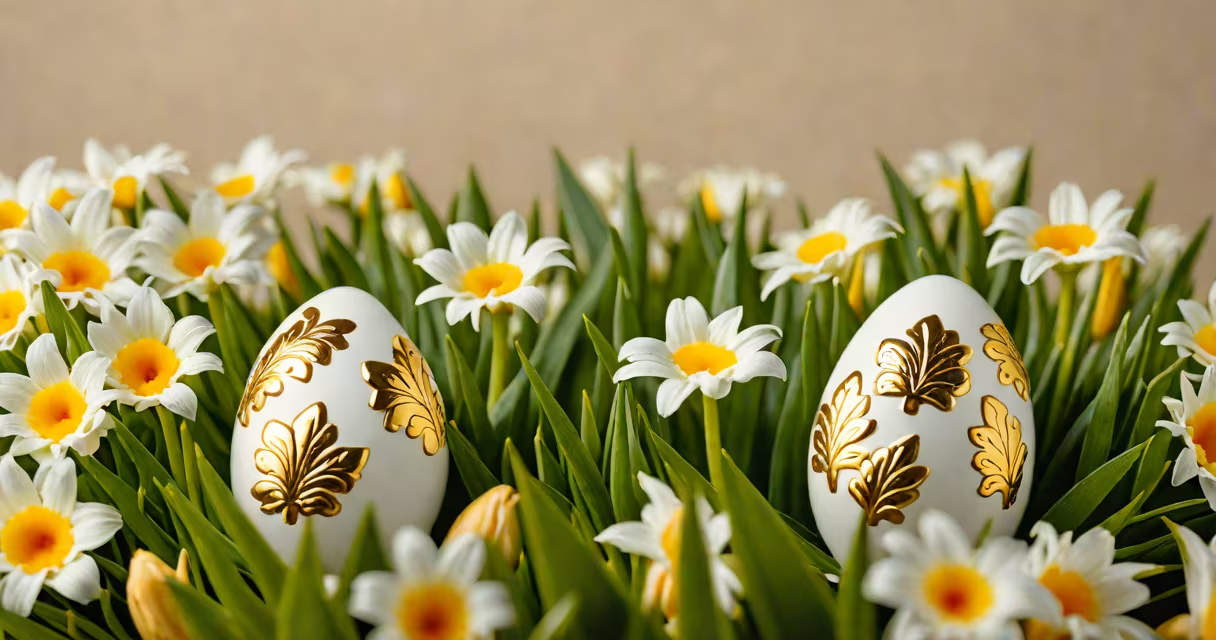
The primary symbol of Easter is the Easter egg, representing rebirth and new life, with the Easter bunny emerging as a cultural icon tied to fertility and springtime. These symbols blend ancient pagan traditions with Christian theology centered on Jesus Christ's resurrection.
Easter eggs date back to pre-Christian Europe, where people painted eggs to mark the arrival of spring. The practice was common among Germanic tribes and Slavic peoples, who associated eggs with fertility and renewal. Early Christians adopted the egg as a metaphor for Christ's emergence from the tomb, likening the cracked shell to the stone rolled away from the sepulcher.
The Easter bunny originated in 17th-century Germany, where the "Osterhase" was a mythical creature believed to lay colored eggs for well-behaved children. German immigrants brought the tradition to America, where it evolved into a secular holiday figure. Unlike the egg, which has theological roots, the bunny is purely cultural and reflects seasonal themes of abundance and fertility.
Together, the egg and bunny form a dual symbolism: the egg signifies spiritual rebirth through Christ's resurrection, while the bunny embodies physical renewal in nature. This fusion explains why Easter celebrations include both religious services and family gatherings centered on egg hunts and candy baskets.
Modern Easter observances often prioritize the bunny and egg over liturgical elements. A 2022 Pew Research Center survey found that 64% of U.S. adults associate Easter primarily with the bunny and egg, not church attendance. Yet the core meaning remains anchored in Christian doctrine: Easter celebrates the belief that death is overcome by life.
For example, during Holy Saturday services in Rome, the Pope blesses a large egg-shaped pastry called a "colomba," symbolizing peace and resurrection. In contrast, American households may place plastic eggs filled with candy in backyard gardens, a practice that has little connection to scripture but echoes the idea of hidden joy and surprise.
While the egg and rabbit dominate popular culture, other symbols appear regionally or historically:
| Symbol | Origin | Meaning | Usage Today |
|---|---|---|---|
| Easter egg | Pre-Christian Europe | Rebirth, divine creation | Painted, chocolate, plastic; used in hunts and gifts |
| Easter bunny | German folklore (1600s) | Fertility, spring abundance | Commercial mascot; appears in parades and ads |
| Lamb | Biblical tradition | Christ as sacrificial offering | Common in church decorations and liturgy |
| Fire and candle | Early Christian rituals | Light overcoming darkness | Used in Easter Vigil services globally |
Each symbol serves a different function. The lamb is the most explicitly religious, appearing in liturgical texts as a reference to Jesus as the "Lamb of God." Fire and candles represent the triumph of light over night, a theme echoed in the Easter Vigil, where a single flame is passed through a congregation.
A lesser-known fact: in some Eastern Orthodox traditions, Easter eggs are dyed red to symbolize Christ's blood. This practice dates to the 4th century and is still observed in Greece and Russia. Red eggs are exchanged during the Easter meal, with each person giving one to the others as a gesture of forgiveness and reconciliation.
Many assume the Easter bunny is a Christian symbol. It is not. The rabbit has no presence in biblical texts or early church writings. Its inclusion in Easter celebrations stems entirely from folk traditions linked to Ostara, a Germanic goddess of spring. The name "Easter" itself may derive from her, though scholars debate this.
Another misconception is that Easter eggs were originally only for Christians. They were not. The earliest known Easter eggs come from ancient Persia and Mesopotamia, where people decorated eggs during Nowruz, the Persian New Year. These traditions predate Christianity by millennia.
When researching Easter symbols, consult sources like the Catholic Encyclopedia and the British Museum's collection of ancient artifacts. The Catholic Encyclopedia notes that the egg became a Christian symbol by the 3rd century, but its adoption was gradual and regional. The British Museum holds a 2nd-century Roman egg carved with a phoenix, a bird associated with rebirth-proving that symbolic eggs existed long before Christianity.
I once attended an Easter service in a small village in southern Italy where families brought hand-painted eggs to the altar. After the blessing, they placed them in baskets to take home. One woman told me she had been doing this since childhood-her mother taught her to use onion skins and beet juice to dye the shells. The colors weren't uniform; some were speckled, others faded. But each egg carried a memory.
This moment illustrated how the symbol of Easter transcends doctrine. The egg is not just a sign of resurrection-it is a vessel of personal history. When someone gives a child a chocolate egg, they're not just passing out candy. They're sharing a ritual of hope, continuity, and care.
Understanding the symbol of Easter requires recognizing both its sacred and secular layers. The egg and bunny are not contradictory-they coexist. One speaks to faith; the other to joy. Together, they reflect how human cultures adapt ancient ideas into living practices.