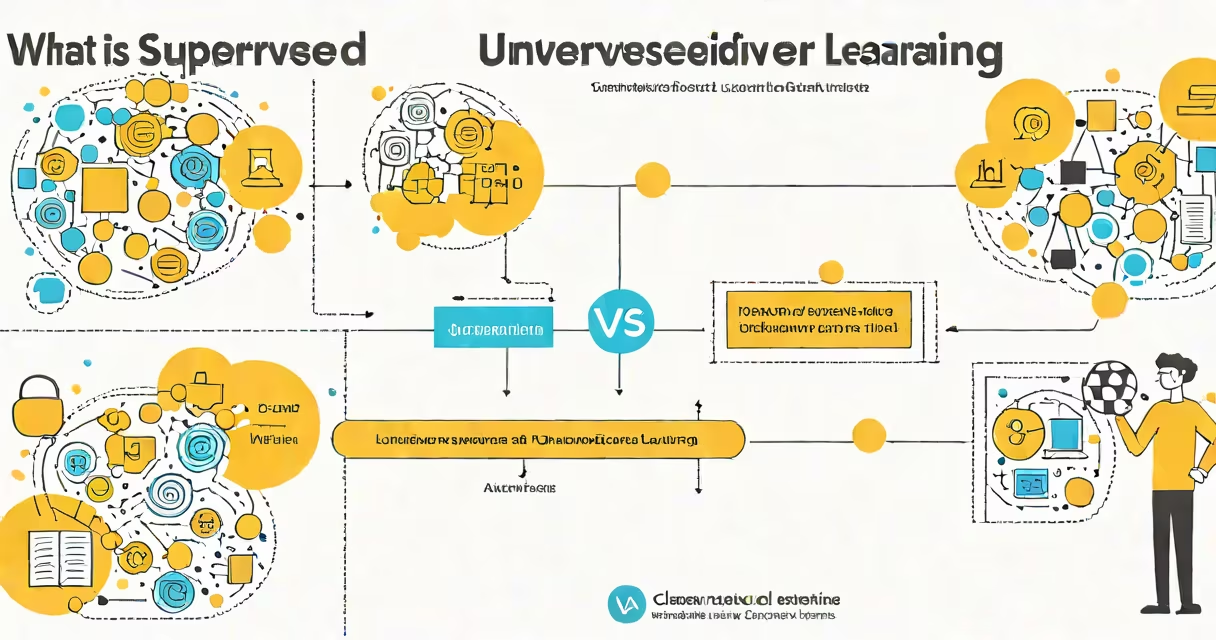
Supervised learning uses labeled data to train models that predict outcomes, while unsupervised learning finds hidden patterns in unlabeled data. Supervised methods require known inputs and outputs; unsupervised methods explore structure without predefined answers.
Both are core approaches in machine learning, but they differ fundamentally in how they process information. Supervised learning mimics human instruction: give the model examples with correct answers, and it learns to generalize. Unsupervised learning resembles discovery: the model identifies relationships in raw data without guidance.
Supervised learning is used when you have clear goals-like classifying emails as spam or predicting house prices. Unsupervised learning reveals insights when you don't know what to look for-such as grouping customers by behavior or reducing data complexity.
Supervised learning trains on input-output pairs. For example, a dataset contains images of cats and dogs, each tagged with "cat" or "dog." The algorithm adjusts its internal weights to minimize prediction errors. After enough examples, it can classify new images correctly.
The model's accuracy depends on data quality and feature relevance. A poorly labeled dataset leads to poor predictions. Algorithms like linear regression, decision trees, and neural networks handle supervised tasks by minimizing error between predicted and actual values.
Unsupervised learning processes data without labels. It detects patterns such as groupings, outliers, or reduced dimensions. For instance, customer purchase histories may form clusters indicating different shopping behaviors-even if no labels exist.
Supervised learning includes classification and regression. Classification assigns categories-like identifying tumors in medical scans. Regression predicts continuous values-such as forecasting monthly sales based on past performance.
Unsupervised learning includes clustering, dimensionality reduction, and anomaly detection. Clustering groups similar data points-used in market segmentation. Dimensionality reduction simplifies complex datasets-helpful in facial recognition. Anomaly detection flags unusual activity-critical in fraud prevention.
| Type | Learning Method | Use Case | Example |
|---|---|---|---|
| Supervised | Classification | Labeling data into categories | Spam detection in email |
| Supervised | Regression | Predicting numerical values | Forecasting housing prices |
| Unsupervised | Clustering | Grouping similar items | Segmenting users by browsing habits |
| Unsupervised | Dimensionality Reduction | Reducing data complexity | Using PCA to compress image data |
A common mistake is assuming unsupervised learning produces actionable results without validation. It identifies patterns-but doesn't confirm their meaning. A cluster of high-income users might represent a profitable segment, but only business analysis confirms that.
Another misconception: supervised learning always outperforms unsupervised. That's false. In exploratory phases, unsupervised methods often reveal insights that supervised models miss. For example, Netflix uses clustering to discover viewer preferences before recommending content.
Supervised learning dominates applications requiring precision. Medical diagnosis tools use it to detect diseases from imaging data. Financial institutions apply it to assess credit risk using historical loan records.
According to Stanford's AI Index Report (2023), 78% of production machine learning systems rely on supervised techniques due to higher accuracy in controlled environments.
Unsupervised learning excels in data exploration and preprocessing. It reduces noise in large datasets before supervised models act on them. For example, Google uses clustering to organize search results by topic, improving relevance even when users don't specify intent.
When building a recommendation engine, combining both approaches improves results. First, use unsupervised clustering to group users by behavior. Then, apply supervised models to predict which products each group is likely to buy.
Many assume supervised learning requires perfect labels. In reality, models tolerate some noise. Amazon's product recommendation system uses partially labeled reviews-some users rate items, others just browse-and still delivers accurate suggestions.
Another error: thinking unsupervised learning lacks evaluation. It doesn't use accuracy scores like supervised models, but metrics like silhouette score or within-cluster sum of squares measure clustering quality. These validate whether groups are meaningful.
I once tested a k-means clustering model on customer transaction logs. Initially, clusters seemed random. After removing duplicate entries and normalizing purchase amounts, the resulting groups separated frequent buyers from occasional ones-proving that data quality matters more than algorithm choice.
Consider a school district using student data to predict final grades. The dataset includes test scores, attendance, homework completion rates, and extracurricular involvement.
Supervised approach: Label each student's final grade as "pass" or "fail" based on a cutoff (e.g., 70%). Train a logistic regression model on past data. Once trained, it predicts pass/fail status for new students using their current metrics.
Unsupervised approach: Use k-means clustering to group students based on performance patterns. No labels are needed. The model identifies four clusters: high performers, consistent middlers, declining students, and those with irregular engagement. Teachers can then tailor interventions to each group.
Combining both methods yields better results. Supervised models identify at-risk students early. Unsupervised clustering reveals subgroups that may respond differently to support strategies.
Understanding the difference between supervised and unsupervised learning is essential for selecting the right tool. Supervised learning answers specific questions with known outcomes. Unsupervised learning explores unknown structures in data. Both are important in modern AI systems.