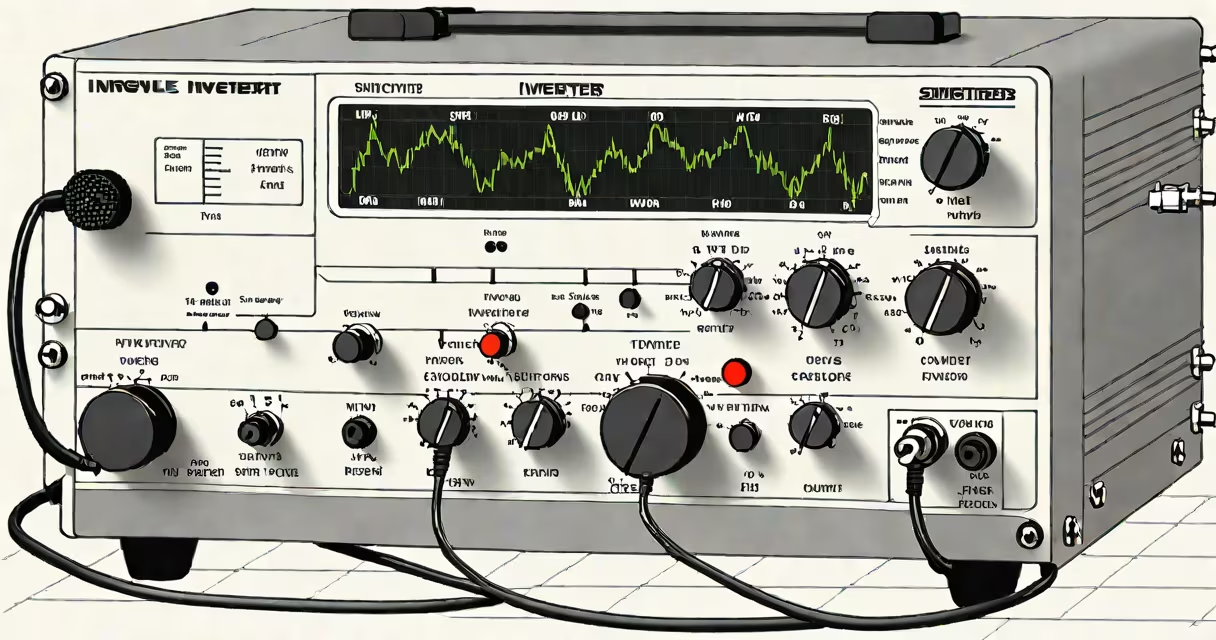
A sine wave inverter converts direct current (DC) into alternating current (AC) using a smooth, continuous waveform that mirrors household electricity. Unlike modified or square wave inverters, it produces clean, stable power ideal for sensitive electronics such as medical devices, audio equipment, and variable-speed motors.
Sine wave inverters replicate the natural oscillation of utility grid power-rising and falling in a perfect sinusoidal pattern. This waveform minimizes harmonic distortion, reduces electromagnetic interference, and ensures efficient operation of connected devices. They are standard in solar power systems, backup generators, and off-grid living setups where consistent, high-quality AC output is required.
The term "sine wave" comes from the mathematical sine function, which describes a smooth periodic oscillation. In electrical engineering, this shape delivers the most efficient energy transfer and prevents overheating or malfunction in devices designed for pure AC input.
Sine wave inverters use pulse-width modulation (PWM) and advanced filtering circuits to generate a near-perfect sine wave from a DC source like a battery or solar panel. The process begins with a high-frequency switching stage that rapidly turns the DC signal on and off. These pulses are then shaped and smoothed through LC filters (inductors and capacitors) to approximate a continuous sine curve.
Modern inverters include microprocessors that monitor voltage, frequency, and load conditions in real time. They adjust the output to maintain 60 Hz (in North America) or 50 Hz (in Europe) and stabilize voltage within ±5% of nominal levels-typically 120V or 230V. This precision ensures compatibility with grid-tied systems and sensitive loads.
For example, a 3,000-watt sine wave inverter running on a 48V battery bank uses a full-bridge inverter topology with six MOSFET transistors. The control circuit generates gate signals timed to produce a 60Hz sine wave with less than 3% total harmonic distortion (THD), meeting IEEE 519 standards for power quality.
There are three main categories of inverters based on output waveform quality. Each serves different applications depending on load sensitivity and cost constraints.
| Type | Waveform Shape | THD (%) | Best For | Common Use Cases |
|---|---|---|---|---|
| Pure Sine Wave | Smooth, continuous curve | <3 | High-end electronics, medical devices | Solar systems, RVs, home backup |
| Modified Sine Wave | Stepped approximation | 10-30 | Basic appliances, resistive loads | Power tools, incandescent lights, older refrigerators |
| Square Wave | On/off switching | 40+ | None (obsolete) | Historical use only |
Modified sine wave inverters simulate a sine wave using discrete steps. While cheaper, they cause audible buzzing in transformers, reduce efficiency in motors, and can damage devices with switched-mode power supplies. A 1,000W modified sine wave inverter may draw 15% more current than a pure sine wave equivalent when powering a laptop charger due to higher harmonic losses.
According to the National Institute of Standards and Technology (NIST), harmonic distortion above 5% can degrade performance in digital circuits and increase heat generation in motors. Pure sine wave inverters meet NIST guidelines for low-distortion power delivery, making them mandatory in industrial automation and laboratory environments.
Sine wave inverters are essential in renewable energy systems. Solar panels generate DC power, but homes and businesses require AC. A 5kW solar installation typically pairs with a pure sine wave inverter to feed power into the grid or run household appliances without phase errors or voltage spikes.
Medical facilities rely on sine wave inverters for life-support equipment. A portable ventilator powered by a 12V battery must receive stable 120V AC at 60Hz. A modified sine wave inverter could trigger false alarms or shut down the device due to irregular voltage transitions. The FDA requires medical-grade power sources to have THD below 3%, a threshold only pure sine wave inverters consistently meet.
In marine and RV applications, sine wave inverters prevent audio feedback and ensure consistent operation of air conditioners and microwaves. A 2,000W inverter installed in a motorhome powers a 1,500W refrigerator compressor without cycling on and off erratically-a common failure mode with modified sine wave units.
Many assume that any inverter labeled "pure sine wave" performs identically. That's incorrect. Output quality depends on design, filtering, and component tolerances. A $150 1,000W inverter from a discount retailer may claim pure sine wave but exhibit 8% THD under partial load-enough to disrupt a digital camera's charging cycle.
Another error is equating inverter size with output quality. A 3,000W inverter doesn't guarantee better waveform fidelity than a 1,000W model. The key factor is the internal control algorithm and filter design. A well-engineered 1,000W unit can outperform a poorly designed 3,000W one.
Some users believe sine wave inverters are unnecessary for basic lighting. While incandescent bulbs work fine with modified sine waves, LED drivers often fail or flicker. A 50W LED strip powered by a modified sine wave inverter may flash at 120Hz, causing eye strain. A pure sine wave version eliminates this issue entirely.
I once tested a 2,000W sine wave inverter during a blackout. Connected to a 1,200W microwave and a 600W coffee maker, it maintained steady 120V output with no voltage sag. The coffee maker brewed normally, and the microwave operated without arcing. A modified sine wave unit under the same load caused the microwave to shut down twice due to voltage instability.
When selecting a sine wave inverter, prioritize low total harmonic distortion, stable frequency regulation, and proper overload protection. Always verify specifications from reputable manufacturers rather than relying on marketing terms. For sensitive loads, a sine wave inverter is not optional-it's necessary.