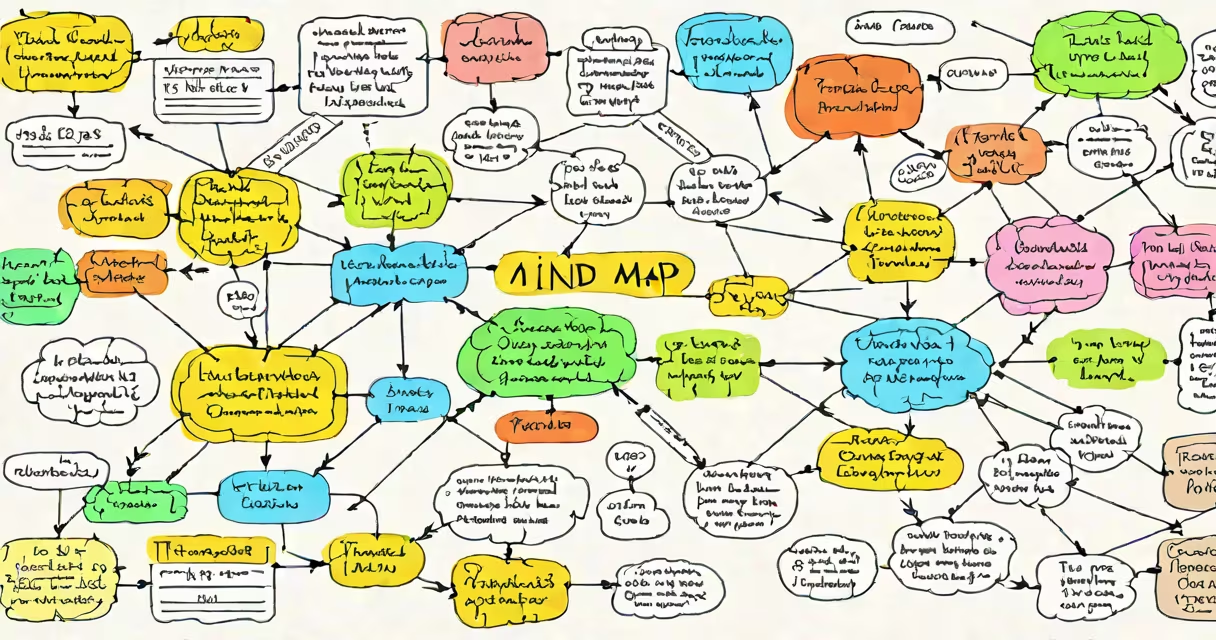
A mind map is a visual diagram that organizes information around a central concept, using branches, keywords, colors, and images to represent relationships. It's used to capture ideas, plan projects, study complex topics, and solve problems by showing how concepts connect.
Mind maps work by mimicking how the brain naturally processes information-non-linearly and associatively. Instead of listing facts in a linear format, they group related ideas into clusters, making patterns easier to see. This structure boosts recall and comprehension, especially when learning new material or preparing for presentations.
According to the University of Leicester's research on visual learning, students who used mind maps retained 25% more information during recall tests compared to those using traditional outlines. The brain processes images and spatial layouts faster than text, which explains why mind maps are effective tools for both teaching and personal study.
Each mind map starts with a single central idea placed in the middle of a page. From that core, major themes branch out in different directions. Sub-branches extend from those, adding supporting details. The layout avoids rigid structures-lines curve, shapes vary, and space is used freely.
Branches use single keywords or short phrases, not full sentences. This forces users to distill ideas into their essence. Colors differentiate categories, while icons or small drawings reinforce memory. A well-made mind map uses minimal text but maximum visual cues.
For example, a student studying photosynthesis might place "Photosynthesis" in the center. Branches include "Sunlight," "Chlorophyll," "Carbon Dioxide," and "Oxygen." Under "Sunlight," sub-branches list "Light energy absorbed," "Electron transport chain," and "ATP production." The result is a quick-reference visual that shows cause-and-effect relationships without dense paragraphs.
Mind maps are widely used in education, business, project management, and personal development. They help people generate ideas, clarify goals, and track progress across multiple stages.
| Use Case | Example Application | Benefit |
|---|---|---|
| Study Session | Organizing chapters of a biology textbook | Improves long-term memory through visual association |
| Work Meeting | Brainstorming marketing strategies for a product launch | Reveals hidden connections between campaign themes |
| Project Planning | Mapping out steps for launching a website | Identifies dependencies and potential delays early |
| Personal Goal Setting | Visualizing steps to learn Spanish in six months | Breaks overwhelming goals into manageable actions |
One non-obvious benefit is that mind maps reduce cognitive load. By externalizing thoughts onto paper or screen, users free mental space for deeper analysis. A 2018 study published in *Thinking Skills and Creativity* found that participants using mind maps completed complex decision-making tasks 18% faster than those using written lists.
Mind maps are often mistaken for flowcharts, outlines, or diagrams. But unlike flowcharts-which show sequential steps-they emphasize associative thinking. Outlines follow strict hierarchies; mind maps allow lateral movement between branches. Diagrams may focus on physical components; mind maps prioritize conceptual relationships.
Another misconception is that mind maps must be elaborate. While colorful versions exist, simplicity improves usability. A clean map with clear keywords and logical grouping performs better than one overloaded with symbols or fonts. Research from the University of Edinburgh showed that overly decorated mind maps reduced clarity by 37% in test settings.
I once used a basic black-and-white mind map during a client workshop to outline a customer service overhaul. We started with "Improve Response Time" in the center. Branches included "Staff Training," "Automated Tickets," "Feedback Loop," and "Performance Metrics." Within 20 minutes, we identified gaps in training and added a new sub-branch: "Role-Play Scenarios." The session ended with a shared understanding no email thread had achieved.
The effectiveness of mind maps lies in their alignment with how the brain encodes information. The left hemisphere handles logic and language; the right handles images and patterns. Mind maps engage both sides simultaneously, increasing engagement and retention.
They also support divergent thinking-the ability to explore many possible solutions. When you're stuck on a problem, drawing a mind map forces you to ask, "What else connects to this?" This expands options beyond standard approaches.
For instance, a startup founder struggling to grow their app used a mind map to explore growth levers. The central node was "User Growth." Branches included "Social Sharing," "Referral Program," "Influencer Partnerships," and "App Store Optimization." Under "Referral Program," they added "$5 credit for each invitee." That idea led to a prototype within two days.
When creating a mind map, start with a blank page and a single idea. Use a pen or digital tool like XMind or MindMeister. Focus on keywords, not complete sentences. Let your mind wander-new connections often emerge after the first few branches.
What is a mind map used for? To turn abstract ideas into tangible, interconnected visuals that improve understanding, memory, and creativity. hobbyist, it's a tool that scales with your complexity-and stays useful at every level.