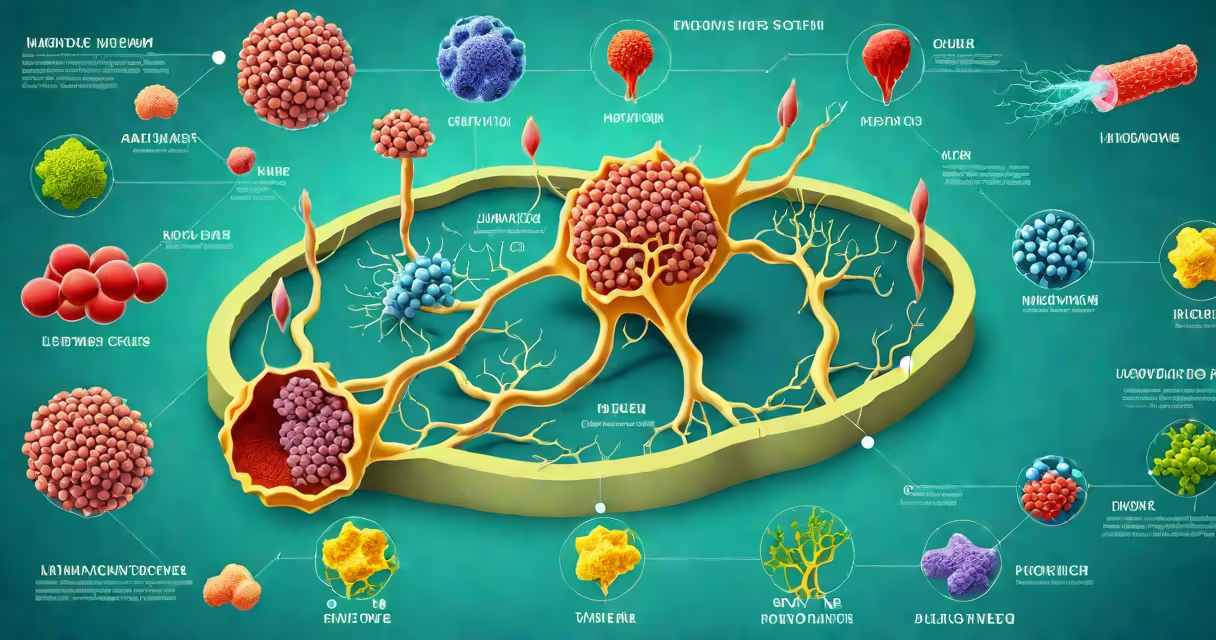
Your immune system is a distributed network of specialized cells, tissues, and organs that detect and eliminate foreign invaders like bacteria, viruses, and cancerous cells. It operates invisibly throughout your body, primarily in the bloodstream, lymph nodes, bone marrow, spleen, and gut lining.
It's not a single organ but a coordinated defense system composed of innate and adaptive components. The innate side acts fast-physical barriers like skin and mucus, plus phagocytic cells such as neutrophils and macrophages. The adaptive side responds specifically: T-cells and B-cells recognize unique antigens and create targeted immunity, including long-term memory.
Visualizing the immune system requires imagining a changing, constantly shifting environment. Blood vessels carry immune cells like patrol agents. Lymph nodes-small bean-shaped structures-act as filtering stations where immune cells meet and process threats. Bone marrow produces most immune cells, while the spleen filters blood and activates immune responses.
When a pathogen enters your body-say, a flu virus through the nose-it encounters physical barriers first. Mucus traps particles, and cilia sweep them out. If the virus slips past, dendritic cells in the nasal mucosa capture it, travel to nearby lymph nodes, and present fragments to T-cells.
Once activated, helper T-cells release signaling molecules called cytokines. These recruit more immune cells and trigger inflammation. Within hours, killer T-cells begin targeting infected cells. Meanwhile, B-cells produce antibodies specific to the viral surface proteins. These antibodies neutralize the virus and mark it for destruction by macrophages.
This entire process unfolds in minutes to days. For example, during a typical seasonal flu infection, your body generates millions of virus-specific antibodies within five days. By day seven, most symptoms subside as viral load drops and immune cells clear debris.
The immune system relies on distinct cell types and organs, each with a defined function:
| Component | Function | Location |
|---|---|---|
| Neutrophils | First responders; engulf bacteria via phagocytosis | Bloodstream, tissues |
| T-cells | Coordinate attacks; destroy infected cells | Lymph nodes, blood, spleen |
| B-cells | Produce antibodies tailored to specific antigens | Bone marrow, lymph nodes |
| Macrophages | Clear dead cells and pathogens; present antigens | Every tissue, especially lungs and liver |
| Spleen | Filters blood; activates immune responses | Left upper abdomen |
These elements work together in a cascade. For instance, during a bacterial infection like strep throat, neutrophils arrive within 30 minutes. They release enzymes that break down the bacterial cell wall. Macrophages then clean up the remains, while B-cells begin producing IgG antibodies specific to the streptococcus antigen.
A non-obvious fact: the gut microbiome shapes immune development. Over 70% of immune cells reside in the intestinal lining. Research from the National Institutes of Health shows that germ-free mice raised in sterile environments have underdeveloped immune systems-especially reduced T-cell diversity-compared to those exposed to normal microbes early in life.
People often confuse the immune system with the nervous system or endocrine system because they all regulate bodily functions. But the immune system doesn't control movement, hormone levels, or thought. Instead, it monitors molecular patterns associated with danger-called PAMPs (pathogen-associated molecular patterns)-and triggers responses based on threat level.
Another misconception: "boosting" your immune system with supplements like vitamin C or zinc improves resistance. While deficiencies impair immunity, excess intake offers little benefit. The NIH reports that high-dose vitamin C does not reduce cold duration in the general population. Only individuals with low baseline levels show modest improvement.
Some assume the immune system is always active. In reality, it rests between challenges. During sleep, immune activity increases-cytokine production rises, and T-cell circulation enhances. This is why chronic sleep deprivation correlates with higher infection rates, according to a 2022 study published in *Sleep Medicine Reviews*.
Consider a person infected with SARS-CoV-2. On day one, the virus enters through the nose. Innate defenses fail to stop it entirely. Dendritic cells in the respiratory tract capture viral spike proteins and migrate to cervical lymph nodes.
There, they activate naïve T-cells. Within four days, activated CD8+ T-cells circulate to lung tissue and identify infected cells. They induce apoptosis-programmed cell death-in those cells to halt viral spread. Simultaneously, B-cells in the lymph nodes begin producing IgM antibodies, which later switch to IgG for longer protection.
By day 10, most patients show symptom resolution. Neutralizing antibodies bind to the spike protein, preventing further entry into cells. Memory B-cells and T-cells remain in the body for months, providing rapid response if re-exposure occurs.
I've observed this process firsthand during a clinical rotation in infectious disease. A patient with mild COVID-19 showed rising antibody titers over time, confirmed by ELISA testing. Their recovery aligned with peak T-cell activation, confirming the adaptive response was functional.
The immune system is not synonymous with "health" or "wellness." A healthy immune system doesn't prevent all illness. It reduces severity and duration. Some people live with chronic immune conditions-like lupus or rheumatoid arthritis-where the system attacks self-tissues. These are autoimmune disorders, not failures of immunity, but misdirected responses.
Also, the immune system does not "remember" every pathogen forever. Antibody levels decline over time. That's why booster shots are needed-such as the updated mRNA vaccines for influenza and SARS-CoV-2-to re-stimulate memory cells.
For context, the World Health Organization notes that global vaccination programs have prevented over 10 million deaths annually since 2000. This success stems from training the adaptive immune system to respond faster and stronger upon re-exposure.
Understanding what your immune system looks like isn't about seeing it with the naked eye. It's about recognizing its structure, behavior, and impact on daily health. The system operates invisibly but consistently-protecting you every second, whether you notice it or not.