Hanukkah means "dedication" in Hebrew, derived from the root חנך (ch-n-kh), which signifies consecration or setting apart for sacred use. The holiday commemorates the rededication of the Second Temple in Jerusalem after its desecration by Antiochus IV Epiphanes in 164 BCE.
The term appears in the Hebrew Bible in reference to the dedication of the Tabernacle (Exodus 40:10-11) and later the First Temple (1 Kings 8:63). Hanukkah preserves this ancient concept of ritual purification and renewal, applied to a specific historical event involving religious freedom and resistance.
Modern Hebrew sources confirm the etymology: the Oxford Dictionary of Jewish Names in English and Hebrew defines Hanukkah as "the feast of dedication," linking it directly to the Maccabean revolt. The Jewish Virtual Library notes that the name reflects both the physical act of rededicating the altar and the spiritual restoration of Jewish worship.
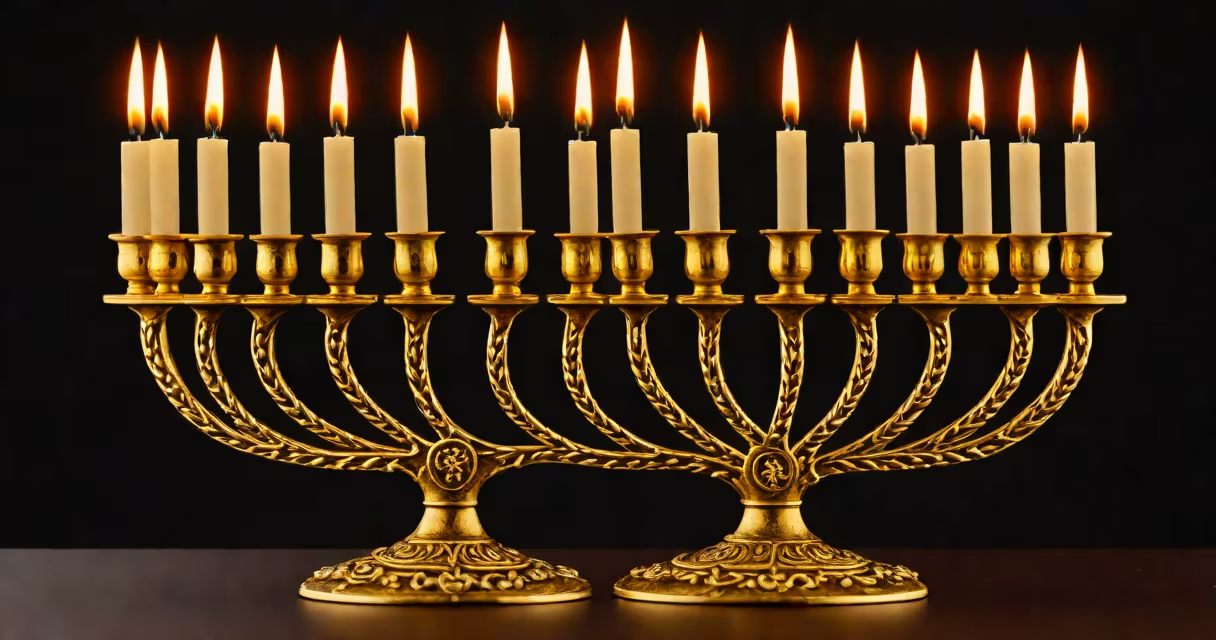
The holiday begins on the 25th of Kislev in the Hebrew calendar, typically falling in November or December. It lasts eight days, each marked by the lighting of one additional candle on a nine-branched menorah called a hanukkiah.
The narrative centers on the Maccabees, a group of Jewish rebels led by Judas Maccabeus. After defeating the Seleucid forces, they reclaimed the Temple in Jerusalem, cleansed it of pagan symbols, and restored the daily sacrifices. According to tradition, only enough pure olive oil was found to last one day-but it burned for eight, symbolizing divine intervention.
This miracle is central to the holiday's identity. The eight-day duration mirrors the oil's unexpected endurance. Families light one candle per night, adding a new flame each evening, culminating in all eight candles burning together on the final night.
The core elements of Hanukkah include the hanukkiah (special menorah), oil, latkes (potato pancakes), sufganiyot (jelly-filled doughnuts), dreidels (four-sided spinning tops), and songs like "Ma'oz Tzur."
Each symbol carries layered meaning. The hanukkiah differs from the seven-branched menorah in the Tabernacle-its ninth candle, the shamash (helper), is used to light the others. This design reinforces the idea of human action (lighting) enabling divine presence (the flame).
Latkes and sufganiyot are fried foods, reflecting the miracle of oil. The dreidel game uses a four-sided top with Hebrew letters: נ (nun), ג (gimel), ה (hey), ש (shin), forming the acronym "Nes Gadol Hayah Sham" - "A great miracle happened there." The game originated in the time of Roman persecution, when Jews studied Torah in secret.
Many assume Hanukkah is equivalent to Christmas due to overlapping dates and gift-giving customs. But Hanukkah is not a major holiday in the biblical sense. It is not mentioned in the Tanakh (Hebrew Bible), nor does it require fasting or pilgrimage.
Another error is equating Hanukkah with the destruction of the Second Temple. The holiday celebrates the temple's rededication, not its fall. The Temple was destroyed decades later under Roman rule, during the Siege of Jerusalem in 70 CE.
A lesser-known fact: the original Hanukkah story is recorded in the Books of the Maccabees, written in Greek and not included in the Hebrew Bible. These texts were preserved in Christian and Jewish traditions but excluded from the canonical Hebrew canon due to their late composition and political context.
Today, Hanukkah is observed globally by Jewish communities. In Israel, it is a national holiday with public menorah lightings in cities like Jerusalem, Tel Aviv, and Haifa. In the United States, the White House hosts an annual Hanukkah reception, and the National Mall features large public menorah displays.
Celebrations emphasize education and memory. Schools teach the history of the Maccabees, and families often share stories of resilience. The holiday serves as a reminder of religious perseverance amid oppression.
For example, in 2023, New York City's Times Square hosted a 30-foot menorah, drawing over 10,000 attendees. The event included performances by Israeli musicians and speeches from city officials, underscoring Hanukkah's role in public life.
While the core rituals remain consistent, regional practices differ. In Morocco, families eat seffa (a sweet dish with almonds and honey). In Ethiopia, Jews celebrate with special prayers and communal meals. In Eastern Europe, the custom of giving gelt (chocolate coins) emerged in the 19th century.
| Region | Unique Custom | Symbolic Meaning |
|---|---|---|
| Israel | Public menorahs in major cities | Shared national identity and visibility |
| Poland (historical) | Gifts for children on each night | Adaptation to surrounding Christian traditions |
| India (Bene Israel community) | Special prayers for protection | Historical isolation and adaptation |
These variations show how Hanukkah's core meaning-dedication-can be interpreted through local culture while preserving its central theme.
I once attended a Hanukkah celebration in a Brooklyn apartment where the host, a second-generation American Jew, lit the hanukkiah with his children. He explained each candle's purpose using a Hebrew-English chart. On the seventh night, the family sang "Had Gadya" in Yiddish, then switched to English for younger guests.
What struck me was how the ritual balanced continuity and change. The Hebrew blessing-"Baruch atah Adonai Eloheinu Melech ha-olam, asher kidshanu b'mitzvotav v'tzivanu l'hadlik ner shel Hanukkah"-was recited with precision. Yet the conversation afterward included jokes about Hanukkah-themed Hanukkah cards and debates over whether sufganiyot should be filled with jelly or chocolate.
This blend of reverence and informality reflects how Hanukkah remains relevant across generations.
Understanding that Hanukkah means "dedication" in Hebrew clarifies its deeper purpose beyond festive lights and food. It is a call to renew commitment-not just to faith, but to ethical living, cultural memory, and resistance to assimilation.
The holiday's name anchors it in a long tradition of sacred space and time. When we say "Hanukkah," we're not just naming a festival-we're affirming a practice of returning to what matters.