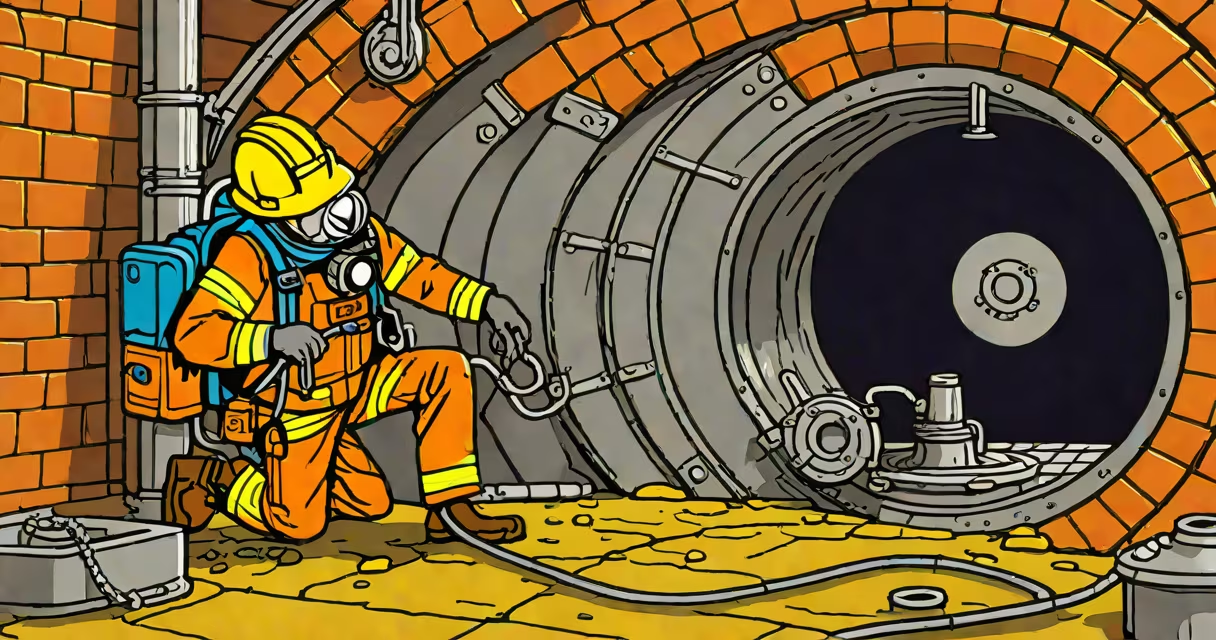
A confined space is an area not intended for continuous human occupancy, with limited entry and exit points, and potential for hazardous conditions such as low oxygen, toxic gases, or engulfment. These spaces are not inherently dangerous but become high-risk due to their physical constraints and environmental hazards.
The Occupational Safety and Health Administration (OSHA) defines a confined space as one that meets three criteria: it is large enough for a person to enter and perform work, has limited or restricted means of entry/exit, and is not designed for continuous employee occupancy. This includes tanks, silos, ducts, sewers, and underground vaults.
For example, a 6-foot diameter storage tank used to hold industrial chemicals qualifies as a confined space under OSHA standards. Even though it's built for storage, workers may need to enter it for cleaning or inspection. The lack of natural ventilation and risk of chemical vapor buildup make it hazardous-especially if no permit is issued before entry.
OSHA requires employers to identify confined spaces during site assessments. A space is classified as confined if it satisfies all three elements: size, access restriction, and non-continuous occupancy. If any one of these is missing, it does not meet the definition.
Access restrictions include narrow openings, vertical shafts, or doors that require tools to open. For instance, a 12-inch diameter access port on a pressure vessel counts as restricted entry. Similarly, a crawl space under a building floor that requires crouching or crawling through a 24-inch-wide tunnel is restricted.
Non-occupancy is determined by design intent. A basement used daily by maintenance staff is not a confined space because it's meant for regular access. But a buried pipeline trench sealed off during construction, only accessible via a ladder and hatch, becomes a confined space.
Confined spaces fall into two categories: unpermitted and permitted. Unpermitted spaces have no known hazard and can be entered safely with minimal precautions. Permitted spaces carry serious risks and require formal entry procedures.
| Type | Entry Conditions | Hazards | Example |
|---|---|---|---|
| Unpermitted | No atmospheric or physical hazard detected | Minor risk of trip/fall | Open electrical panel cabinet |
| Permitted | Requires permit, monitoring, and trained personnel | Oxygen deficiency, flammable gases, toxic fumes | Underground fuel tank, wastewater treatment chamber |
Permitted spaces often contain hidden dangers. In 2019, a worker died in a sewage pump station after entering a 10-foot-deep sump without testing for hydrogen sulfide. The gas had accumulated from decomposing waste. Even though the space was dry and clean, the absence of air monitoring led to fatal exposure.
Another common mistake is assuming that a space is safe because it hasn't caused problems before. A 2021 NIOSH report found that 40% of confined space incidents occurred in areas previously deemed "low risk" due to outdated hazard assessments.
Many people confuse confined spaces with hazardous locations. A confined space is defined by structure and access, not by the presence of danger. A warehouse aisle with narrow walkways is not a confined space unless it meets the OSHA criteria.
Also, confined space does not mean "small." A 30-foot-long tunnel in a mine may be considered a confined space even if it's wide enough to stand upright. The key factor is restricted access-not size.
Some assume that using a respirator makes entry safe. That's false. Respirators protect against airborne contaminants but don't address physical hazards like engulfment or entrapment. A worker trapped in a grain silo cannot escape even with proper breathing protection.
One non-obvious rule: a space can be both a confined space and a hazardous location. For example, a boiler room with poor ventilation and high heat levels is a confined space due to limited access. If it also contains flammable vapors, it becomes a permit-required confined space under OSHA 1910.146.
Consider a city utility crew preparing to inspect a sewer manhole. The structure is 6 feet in diameter, 12 feet deep, with a single 24-inch access cover. Workers must descend via a ladder and remain inside for up to 90 minutes.
Before entry, the team tests for methane, carbon monoxide, and oxygen levels. Methane readings exceed 10% LEL (lower explosive limit), indicating a flammable atmosphere. Oxygen drops to 17.5%, below the safe threshold of 19.5%. The space is now classified as a permit-required confined space.
Required actions include: posting warning signs, assigning a standby attendant, using a gas detector with alarm, and securing a lifeline. Only then can a trained worker enter with a permit signed by a supervisor.
Failure to follow this process led to a 2020 incident in Chicago where two workers died after entering a manhole without atmospheric testing. The investigation cited inadequate training and skipped safety steps.
OSHA mandates that employers provide training, equipment, and written procedures for confined space entry. Employers must also designate roles: entrant, attendant, and supervisor. Each role has specific responsibilities under 29 CFR 1910.146.
Training must cover hazard recognition, communication protocols, emergency response, and equipment use. Workers who enter permitted spaces must be certified and retrained annually.
When a space is not routinely accessed, periodic reassessment is required. A 2022 OSHA directive emphasized that employers must re-evaluate confined space classifications after changes in operations, equipment, or layout-even if no prior incidents occurred.
One personal observation: during a site audit in 2021, I found a 4-foot-diameter pipe used for steam distribution labeled as "non-confined" by facility staff. Upon review, it met all three OSHA criteria. After correcting the classification and adding entry controls, we prevented a potential fatality during maintenance.
Understanding what does confined space mean prevents avoidable accidents. Always apply OSHA's three-part test before assuming a space is safe. If in doubt, treat it as permit-required.