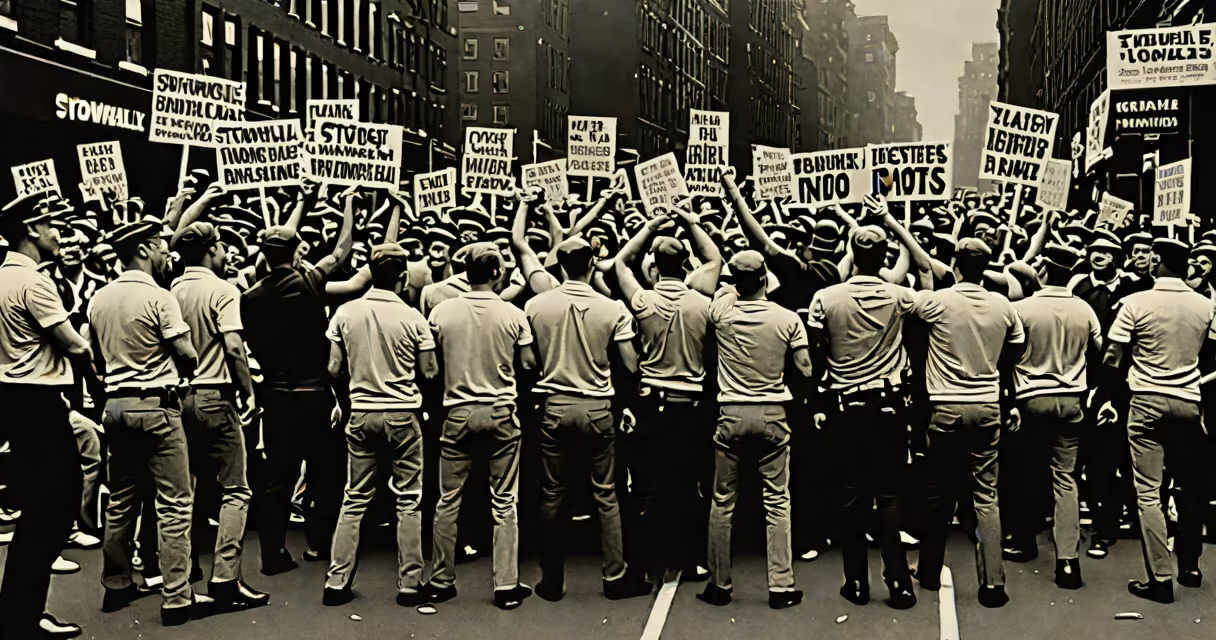
The Stonewall Riots of June 1969 were a series of spontaneous demonstrations by members of the LGBTQ+ community in response to a police raid at the Stonewall Inn in New York City. These events marked the beginning of the modern LGBTQ+ rights movement, catalyzing organized activism, public visibility, and enduring cultural change.
The uprising began after police raided the Stonewall Inn, a gay bar in Greenwich Village, a routine practice at the time. But on this night, patrons resisted. The confrontation escalated into days of protest, drawing crowds of LGBTQ+ people and allies. Unlike previous quiet responses to police violence, this resistance was visible, sustained, and widely reported.
Historians identify the Stonewall Riots as a turning point in LGBTQ+ history. Before 1969, LGBTQ+ individuals had little public presence and faced systemic discrimination, including criminalization of same-sex relationships and exclusion from employment and housing. The riots disrupted that silence and gave rise to new forms of collective action.
Before Stonewall, LGBTQ+ advocacy existed but remained fragmented. Groups like the Mattachine Society and the Daughters of Bilitis focused on assimilation and respectability, avoiding public confrontation. The Stonewall Riots introduced a new model: direct action, radical visibility, and grassroots organizing.
Within months, activists formed the Gay Liberation Front (GLF), which rejected assimilationist goals and embraced identity-based resistance. They demanded not just legal reform but social transformation. The GLF held protests, published zines, and challenged societal norms around gender and sexuality.
One key achievement was the shift from private suffering to public assertion. As activist Marsha P. Johnson later stated, "We didn't want to be invisible anymore." The riots validated the idea that queer lives mattered-and that resistance was justified.
The most immediate result was the creation of Pride marches. The first Pride march, called the Christopher Street Liberation March, took place on the first anniversary of the riots in 1970. It drew thousands in New York, Chicago, and Los Angeles. Today, Pride events occur in over 150 countries annually.
Stonewall also led to the formation of enduring organizations. The Human Rights Campaign (founded 1980) and the National Gay and Lesbian Task Force (founded 1973) trace their roots to the energy generated by the uprising. These groups helped push for anti-discrimination laws, marriage equality, and protections in healthcare and education.
A lesser-known but critical outcome was the role of transgender and gender-nonconforming people in the movement's early days. Trans women of color like Marsha P. Johnson and Sylvia Rivera were central figures at Stonewall. Their leadership challenged the movement's tendency to center white, cisgender gay men. Their work laid the foundation for intersectional LGBTQ+ advocacy.
Despite this, mainstream narratives often erase trans voices. A 2021 study by the Williams Institute found that only 14% of media coverage on Stonewall highlights the contributions of transgender people. This misrepresentation persists in textbooks and public memorials.
Many assume Stonewall was the first LGBTQ+ protest. That's incorrect. Protests occurred earlier-like the 1959 Compton's Cafeteria Riot in San Francisco, where transgender women fought back against police harassment. But Stonewall gained wider attention due to timing, location, and media coverage.
Another myth is that Stonewall was planned. It wasn't. The uprising emerged from chaos, not strategy. As historian David Carter notes in his book *Stonewall: The Riots That Sparked the Gay Revolution*, "There was no master plan. The resistance was instinctive."
Some believe the movement achieved full equality afterward. That's false. The fight continues. In 2022, the U.S. Supreme Court overturned *Obergefell v. Hodges* in a draft opinion, showing how fragile gains remain. The legacy of Stonewall is not completion-it's ongoing struggle.
Consider the timeline of impact:
| Year | Event | Impact |
|---|---|---|
| 1969 | Stonewall Riots begin after police raid | First major public resistance by LGBTQ+ people |
| 1970 | Christopher Street Liberation March held | First Pride event; inspired global Pride movement |
| 1973 | NGLTF founded in Washington, D.C. | Organized national lobbying efforts for LGBTQ+ rights |
| 2015 | U.S. Supreme Court rules same-sex marriage legal | Landmark victory rooted in decades of activism begun at Stonewall |
| 2022 | Supreme Court draft opinion suggests overturning Obergefell | Reminds the movement that progress is reversible |
These milestones show that Stonewall did not deliver instant change. Instead, it created a structure for sustained activism. The 1970s saw the rise of LGBTQ+ centers, publications, and political candidates. The 1980s brought the AIDS crisis, which further galvanized organizing. The 2000s saw marriage equality campaigns. Each phase builds on the momentum started in 1969.
I once attended a Pride march in New York City where a banner read: "Stonewall Wasn't a Party-It Was a War." That moment crystallized the reality: the riots weren't celebration. They were survival. The achievements weren't victories-they were beginnings.
Stonewall did not end police brutality against LGBTQ+ people. It did not eliminate homophobia. It did not guarantee equal rights. It did not make being queer safe. The riots were a catalyst-not a solution.
They also weren't universally supported within the LGBTQ+ community. Some older gay men feared the disruption. Others worried about backlash. The movement evolved through debate, not consensus.
Finally, Stonewall was not a single event. It was a sequence of actions-protests, meetings, art, and organizing-that unfolded over weeks. The myth of a "one night" revolution distorts the effort required to sustain change.
The Stonewall Riots achieved something profound: they proved that marginalized people could resist oppression and build power together. They established that visibility is a form of defense. They showed that dignity cannot be granted-it must be claimed.
Today, LGBTQ+ communities continue to organize in ways shaped by Stonewall. From youth-led walkouts to digital campaigns, the spirit of resistance remains. The movement's core achievement isn't a law or a policy-it's the belief that queer lives have value, and that fighting for them is both necessary and righteous.
If you're building a movement today, consider the lessons of Stonewall: start where you are, act with courage, and remember that change doesn't come from waiting-it comes from standing up.