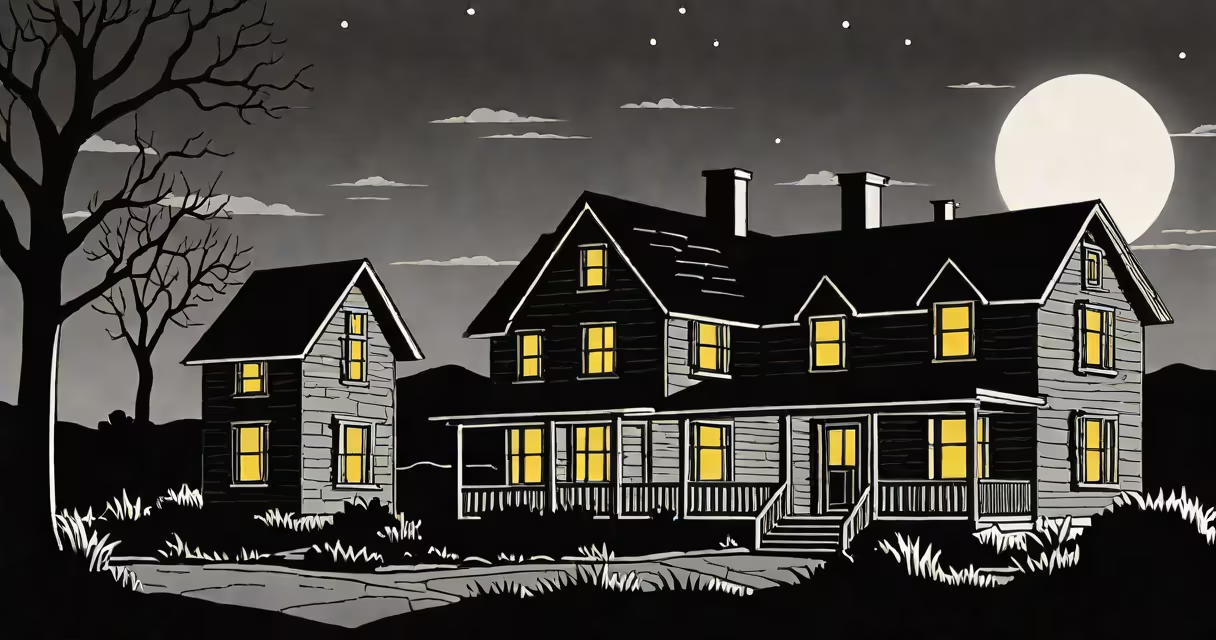
"Wait Till Helen Comes" is a 1981 short story by Stephen King that follows a young boy's growing dread as he spends a summer alone with his older sister, who begins acting increasingly erratic and menacing. The narrative builds tension through unreliable perception, childhood anxiety, and supernatural ambiguity, culminating in a chilling climax that blurs reality and imagination.
The story centers on a nine-year-old boy staying at a remote lakeside cabin with his teenage sister, Margaret. Their parents are away, and the boy's sense of safety erodes as Margaret isolates him, locks doors, and speaks in cryptic tones. He begins hearing footsteps, seeing shadows, and believing a female intruder-Helen-is stalking the house. His fear intensifies until the final scene, where Margaret confronts him in the dark, claiming she is Helen. The ending leaves the reader uncertain whether Helen is real, a hallucination, or a manifestation of Margaret's mental state.
King wrote "Wait Till Helen Comes" during a period of personal turmoil, drawing from his own childhood fears and experiences with sibling dynamics. The story was first published in *The New Yorker* in 1981 and later included in King's 1982 collection *Night Shift*. It exemplifies his early mastery of psychological suspense, using minimal dialogue and tight internal narration to amplify unease. The absence of overt violence makes the threat feel more intimate and inevitable.
The story unfolds in real time over a few days, with no chapter breaks. This creates a continuous pressure cooker effect. The boy's perspective is limited-he cannot verify events, only react. When he hears a footstep in the attic, sees a handprint on the window, or finds a door locked from the inside, he assumes danger. But the reader never confirms whether these events are real or imagined.
King uses sensory details to ground the fear. The smell of damp wood, the sound of wind through broken shutters, the flicker of a flashlight beam-all contribute to a setting that feels alive and hostile. The lake outside the cabin becomes a symbol of the unknown. Its stillness during the day contrasts with the sounds that emerge at night, suggesting something hidden beneath the surface.
One non-obvious detail: Margaret never explicitly says she is Helen. She only says, "I'm Helen," in a flat tone, while holding a knife. The boy doesn't respond. The silence after her statement is more terrifying than any scream. This lack of reaction forces the reader to interpret the moment-did Margaret lose her mind? Is she pretending? Or is the boy too afraid to process what he's seeing?
"Wait Till Helen Comes" taps into several distinct forms of fear common in horror literature:
These elements combine to create a story that functions less as supernatural horror and more as psychological realism. The terror lies not in monsters, but in the breakdown of trust between siblings.
Many readers assume "Helen" is a ghost or a literal intruder. That interpretation misses King's intent. The story offers no evidence of a supernatural presence. There are no spirits, no past tragedies tied to Helen, no backstory. The name "Helen" appears only once in the text-when Margaret says it.
Another mistake is equating Margaret's behavior with psychosis. While her actions suggest instability, King avoids clinical labeling. She doesn't have a diagnosis, nor does the boy. The story resists explanation. This ambiguity is intentional. As King told *The Paris Review* in 2016, "I don't want to explain the fear. I want you to feel it."
A third error: assuming the story is part of a larger series. "Wait Till Helen Comes" stands alone. It was not adapted into a novel or film. It appears only in *Night Shift* and later in *The Bazaar of Bad Dreams* (2015). Its standalone nature preserves its emotional impact-it's not a setup for a sequel.
At 11:47 PM, the boy is in bed. The power goes out. Margaret enters his room with a flashlight. She says, "I'm Helen." She holds a kitchen knife. The boy freezes. The story ends with: "She looked at me. I looked at her. The light went out."
Breakdown:
This moment is not resolved. It is not a fight. It is not a reveal. It is a pause. And that pause is what makes the story enduring.
"Wait Till Helen Comes" is often cited as one of King's most effective short stories. According to *The Guardian*, it "distills the essence of childhood terror into under 1,500 words." The story's brevity amplifies its impact-every sentence serves tension.
It also reflects King's early focus on domestic horror. Before *The Shining* or *It*, he explored fear within family structures. The cabin, the lake, the locked door-all became archetypes. Modern authors like Paul Tremblay and Carmen Maria Machado cite King's short fiction, including this story, as foundational to contemporary horror.
I once read this story aloud at a writers' workshop. After the last line, the room stayed silent for ten seconds. No one moved. That moment confirmed what King intended: fear lives in the pause after the light goes out.
Other King stories with comparable structure include "The Man Who Loved Women" (from *Different Seasons*) and "The Boogeyman" (from *Nightmares & Dreamscapes*). All use minimalism, slow escalation, and ambiguous endings to unsettle the reader.
"Wait Till Helen Comes" remains a benchmark for short horror. It proves that terror doesn't require blood or monsters-it only requires a child's fear, a locked door, and a whisper in the dark.