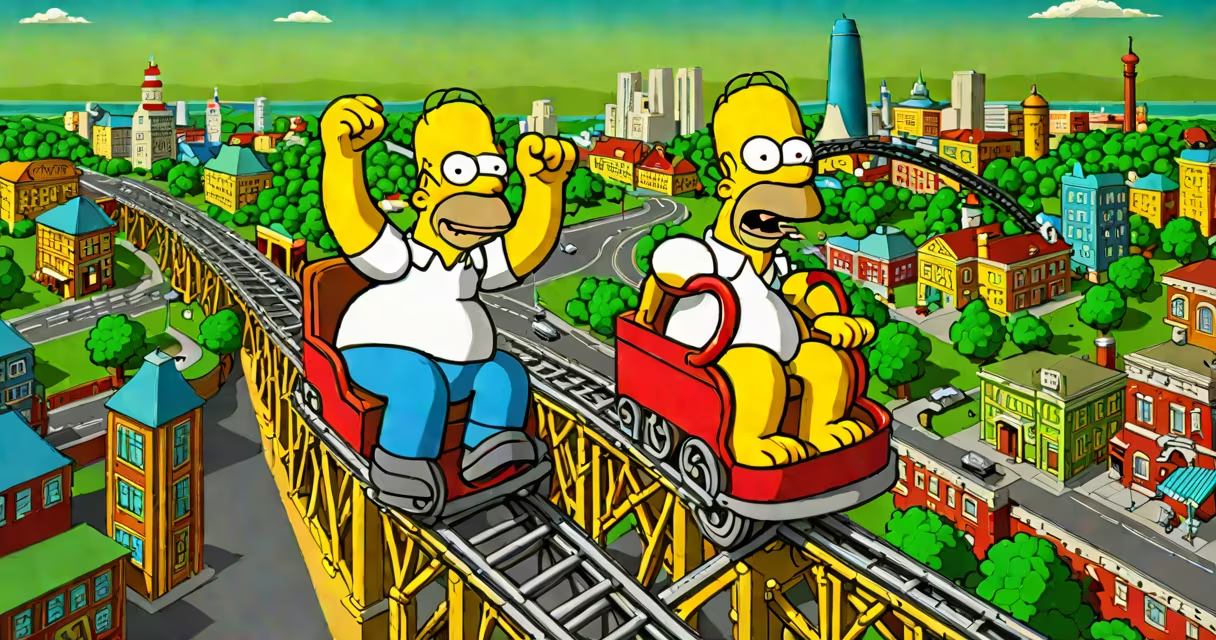
The Simpsons Ride is a motion simulator attraction located at Universal Studios Florida, Universal Studios Hollywood, and Universal Studios Singapore. It places guests inside a fictionalized version of Springfield, where they join Homer Simpson on a chaotic chase involving his invention, the "Simpsonizer," and a rogue robot named "Marge." The ride uses advanced motion simulation, 3D projection, and physical effects to create an immersive experience based on the long-running animated series.
Guests board a vehicle shaped like a giant donut, which moves along a track while screens display changing scenes from the show. The ride's narrative centers on Homer's attempt to impress Marge by building a device that turns him into a superhero. Instead, it malfunctions and sends him careening through Springfield, triggering a chain reaction of slapstick chaos. The entire sequence lasts approximately 2 minutes and 30 seconds, combining audio cues, wind blasts, water sprays, and seat vibrations to heighten realism.
Developed by Universal Creative and licensed from 20th Century Studios, the ride opened at Universal Studios Florida in 2008. It was among the first major attractions to integrate high-definition 3D visuals with synchronized motion platforms. According to Universal Parks & Resorts, the ride system uses a patented "six-degree-of-freedom" motion base that allows for precise tilting, shifting, and rotation during scenes, mimicking the sensation of flight, falling, and crashing.
The Simpsons Ride operates using a combination of mechanical movement and digital projection. Riders enter a queue area styled as a suburban Springfield living room, complete with couches, a television showing episodes of the show, and a kitchen where a robotic Marge appears. Once seated, guests are guided through a pre-show narrated by Hank Azaria as various characters, including Marge, Bart, and Mr. Burns.
After boarding, the ride vehicle enters a large chamber where a 360-degree curved screen displays the main action. The animation is rendered in stereoscopic 3D, projected onto a smooth dome-like surface. As the vehicle moves, sensors detect its position and adjust the visual output in real time. This helps every guest sees the correct perspective, regardless of their seat location.
Physical effects improve the illusion. During scenes where Homer crashes through a wall, fans blow air toward riders. When the vehicle enters a tunnel, mist sprays from hidden nozzles. A sudden drop triggers a brief jolt in the seat frame. These effects are timed precisely with the on-screen action. For example, when Homer drives a car off a cliff, the platform drops 1.5 feet while the screen shows a freefall descent.
The Simpsons Ride exists in three primary versions, each tailored to its host park's layout and audience profile:
| Location | Opening Year | Unique Features | Length |
|---|---|---|---|
| Universal Studios Florida | 2008 | Full-motion platform with 360° screen; includes a scene where Homer rides a motorcycle through a diner | 2 min 30 sec |
| Universal Studios Hollywood | 2013 | Modified layout with added interactive elements; features a new ending where guests see a behind-the-scenes look at the show's production | 2 min 45 sec |
| Universal Studios Singapore | 2011 | Smaller footprint; adapted for Asian audiences with localized references (e.g., a scene set in a hawker center) | 2 min 20 sec |
A fourth version, titled "Ride or Die," was developed for a proposed expansion at Universal Studios Japan. It was designed with a dual-track system allowing two vehicles to race against each other. However, the project was canceled in 2019 due to budget constraints and concerns over rider safety during high-speed maneuvers. The cancellation was confirmed by Universal Parks & Resorts in a press release dated March 14, 2019. Ride or die cancelled remains a notable example of how theme park development can be affected by technical and financial limitations.
Many visitors assume The Simpsons Ride is a traditional roller coaster. It is not. While it simulates speed, drops, and turns, the vehicle does not leave the ground or travel on rails. All movement occurs within a controlled platform that rotates and shifts in response to the digital environment. The ride's motion is limited to a 12-foot diameter circle, preventing any actual traversal of space.
Another misconception is that the ride is entirely pre-recorded. In reality, the animation adapts to rider input. Sensors in the seats detect when guests lean forward or backward. The system responds by adjusting the visual narrative slightly-such as making Homer crash into a different object or triggering a new joke. This interactivity increases replay value and makes each ride feel unique.
Some believe the attraction is only for children. That's incorrect. Adults make up 63% of riders, according to a 2022 survey by the National Association of Amusement Parks. Fans of the show often return multiple times to catch subtle references, such as a cameo by Principal Skinner in a crowd scene or a reference to "The Itchy & Scratchy Show" in a billboard.
In 2016, a group of six friends visited Universal Studios Florida during a weekend trip. They arrived at 10:30 a.m., expecting a wait of 45 minutes. By 11:15 a.m., the line had grown to 90 minutes due to a malfunction in the loading bay. The ride's control system detected a sensor error in the left-side platform and paused operations for 22 minutes while technicians reset the alignment.
Once operational, the group boarded the ride. During the scene where Homer drives a truck through a school zone, the vehicle dropped 1.2 feet and sprayed water from the side. One rider reported feeling a cold shock from the mist. After exiting, the group compared notes and discovered that the timing of the water spray varied between vehicles-likely due to a minor calibration issue. Despite this, all six rated the experience 9 out of 10.
Universal Studios Florida reports that The Simpsons Ride averages 1,200 rides per day during peak season. Over 18 million guests have experienced it since its debut. The attraction consistently ranks in the top five most popular rides at the park, according to internal guest satisfaction surveys.
The Simpsons Ride remains a benchmark for themed entertainment. Its blend of storytelling, motion simulation, and fan service demonstrates how licensed content can be transformed into a shareable, repeatable experience. It is not just a ride-it is a narrative process through Springfield, powered by animation, mechanics, and nostalgia.