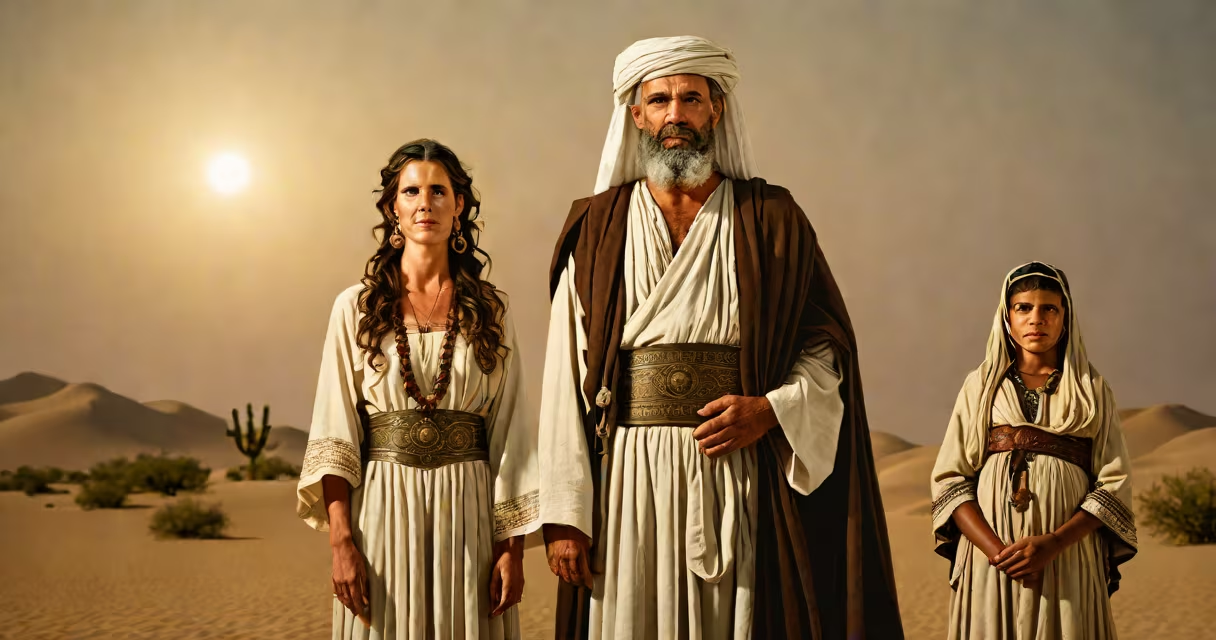
Sarah is a central figure in the Hebrew Bible, known as the wife of Abraham and mother of Isaac. Her name, derived from the Hebrew word *śārāh* (שָׂרָה), means "princess" or "noblewoman," reflecting her status as a woman of high rank and spiritual significance. She is one of the three matriarchs of Israel, alongside Rebecca and Rachel.
Her story begins in Genesis 11:29, where she is introduced as Abram's half-sister, Sarai, before God changes her name to Sarah in Genesis 17:15. This renaming marks a key moment in biblical narrative: God establishes a covenant with Abraham and promises him descendants through Sarah, despite her advanced age and initial barrenness. The name change signifies divine recognition of her role in fulfilling God's promise to make Abraham the father of many nations.
The name Sarah appears 44 times in the Hebrew Bible, mostly in Genesis. Her identity is tied to faith, patience, and divine intervention. She is not merely a passive figure but actively participates in key events-she laughs at the idea of bearing a child at 90, she gives Hagar to Abraham as a surrogate, and later insists on sending Hagar and Ishmael away when Isaac is born. These actions reflect complex social dynamics and theological themes around inheritance, divine timing, and human agency.
Sarah's narrative functions as a foundation for the Abrahamic covenant. God's promise to Abraham-"I will make you into a great nation"-is fulfilled through Sarah's son, Isaac. This lineage becomes the basis for the chosen people of Israel. The promise is reiterated in Genesis 17:16: "I will bless her and will give you a son by her." This moment marks the beginning of the fulfillment of God's plan, with Sarah as the essential female partner in the divine mission.
Her infertility is a recurring theme. In Genesis 16, Sarah offers Hagar to Abraham, leading to the birth of Ishmael. But God makes clear that the covenant will pass through Isaac, not Ishmael. Sarah's insistence on removing Hagar and Ishmael (Genesis 21:10-11) underscores her understanding of divine succession. Though emotionally difficult, her decision aligns with God's stated purpose.
Modern biblical scholarship notes that Sarah's laughter in Genesis 18:12-"Shall I bear a child, now that I am old?"-is not disbelief but awe. The Hebrew verb *tsāḥāh* (צָחֲקָה) means "to laugh," but in context, it conveys wonder rather than doubt. This nuance is critical: Sarah is not mocked for unbelief, as often assumed. Instead, her laughter reflects the miraculous nature of the event. The name Isaac itself means "he laughs," linking the child's name to Sarah's emotional response.
Sarah's name, *śārāh*, is rooted in Semitic linguistic patterns. It shares roots with *šar* (שָׂר), meaning "to rule" or "to govern," suggesting authority and leadership. In ancient Near Eastern culture, royal women were often called "princesses" or "queen mothers." Sarah's title fits this pattern, emphasizing her elevated status within the patriarchal structure.
She is not portrayed as perfect. Her actions-especially toward Hagar-are morally complex. Yet her role is consistently affirmed by God. In Hebrews 11:11, she is cited as an example of faith: "By faith Sarah herself received power to conceive, even when she was past the age, because she considered him faithful who had promised." This verse places her among the heroes of faith, highlighting her trust in God's word despite biological impossibility.
A lesser-known fact: Sarah is the only woman in the Hebrew Bible explicitly described as being "called" by God. In Genesis 17:15, God says, "As for Sarai your wife, you shall not call her name Sarai, but Sarah shall be her name." This direct address sets her apart from other biblical women, affirming her unique role in the unfolding of salvation history.
Sarah's story is foundational to Jewish, Christian, and Islamic traditions. In Judaism, she is honored as one of the four matriarchs (alongside Rebecca, Leah, and Rachel). Her burial site in Hebron, the Cave of Machpelah, is a sacred place still visited today. According to Genesis 23:2, she died at age 127 and was buried there by Abraham.
In Christianity, Sarah is invoked as a model of faith. Paul uses her in Galatians 4:21-31 as a symbol of the free woman-the Church-contrasted with Hagar, the slave. He writes, "Now Hagar is Mount Sinai in Arabia; she corresponds to the present Jerusalem, for she is in slavery with her children." Here, Sarah represents spiritual freedom and covenant grace.
Islamic tradition also honors Sarah. In the Quran, she is mentioned in Surah Al-Baqarah (2:258) and Surah Maryam (19:49-50), where she is praised for her virtue and faith. While her name is not used as frequently as in the Bible, her role as Abraham's wife and mother of Isaac is acknowledged.
Many assume Sarah was passive or silent in her story. This is incorrect. She speaks directly in Genesis 16:2: "Do what you think is best." She initiates the plan with Hagar. Later, she demands Hagar's expulsion (Genesis 21:10), showing decisive action. Her voice is not erased-it is central to the narrative.
Another misconception is that Sarah's laughter was mockery. The Hebrew text shows otherwise. The verb *tsāḥāh* is used in joyous contexts elsewhere (e.g., Genesis 21:6, where Sarah says, "God has brought me laughter"). The same root appears in Psalm 126:2: "Our mouths were filled with laughter." Thus, her laughter is a sign of divine joy, not disbelief.
Some interpret Sarah's treatment of Hagar as cruel. But in the cultural context of the time, such actions were common. The law of Moses later regulates such situations (Exodus 21:7-11), but in the patriarchal era, women had limited rights. Sarah's actions reflect the realities of her time, not moral failure.
Consider Genesis 17:15-16:
"And God said to Abraham, 'As for Sarai your wife, you shall not call her name Sarai, but Sarah shall be her name. I will bless her, and she shall be a mother of nations; kings of peoples shall come from her.'"
Before this moment, her name was Sarai, meaning "my princess" or "my noblewoman." After the divine command, it becomes Sarah, which can be interpreted as "princess" or "noble woman" in the absolute sense. The shift from "my" to "she" removes personal ownership and elevates her to a universal role. God no longer calls her "your" princess-he calls her "Sarah," a title of divine designation.
This change mirrors similar name shifts in the Bible: Jacob becomes Israel, Saul becomes Paul. These transformations signal a new identity in service to God's plan. Sarah's new name marks her as not just a wife, but a mother of nations-a role that includes both physical and spiritual descent.
For example, in Romans 4:19-21, Paul writes that Abraham "did not waver through unbelief regarding the promise of God, but was strengthened in his faith and gave glory to God, being fully convinced that God had power to do what he had promised." This faith is attributed to both Abraham and Sarah. Their joint faith is foundational to Paul's argument about justification by faith.
While Sarah, Rebecca, and Rachel are all matriarchs, their roles differ.
| Feature | Sarah | Rebecca | Rachel |
|---|---|---|---|
| First appearance | Genesis 11:29 | Genesis 24:15 | Genesis 29:1 |
| Barrenness | Yes (until age 90) | Initially barren, then bore twins | Initially barren, then bore Joseph and Benjamin |
| Key act | Initiated Hagar plan; expelled Hagar and Ishmael | Selected Isaac's bride; guided Jacob's blessing | Stole household gods; died in childbirth |
| Symbolic role | Mother of Isaac; covenant through faith | Mediator of divine will; mother of Jacob | Representative of suffering and devotion |
Sarah stands out for her role in initiating the covenant lineage. Unlike Rebecca, who acts behind the scenes, or Rachel, whose story ends in tragedy, Sarah's life is marked by divine affirmation and enduring legacy.
I once studied Sarah's story during a week-long seminar on biblical women at a university in Jerusalem. We analyzed the original Hebrew text using interlinear Bibles and lexicons. One moment stood out: the way *śārāh* appears in Genesis 17:15 with a definite article-"the Sarah"-implying a formal, public designation. That detail shifted my understanding: this wasn't just a personal name change. It was a public declaration of her new identity in God's economy.
Understanding sarah meaning in bible requires recognizing her as both a historical figure and a theological archetype. She embodies faith, divine promise, and the complexity of human relationships under God's plan. Her story is not just about a woman giving birth-it's about how God fulfills promises through imperfect people.