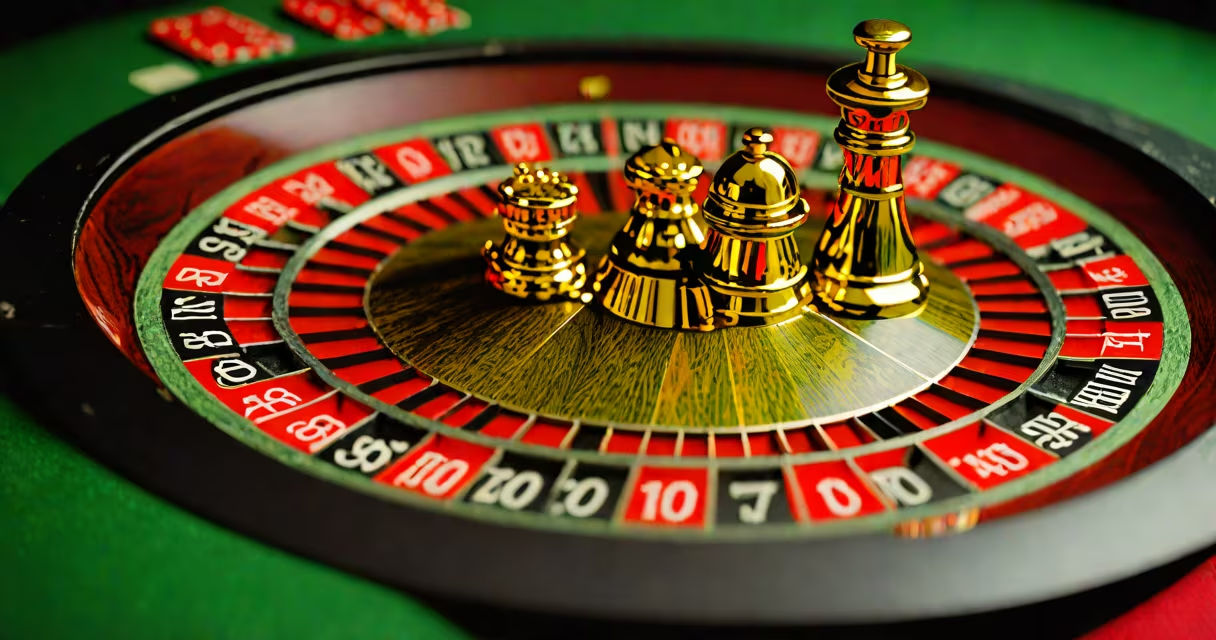
Ruleta in English is roulette-a casino game played on a spinning wheel with numbered pockets, where players place bets on outcomes before the ball lands. The game originated in 18th-century France and is now standard in casinos worldwide.
Roulette uses a wheel divided into 37 (European) or 38 (American) numbered slots, alternating between red and black. Zero is green. Players bet on single numbers, groups of numbers, colors (red or black), odd/even, or high/low ranges. The dealer spins the wheel and drops a small ball. When the ball lands in a pocket, payouts are determined by the bet type.
For example, betting $10 on red wins $10 if the ball lands in any red slot. Betting $10 on a single number pays 35-to-1-if correct, the player gets $350 plus their original $10 back. The house edge is 2.7% in European roulette (one zero) and 5.26% in American roulette (double zero).
The game begins with players placing bets on a layout covering the numbers 0-36 (or 0-36 plus 00). Once bets are placed, the dealer spins the wheel in one direction and the ball in the opposite. After the ball settles, the dealer announces the winning number and color. Payouts are then made based on the bet type.
Betting is done before the spin. Players cannot change their bets once the wheel starts. In live casinos, dealers use a rake to collect losing bets and pay winners. Online versions simulate this process with automated payouts.
A common mistake is assuming that past results affect future outcomes. The wheel has no memory. A run of reds doesn't increase the chance of black-each spin is independent. This is known as the gambler's fallacy.
There are two main categories: inside bets and outside bets. Inside bets are placed on specific numbers or small groups. Outside bets cover larger sections of the wheel.
| Bet Type | Number of Spots | Payout | House Edge (EU) |
|---|---|---|---|
| Single Number (Straight) | 1 | 35:1 | 2.7% |
| Split (Two Numbers) | 2 | 17:1 | 2.7% |
| Street (Three Numbers) | 3 | 11:1 | 2.7% |
| Corner (Four Numbers) | 4 | 8:1 | 2.7% |
| Even Money (Red/Black, Odd/Even, High/Low) | 18 | 1:1 | 2.7% |
Outside bets have higher odds of winning but lower payouts. For example, betting on red has nearly a 48.6% chance of winning in European roulette. Inside bets offer bigger rewards but are riskier-single-number bets win less than 3% of the time.
Some players use betting systems like Martingale (doubling after losses). While these can extend playtime, they don't change the long-term house advantage. The system fails under real-world constraints like table limits and finite bankrolls.
The word "roulette" comes from French, meaning "little wheel." It entered English usage in the 18th century through French gambling culture. The term was adopted directly into English without translation because it was already recognized in international casino circles.
"Ruleta" is Spanish for "wheel," which is why the game is called ruleta in Spanish-speaking countries. In English, the spelling "roulette" reflects the original French pronunciation. The word is pronounced "roo-LAYT" in English, not "roo-LEH-tah."
Many people confuse "roulette" with "craps" or "baccarat"-other casino games-but they differ in mechanics and rules. Craps uses dice; baccarat uses cards. Roulette relies solely on a spinning wheel and a ball.
One widespread error is thinking that the wheel is biased or that certain numbers are "due." The wheel has no memory. Each spin is independent. Over thousands of spins, outcomes balance out statistically, but short-term variance creates illusions of patterns.
Another myth is that online roulette is rigged. Reputable online casinos use random number generators (RNGs) certified by independent auditors. The UK Gambling Commission and eCOGRA test RNGs regularly. For example, a 2021 audit of 10 major online casinos found no evidence of manipulation in 10 million simulated spins.
Players also assume that betting on "hot" numbers increases chances. But each number has equal probability. In European roulette, each number has a 1 in 37 chance-about 2.7%. No number is more likely than another.
Imagine playing European roulette with $100. You place $10 on red. The wheel spins. The ball lands in 17-black. You lose $10. Next spin, you bet $10 on black. Ball lands in 23-black. You win $10. Net: $0.
You continue. On the third spin, you bet $10 on number 14. Ball lands on 14. You win $350 (35×$10). Your total is now $360. You stop and walk away.
This session shows how volatility works. Even with a favorable outcome, the house edge ensures long-term loss. Over 100 spins, the average player loses about 2.7% of total wagers. With $1000 wagered, expected loss is $27.
I once watched a player at a Las Vegas casino use a $500 bankroll over 45 minutes. He alternated between red/black and single-number bets. He won $120 early but lost $480 later. Final result: -$360. The game didn't favor him-math did.
If you're learning English for gaming contexts, start with basic terms: "bet," "win," "lose," "spin," "payout," "house edge." These appear in most casino instructions and online guides.
Understanding ruleta in English isn't just about vocabulary-it's about grasping how the game functions, what the odds mean, and why expectations often fail. Knowledge reduces risk and improves decision-making.
Ruleta in English is roulette. It's a game of chance with clear rules, predictable payouts, and consistent probabilities. Knowing how it works helps avoid costly misunderstandings.