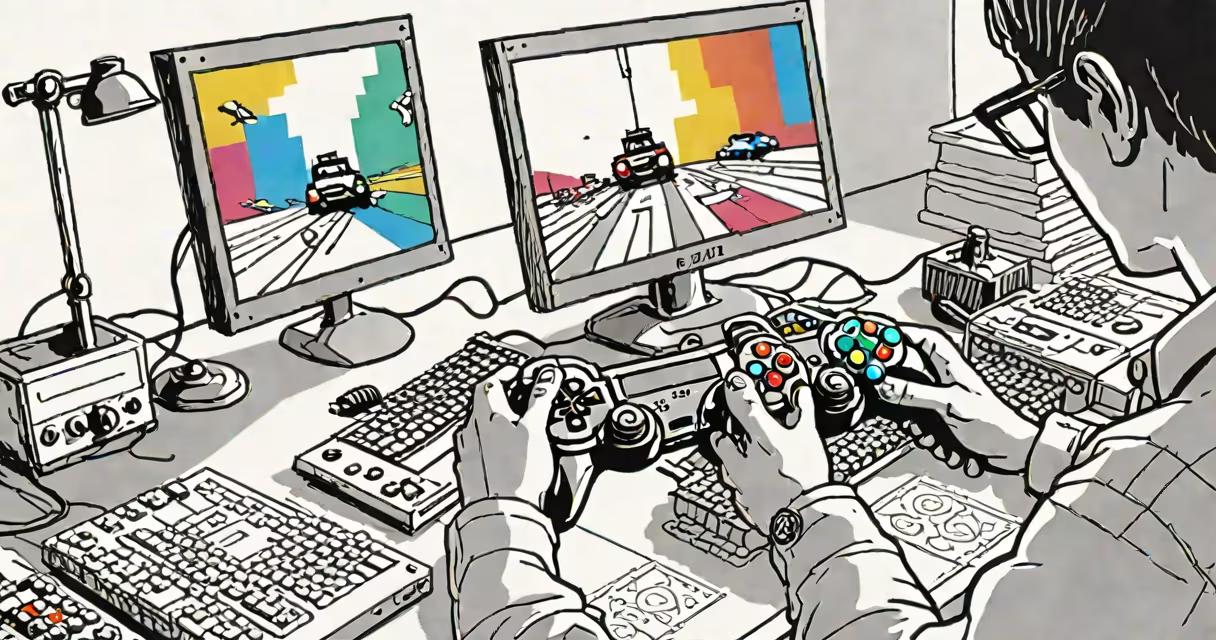
Playing a game means actively participating in a structured activity governed by rules, objectives, and feedback loops designed to create challenge, fun, and engagement. It can involve physical movement, mental strategy, or digital interaction across platforms like consoles, computers, or mobile devices.
Games operate through systems of cause and effect. A player makes a move-pressing a button, moving a piece, solving a puzzle-and the game responds with a change in state. This interaction forms the core of gameplay. For example, in a platformer like *Celeste*, jumping onto a ledge triggers a visual animation, changes the level layout, and advances the story. The game tracks progress, applies physics, and adjusts difficulty based on performance.
Games are not passive experiences. They require attention, decision-making, and adaptation. Success depends on understanding the rules, learning patterns, and reacting under pressure. A player who masters timing in *Super Mario Bros.* can skip entire sections by executing precise jumps. This mastery creates satisfaction, reinforcing continued play.
Every game begins with a set of rules-explicit or implied-that define what actions are allowed and what outcomes follow. These rules form a structure for interaction. In chess, pieces move in specific ways, and capturing the opponent's king ends the game. In *Fortnite*, players collect materials, build structures, and eliminate others in a shrinking map. The rules are enforced by the game engine, which processes inputs and updates the environment in real time.
Objectives give direction. Without a goal, a game lacks purpose. Objectives can be short-term (reach the next checkpoint), medium-term (complete a level), or long-term (beat the final boss). In *The Legend of Zelda: Breath of the Wild*, the objective is to rescue a kingdom, but players discover it through exploration rather than linear tasks. This design encourages curiosity and rewards independent problem-solving.
Feedback mechanisms keep players engaged. Points, levels, sound effects, and visual cues signal success or failure. In *Tetris*, clearing lines produces a satisfying chime and increases the score. The game grows faster as levels advance, raising tension. This loop-action → result → adjustment-drives continued play. Research from the University of California, Santa Cruz shows that immediate feedback increases dopamine release, reinforcing behavior and extending session duration.
Games vary widely in format, but all share core elements: rules, goals, challenges, and interactivity. The following table outlines common categories:
| Type | Key Features | Example | Player Role |
|---|---|---|---|
| Video game | Software-based, often multiplayer, uses screens and controllers | *Minecraft* | Builder, explorer, survivor |
| Board game | Physical components, turn-based, limited to tabletop space | *Pandemic* | Team strategist, resource manager |
| Card game | Deck-based, relies on probability and bluffing | *Magic: The Gathering* | Spellcaster, deck builder |
| Role-playing game (RPG) | Character progression, narrative-driven, persistent worlds | *Dungeons & Dragons* | Storyteller, adventurer |
Each type emphasizes different aspects of gameplay. Video games offer changing environments and complex mechanics. Board games rely on social interaction and shared decision-making. Card games depend on memory, risk assessment, and psychological insight. RPGs focus on narrative immersion and long-term progression.
A key distinction often missed is that not all interactive media qualify as games. A simulation like *Microsoft Flight Simulator* offers rich detail and realism, but without clear win conditions or structured challenges, it functions more as a training tool than a game. According to the International Game Developers Association (IGDA), a game must have "a measurable outcome" tied to player actions to be classified as such.
Many assume that playing a game requires competition. That's false. Solitaire, *Process*, and *Animal Crossing: New Horizons* are single-player experiences with no opponents. Their appeal lies in pacing, atmosphere, and personal achievement-not winning against others.
Another error is equating "fun" with "easy." Games are enjoyable because they balance challenge and reward. Too little difficulty leads to boredom; too much causes frustration. The concept of "flow," introduced by psychologist Mihaly Csikszentmihalyi, describes the optimal state where task difficulty matches skill level. In *Dark Souls*, players die repeatedly until they master enemy patterns. Each death teaches a lesson, and eventual success feels earned.
Some confuse playing a game with watching someone else play. Streaming platforms like Twitch host millions of viewers watching live gameplay. But watching is not playing. The viewer receives information passively. The player makes choices that alter the game state. One study by the Entertainment Software Association (ESA) found that 65% of gamers prefer playing over watching, even when the stream is entertaining.
In 2021, I spent three weeks building a simple puzzle game using Unity and C#. The goal was to create a level where players had to rotate tiles to align colors. I tested it with friends. One participant failed 12 times before succeeding. On the 13th try, they smiled and said, "I finally get it." That moment confirmed the power of deliberate practice within a game system. The feedback loop-failure → reflection → improvement → success-was tangible.
The game wasn't polished. It lacked music and animations. But the structure worked. Players understood the rules, saw consequences, and adapted. This mirrors how professional developers test prototypes: isolate mechanics, measure player behavior, refine until engagement holds.
Playing a game is not just entertainment-it's a cognitive exercise, a social ritual, and a creative outlet. arranging tiles on a board, the act of playing engages your mind, body, and emotions in a structured yet open-ended way. Understanding how it works helps you enjoy it more, design it better, or simply recognize its role in daily life.