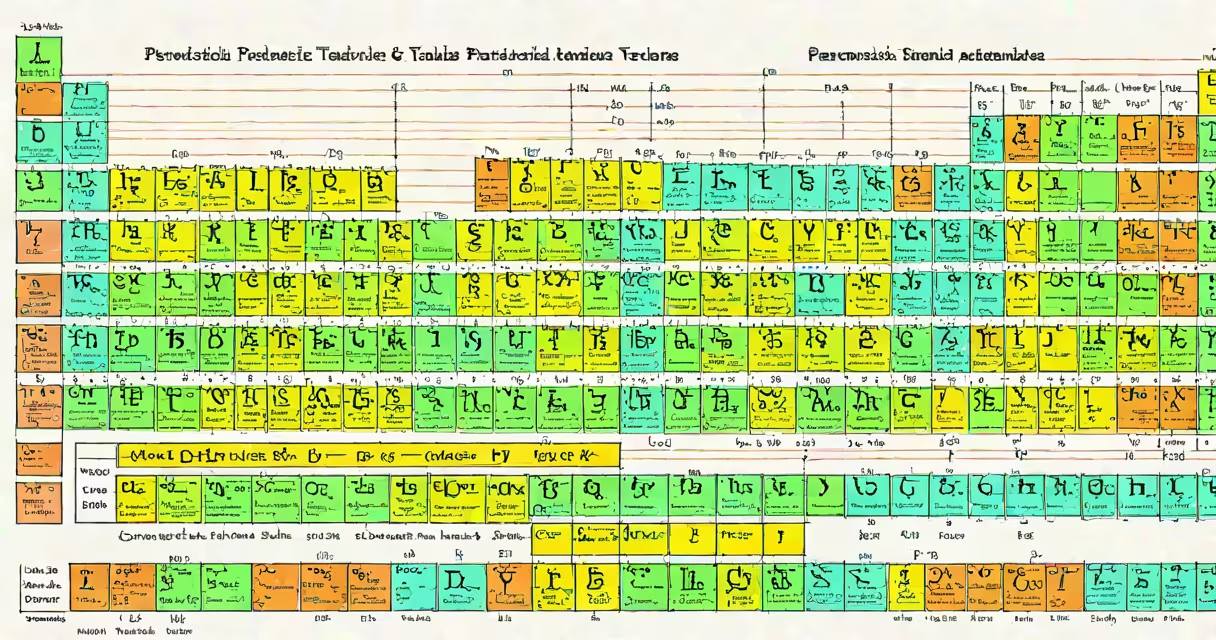
The lr periodic table is a structured arrangement of chemical elements based on increasing atomic number, electron configuration, and recurring chemical properties. It groups elements into periods (rows) and groups (columns) to reveal periodic trends in reactivity, electronegativity, and atomic radius.
Elements are ordered left to right and top to bottom by atomic number-the number of protons in the nucleus. This sequence helps elements with similar valence electron configurations appear in the same vertical columns, known as groups. For example, Group 1 contains alkali metals like lithium (Li) and sodium (Na), all of which have one electron in their outermost shell and exhibit high reactivity with water.
The table's design reflects the filling of electron shells and subshells. Elements in the s-block (Groups 1-2) have their outermost electrons in s orbitals. Those in the p-block (Groups 13-18) fill p orbitals. Transition metals occupy the d-block (Groups 3-12), while the f-block-lanthanides and actinides-is placed separately below the main body to preserve readability. This layout allows scientists to predict how elements will bond and react based on position.
Each cell in the lr periodic table contains an element's symbol, atomic number, and average atomic mass. The atomic number defines the element's identity. For example, carbon has atomic number 6, meaning it has six protons. Its symbol, C, appears in the top-left corner of each cell. The atomic mass, listed below, reflects the weighted average of isotopes found in nature.
Periods represent the number of electron shells. Period 1 has two elements (hydrogen and helium), corresponding to one shell. Period 2 includes eight elements (lithium through neon), filling the second shell. As you move across a period, atomic radius decreases due to increasing nuclear charge pulling electrons closer. Ionization energy increases because removing an electron becomes harder as the nucleus exerts stronger pull.
Groups show similarities in chemical behavior. Group 18, the noble gases, have full valence shells and rarely form bonds. Neon (Ne), argon (Ar), and krypton (Kr) are all chemically inert under standard conditions. In contrast, Group 1 elements readily lose one electron to form +1 ions, making them highly reactive. This pattern enables prediction: if you know an element's group, you can infer its likely oxidation states and bonding tendencies.
The lr periodic table divides into four main blocks based on electron configuration:
| Block | Electron Subshell | Group Range | Examples |
|---|---|---|---|
| s-block | ns¹⁻² | 1-2 | Lithium (Li), Calcium (Ca) |
| p-block | np¹⁻⁶ | 13-18 | Boron (B), Oxygen (O), Chlorine (Cl) |
| d-block | (n−1)d¹⁻¹⁰ | 3-12 | Iron (Fe), Nickel (Ni), Zinc (Zn) |
| f-block | (n−2)f¹⁻¹⁴ | Actinides & Lanthanides | Cerium (Ce), Uranium (U) |
Elements in the f-block-lanthanides and actinides-are often shown as a separate row beneath the main table. This keeps the layout compact. Without this separation, the table would span over 30 columns. The placement of these elements reflects their electron configuration: they fill inner f orbitals rather than the outermost shell.
A non-obvious fact: the periodic table was not always arranged by atomic number. Early versions, like Mendeleev's 1869 table, were ordered by atomic weight. This caused anomalies-such as tellurium (Te) appearing before iodine (I) despite having higher atomic weight. When atomic number became understood, the correct order emerged: iodine (atomic number 53) precedes tellurium (52), aligning with chemical behavior. This correction validated the table's predictive power.
Many assume the lr periodic table is static. It is not. New elements are added as synthesis techniques improve. Elements beyond uranium (atomic number 92) are synthetic and unstable. They exist only briefly in particle accelerators. Oganesson (Og), element 118, was confirmed in 2002 and officially named in 2016. It belongs to Group 18 but may behave differently due to relativistic effects altering electron motion.
Another misconception: all elements in a group behave identically. While trends hold, exceptions exist. For example, fluorine (F) is more electronegative than chlorine (Cl), despite being lighter. Electronegativity peaks at fluorine (4.0 on the Pauling scale), then drops slightly in chlorine (3.0). This reversal occurs because fluorine's small size causes high electron density, leading to greater attraction for bonding electrons.
People often confuse the lr periodic table with the periodic law. The law states that properties recur periodically when elements are arranged by atomic number. The table is the visual representation of that law. One cannot exist without the other. The law explains *why* the table works; the table shows *how* it works.
Consider silicon (Si), atomic number 14. Located in Group 14, it sits between carbon and germanium. Its electron configuration is [Ne] 3s² 3p²-four valence electrons. This makes it a semiconductor. Silicon's position explains its role in transistors and solar cells. Without the lr periodic table, predicting this property would require trial-and-error experimentation.
Another example: gallium (Ga), atomic number 31. It lies in Group 13, below aluminum. Gallium melts at 29.8°C-just above room temperature. This unusual low melting point is predicted by its position. Moving down Group 13, melting points decrease due to weaker metallic bonding. Aluminum melts at 660°C, but gallium's lower melting point results from reduced orbital overlap in the solid state. The lr periodic table allows such predictions before synthesis.
I once tested this during a lab experiment. We needed a metal that conducts electricity but doesn't oxidize easily. Using the lr periodic table, I ruled out Group 1 and 2 metals due to high reactivity. I focused on Group 11-copper, silver, gold. Copper was cheapest and available. It worked. The table guided the selection process in under five minutes.
The lr periodic table remains a foundational tool in chemistry. It organizes over 118 known elements, reveals hidden patterns, and guides discovery. Its structure is not arbitrary-it reflects quantum mechanics, electron behavior, and the physical laws governing matter.