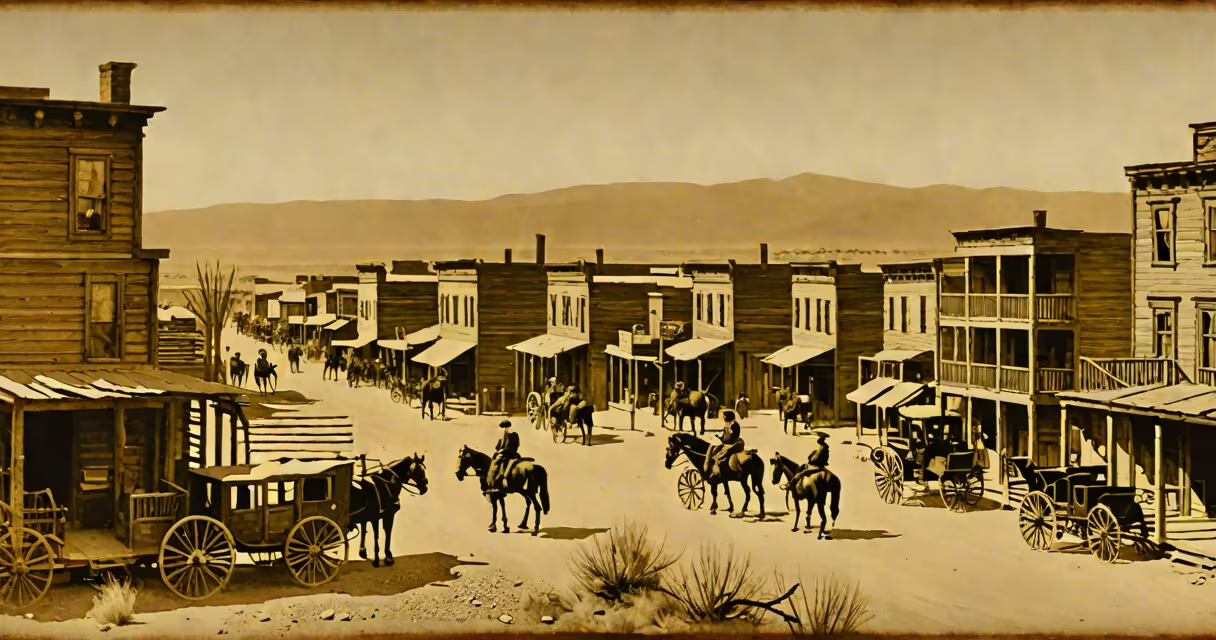
The Lincoln County War was a violent conflict in 1875-1878 between rival factions in Lincoln County, New Mexico Territory, primarily over control of trade, law enforcement, and political power. It erupted from tensions between cattle barons, merchants, and lawmen aligned with the Murphy-Dolan faction, and a group of outlaws and vigilantes led by Billy the Kid and others who opposed their dominance.
At its core, the war was not a single battle but a series of ambushes, assassinations, and retaliatory killings rooted in economic competition and personal vendettas. The conflict began after the arrival of the Murphy-Dolan company, which controlled the local store and sheriff's office through political influence and violence. Their rivals, including former lawmen and ranch hands, resisted what they saw as corrupt monopolization of justice and commerce.
Historians identify the war as a key moment in the American West's transition from frontier chaos to state-building. It exposed how loosely enforced federal authority allowed private interests to dominate local governance. The U.S. government did not intervene until after multiple deaths, including those of prominent figures like Sheriff William Brady and Sheriff George Hindman.
Control of the Lincoln County Courthouse and the local jail was central to the conflict. The Murphy-Dolan faction used their position as county officials to enforce debt collection, deny credit to rivals, and manipulate legal outcomes. They also operated a mercantile business that charged high prices and extended credit only to loyalists.
Opposition came from a coalition of individuals including John Tunstall, a British-born merchant who challenged the monopoly. Tunstall hired armed guards and established his own trading post. His murder in February 1876 triggered a chain reaction: Billy the Kid, then 17, joined the Tunstall party, and the war escalated into a full-scale insurgency.
Violence followed a pattern: ambushes during travel, nighttime raids on homes, and targeted assassinations. The most infamous incident occurred on April 1, 1878, when a group of Tunstall supporters attacked the courthouse in Lincoln, killing several deputies. The town became a battleground where loyalty determined survival.
Two main coalitions emerged. The Murphy-Dolan faction included Lawrence Murphy, James Dolan, and Sheriff Pat Garrett, who later gained fame for killing Billy the Kid. They represented established business interests backed by political patronage and armed enforcers.
The opposing side centered on John Tunstall, whose death sparked the war. He was a Scottish immigrant who arrived in 1875 with capital and business acumen. His associates included Billy the Kid (William Bonney), Tom O'Folliard, and Frank Coe. These men were often labeled "outlaws" by authorities but were also farmers, cowboys, and traders seeking fair access to markets.
| Faction | Leaders | Primary Goals | Notable Actions |
|---|---|---|---|
| Murphy-Dolan | Lawrence Murphy, James Dolan, Pat Garrett | Monopolize trade, maintain control of law enforcement | Used court appointments to remove rivals; orchestrated Tunstall's assassination |
| Tunstall Allies | John Tunstall (deceased), Billy the Kid, Tom O'Folliard | Challenge monopolies, secure fair trade and legal protection | Formed armed patrols; attacked courthouses and supply lines |
One lesser-known fact: Billy the Kid was not a lone gunman. He operated within a network of young men from diverse backgrounds-Irish, Mexican, Anglo-American-who shared a distrust of centralized authority. His reputation as a killer grew after he survived multiple confrontations, including one where he killed Sheriff Brady in retaliation for Tunstall's death.
Lincoln County, located in eastern New Mexico Territory, was sparsely populated and lacked consistent federal oversight. The region's economy relied heavily on cattle drives, freight transport, and trade with nearby towns like Fort Sumner and Santa Fe. With no standing military or police force, disputes were settled by private militias and informal justice systems.
The war intensified due to the arrival of the railroad in nearby towns. As transportation improved, control over supply routes became critical. The Murphy-Dolan faction blocked access to key trails and denied credit to independent traders. This created a dependency that forced many to choose sides.
A concrete example: In May 1877, a group of Tunstall allies intercepted a supply wagon carrying goods from Santa Fe. They seized the cargo and redistributed it to local families. The event was not just theft-it was a statement of resistance against economic exclusion. The Murphy-Dolan faction responded by arresting several leaders, sparking further violence.
Many assume the Lincoln County War was a simple clash between good and evil. In reality, both sides committed atrocities. The Murphy-Dolan faction used false arrests and extrajudicial killings to eliminate opposition. The Tunstall allies engaged in ambushes and arson. Neither side had a consistent moral structure.
Another misconception: Billy the Kid single-handedly won the war. He was a skilled fighter and a symbol of defiance, but he never commanded a large army. After Tunstall's death, leadership fragmented among smaller groups. The war ended not through victory but exhaustion and federal intervention.
Historian Robert M. Utley notes in *The Old West: A Narrative History* that "the war was less about ideology than about survival in a field where law was arbitrary and violence was currency." This insight separates the Lincoln County War from romanticized Western myths.
The Lincoln County War ended in 1878 after federal troops were deployed to restore order. Pat Garrett, now a deputy under federal authority, captured and later killed Billy the Kid in 1881. The conflict left behind a legacy of contested narratives, with descendants on both sides preserving conflicting memories.
Today, the site of the original courthouse in Lincoln, New Mexico, is preserved as a historical landmark. Visitors can see bullet holes in the walls and read accounts from surviving witnesses. The town's museum displays Tunstall's ledger books and letters from the period, offering rare insight into daily life during the conflict.
For researchers, the war remains a case study in how economic inequality and weak institutions fuel violence. The National Archives holds over 1,200 documents related to the conflict, including court records, telegrams, and personal correspondence. These materials show that the war was not a sudden outbreak but a slow unraveling of trust in local governance.
The Lincoln County War was not a mythic showdown between heroes and villains. It was a real struggle over control of resources, justice, and identity in a rapidly changing American West. Its lessons endure in how communities respond to power imbalances and the consequences of unchecked authority.