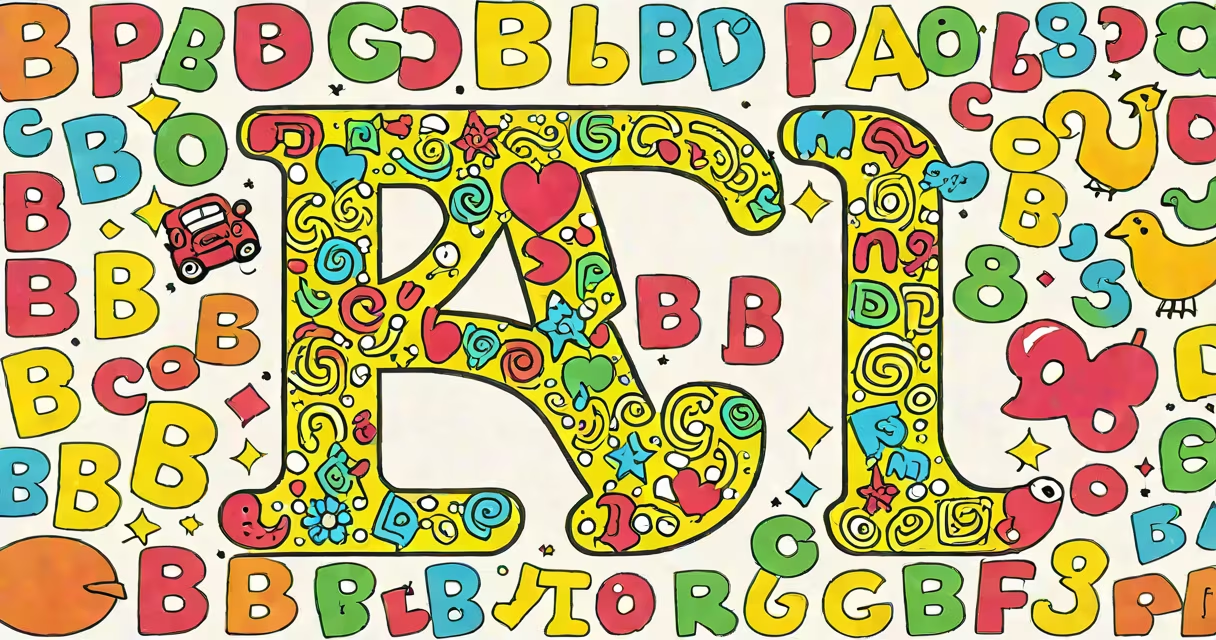
A letter B coloring page is a printable worksheet featuring the letter B in uppercase or lowercase form, often paired with a simple image related to the sound it makes, such as a butterfly, ball, or bee. These pages help young children learn letter shapes, develop hand-eye coordination, and practice color recognition through creative play.
Designed for preschool and kindergarten levels, letter B coloring pages typically include thick outlines to make coloring easy for small hands. Many incorporate visual cues-like a bee with wings shaped like a B-to reinforce phonetic associations. Pages may also include dotted lines showing how to write the letter correctly.
According to the National Association for the Education of Young Children (NAEYC), activities like coloring letters support early literacy development by linking visual symbols to spoken sounds. A 2021 study published in *Early Childhood Research Quarterly* found that children who engaged in structured coloring tasks showed improved letter recognition accuracy compared to those using unstructured drawing tools.
These pages function as tactile learning tools. Children trace the letter's outline with crayons or colored pencils, reinforcing muscle memory for proper formation. The act of selecting colors and filling in spaces strengthens finger dexterity and focus-skills essential for later handwriting.
Most pages feature a central B surrounded by related objects. For example, a bee might appear near the letter, emphasizing the /b/ sound. This visual association helps children connect the letter to real-world vocabulary. Some versions include space for writing the letter multiple times, promoting repetition and retention.
Pages are usually single-sided, black-and-white line art on standard 8.5 x 11 inch paper. They require no special materials-just crayons, markers, or colored pencils. Teachers and parents can use them during circle time, morning routines, or independent learning stations.
Letter B coloring pages come in several formats tailored to different learning goals:
| Type | Features | Best For |
|---|---|---|
| Simple Outline | Thick lines, minimal details, large letter | Pre-K students, fine motor skill building |
| Themed Scene | B with a bee, balloon, or basketball | Phonics lessons, vocabulary expansion |
| Tracing Practice | Dotted or dashed lines showing stroke order | Writing readiness, letter formation |
| Interactive | Fill-in-the-blank words, matching games | Classroom centers, homeschool curriculum |
Some advanced versions include hidden letters, mazes, or dot-to-dot patterns using the letter B as a guide. These add cognitive challenges while maintaining engagement.
Letter B coloring pages are widely used in preschool classrooms, homeschool settings, and early intervention programs. They serve as low-pressure tools for introducing letter sounds and shapes before formal reading instruction begins.
Teachers often integrate them into weekly themes. For example, during a "Bees and Blossoms" unit, a teacher might distribute a bee-themed B coloring page to kick off phonics practice. The activity reinforces both letter identity and thematic vocabulary.
Parents use these pages at home to supplement schoolwork or provide quiet time activities. A 2022 survey by the American Academy of Pediatrics found that 68% of caregivers reported using coloring sheets to support their child's pre-reading skills. The most effective pages included clear instructions and age-appropriate complexity.
Many assume letter B coloring pages are purely decorative. In reality, they are designed with developmental objectives in mind. The thick lines aren't just for aesthetics-they prevent accidental coloring outside the boundaries, which supports precision and control.
Another misconception is that all B pages look the same. In fact, research shows that themed pages improve retention. A 2019 study in *Journal of Early Literacy* found children remembered the letter B 30% longer when it was paired with a familiar image like a ball or bat compared to plain letter forms.
Some educators mistakenly believe that coloring should be limited to free expression. However, structured coloring with guided shapes builds foundational skills. The goal isn't artistic perfection-it's consistent, controlled movement.
In a kindergarten class in Portland, Oregon, a teacher used a bee-themed letter B coloring page during a lesson on beginning sounds. She began by saying, "Today we're learning the sound /b/, like in 'bee.'" Students then colored the page while repeating the sound aloud.
After coloring, the class played a game: the teacher held up flashcards with pictures of bees, balls, and bats. Students raised their hands when they heard a word starting with /b/. The teacher noted that 92% of students correctly identified the sound within five minutes.
Later, the students used their finished pages as bookmarks. The teacher later observed that during storytime, children were pointing to the letter B in books, showing increased awareness of letter forms.
Don't use pages with overly detailed illustrations. Small parts increase frustration and reduce success rates in young children. Stick to clean, high-contrast designs.
Avoid pages that mix uppercase and lowercase B without context. Children under five struggle to distinguish between the two forms unless explicitly taught. Use only one version per page unless teaching comparison.
Never assume that coloring is passive. Each stroke builds neural pathways linked to language processing. The act of coloring a letter is a form of rehearsal for writing.
I once spent a rainy afternoon helping my niece color a letter B page with a butterfly. She kept asking, "Why is the butterfly blue?" I explained that butterflies don't have to be one color-she could choose any shade. That moment sparked a conversation about color mixing and imagination. It wasn't just about the letter anymore.