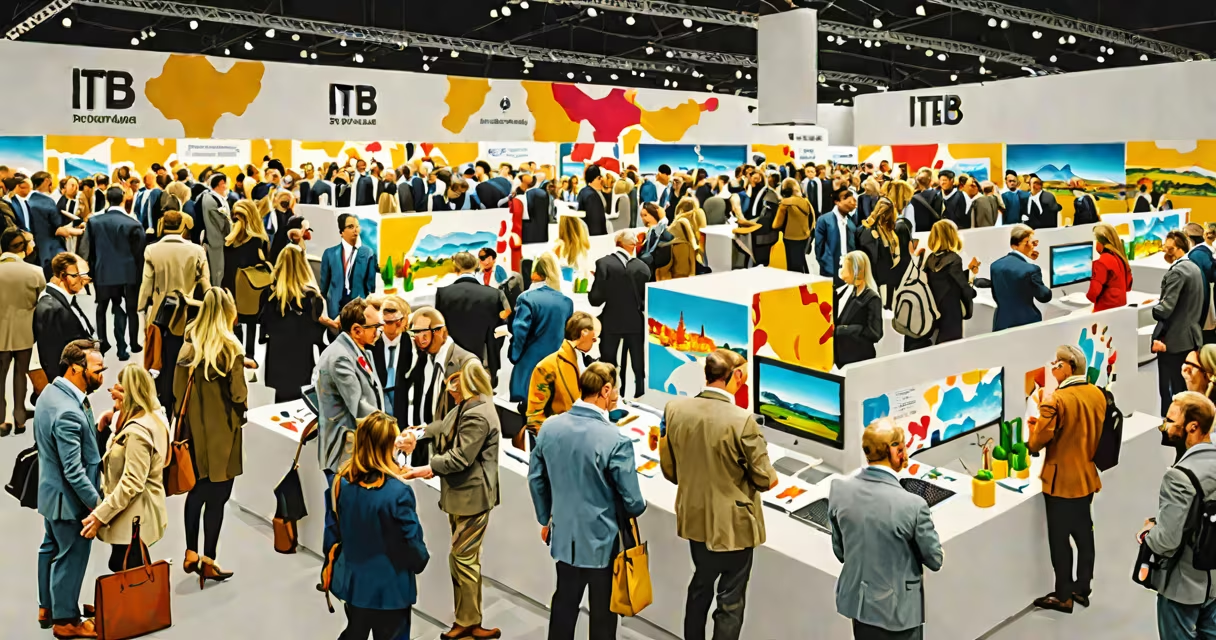
ITB Berlin 2026 is the world's largest travel trade show, hosted annually at Messe Berlin. It serves as a global platform for tourism professionals, destination marketers, airlines, hotels, and travel tech providers to network, launch products, and shape industry strategy.
The event is organized by Reed Exhibitions, a division of RELX Group, which manages over 500 exhibitions worldwide. ITB Berlin 2026 will run from March 8 to March 11, 2026, at the Berlin ExpoCenter City, a venue capable of hosting 180,000 attendees across 250,000 square meters of exhibition space. This scale makes it the most significant gathering of the global tourism sector each year.
Historically, ITB Berlin began in 1966 as a German national event focused on domestic tourism. By 1980, it had expanded into an international forum. Today, it attracts over 15,000 exhibitors and 200,000 visitors from more than 180 countries. Attendance numbers have consistently risen since 2019, with 2024 drawing 194,000 registered participants, according to official reports from Reed Exhibitions.
ITB Berlin 2026 operates as a B2B (business-to-business) event. Attendees include travel agencies, tour operators, hotel chains, government tourism boards, and travel technology firms. Exhibitors set up booths to demonstrate services, sign contracts, and host presentations. The core function is facilitation-connecting supply and demand in global tourism.
Each day features keynote sessions, panel discussions, and workshops led by industry leaders. Topics in past years have included sustainable tourism, AI in customer service, and post-pandemic recovery strategies. For 2026, organizers have confirmed sessions on climate-resilient tourism infrastructure and digital identity systems for cross-border travel.
Registration is required. Professional attendees must verify their employment in the travel sector through company documentation or membership in recognized associations such as the European Travel Commission or the World Travel & Tourism Council. Visitors without valid credentials may be denied entry.
ITB Berlin 2026 consists of four primary components: exhibition halls, conference zones, networking lounges, and digital integration platforms. The exhibition halls are divided by region and theme-such as "Adventure Travel," "Luxury Resorts," and "Sustainable Mobility." Each zone hosts specialized content and curated buyer meetings.
Conference zones feature live panels and breakout sessions. In 2024, the "Future of Travel" track attracted 12,000 attendees. For 2026, a new track titled "Tourism in the Age of AI" will debut, covering topics like chatbot-driven itinerary planning and predictive demand modeling.
Networking lounges provide private spaces for business meetings. These are reserved via the official ITB app, which allows users to schedule appointments, view attendee profiles, and access session recordings. The app also integrates with digital badges that grant access to restricted areas.
| Type | Focus Area | Examples of Participants |
|---|---|---|
| Destination Pavilions | National and regional tourism promotion | Visit Berlin, Tourism Australia, Costa Rica Ministry of Tourism |
| Technology Zones | Travel software, booking engines, AI tools | Amadeus, Sabre, Skyscanner, Airbnb Tech |
| Sustainability Hubs | Eco-certifications, low-carbon transport, green hotels | Green Globe, EarthCheck, Global Sustainable Tourism Council |
| Start-up Corners | New travel startups | Traveler's Choice, TripTik, EcoVoyage |
ITB Berlin 2026 takes place at Messe Berlin, a complex located near the city center with direct access to the U-Bahn and S-Bahn lines. The venue is equipped with high-speed fiber-optic internet, climate-controlled exhibition spaces, and multilingual support staff. Accessibility standards meet EU Directive 2010/63/EU for public venues.
Organizations use ITB Berlin 2026 to launch new product lines, secure distribution deals, and gather market intelligence. A 2023 study by the University of Hamburg found that 68% of exhibitors reported securing at least one major contract during the event. One participant, a Swiss alpine resort group, signed a distribution agreement with a Dubai-based tour operator during a scheduled meeting at the 2023 event.
For governments and tourism boards, ITB Berlin 2026 is a tool for brand visibility. Countries like Rwanda and Georgia have used the platform to reposition themselves as emerging adventure tourism hubs. In 2022, Georgia's delegation reported a 40% increase in inbound interest from European travel agents following their ITB presence.
ITB Berlin 2026 is often mistaken for a consumer-facing travel fair. It is not. Unlike events such as the Consumer Electronics Show (CES) or the National Retail Federation's annual conference, ITB Berlin is strictly for industry professionals. The public cannot attend unless invited as a guest of an exhibitor.
A common error is assuming ITB Berlin 2026 is solely about air travel. While airlines participate, the focus is broader-covering accommodations, ground transportation, cultural experiences, and digital travel tools. In 2024, 34% of exhibitors represented non-airline sectors, including rail providers and cruise lines.
Another misconception is that ITB Berlin 2026 is a single event. It is not. The show runs over four days, with different themes each day. Day one focuses on sustainability and innovation. Day two highlights emerging markets. Day three centers on technology and automation. Day four is dedicated to policy and regulation.
One non-obvious fact: ITB Berlin 2026 includes a formal accreditation process for media. Journalists must apply through the official press office and receive a verified badge. Without it, they cannot access press conferences or interview speakers. This ensures content accuracy and prevents unauthorized reporting.
In 2023, a small eco-lodge chain from northern Norway used ITB Berlin to launch a new carbon-neutral booking system. They partnered with a Finnish fintech firm to integrate blockchain-based verification of offset credits. During the event, they secured pilot agreements with five major European tour operators. The system was later adopted by 12 additional lodges across Scandinavia.
This example illustrates how ITB Berlin 2026 functions as a catalyst for innovation. It doesn't just display existing products-it enables the creation and validation of new ones through direct collaboration.
As a professional who attended ITB Berlin 2024, I observed that the most effective exhibitors were those who combined clear messaging with interactive demos. One startup used augmented reality to simulate a trip to Patagonia. Attendees wore headsets and walked through virtual landscapes while hearing narrated guides. That booth generated over 800 qualified leads in two days.
ITB Berlin 2026 remains the central nexus for global tourism strategy, innovation, and partnership. Its influence extends beyond the exhibition halls into policy, investment, and consumer behavior. Understanding its structure and purpose is essential for anyone involved in the travel industry.