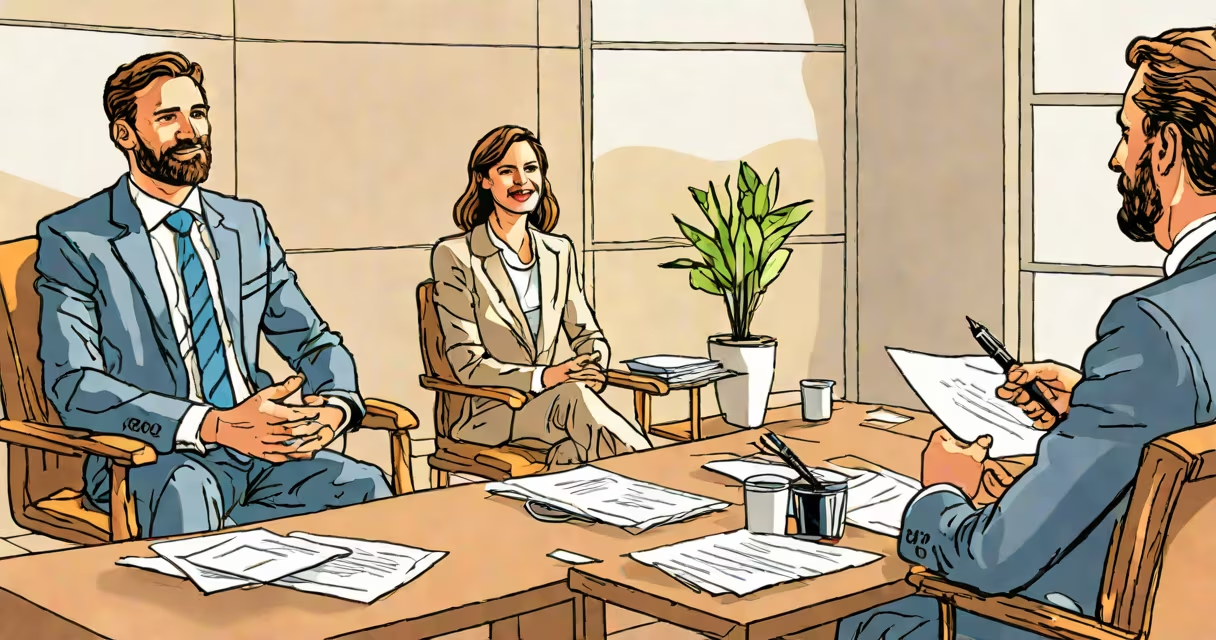
An introduction in a interview is a brief, intentional statement delivered early in the conversation that establishes identity, purpose, and relevance. It signals readiness, clarifies context, and shapes the interviewer's initial perception. A well-crafted version avoids rambling, focuses on value, and aligns with the role.
Interviews begin with silence or small talk. The introduction ends that pause. It is not a monologue, nor a rehearsed speech. It is a strategic moment-typically 15 to 30 seconds-where candidates assert presence, confirm alignment, and invite engagement. According to the Harvard Business Review, first impressions form within 7 seconds of meeting someone, and they influence decisions more than facts do.
Most candidates fail not because they lack skills, but because their introductions are generic. Phrases like "I'm here to learn" or "I've always wanted to work in this field" lack specificity. A strong introduction names the role, references one relevant achievement, and states intent. For example: "I'm Sarah Lin, a project manager with five years leading cross-functional teams in tech startups. I applied because I've successfully scaled user acquisition programs-like the one I led at NovaFlow, which grew sign-ups by 140% in six months."
The introduction functions as a cognitive anchor. It gives the interviewer a mental structure to interpret everything that follows. Without it, responses may seem disconnected or off-topic. With it, each answer becomes a supporting detail to a central narrative: "This candidate is experienced, focused, and aligned with our goals."
It operates on three levels: identity (who you are), relevance (why you're here), and intent (what you want to achieve). Identity includes name, current role, and core expertise. Relevance ties past work to the job description. Intent expresses interest and direction-impact.
For example, a software engineer applying for a backend role at a fintech company might say: "I'm James Tran, a full-stack developer with three years building secure APIs for financial platforms. At my last role, I reduced latency by 40% through caching optimization. I'm applying because I want to contribute to systems that handle high-volume transactions reliably." This introduces him as skilled, results-driven, and mission-aligned.
There are three common formats based on career stage and context:
| Type | Best For | Length | Example |
|---|---|---|---|
| Direct | Experienced professionals, technical roles | 20-30 sec | "I'm Elena Torres, a UX designer with eight years at SaaS companies. I specialize in accessibility-focused interfaces. I'm here because I've redesigned onboarding flows that cut drop-off by 35%." |
| Transition | Job changers, career switchers | 25-40 sec | "I'm David Kim, a former teacher who shifted into instructional design. I created digital modules used by 12,000 students. I'm applying here because I want to build learning tools that scale globally." |
| Aspirational | Entry-level, recent graduates | 15-25 sec | "I'm Maya Patel, a recent computer science graduate. My capstone project automated inventory tracking using IoT sensors. I'm eager to apply my skills in a team that values innovation." |
Each format uses the same core structure: name, role, one achievement, and relevance to the position. The difference lies in framing. Aspiring candidates emphasize eagerness and potential. Experienced ones show proven outcomes.
A common mistake is listing multiple achievements. One metric is enough. Too many details overwhelm the listener and dilute focus. The goal is clarity, not completeness.
Many think the introduction is a resume read-aloud. It is not. A resume summarizes history. An introduction frames purpose. One is a document. The other is a performance.
Another misconception: the introduction must be creative or memorable. That's not required. Creativity can backfire. A joke, a metaphor, or a dramatic flair risks misreading. The priority is professionalism, not entertainment.
For example, saying "I'm the kind of person who turns coffee into code" may sound clever-but it doesn't convey qualifications. Interviewers don't hire for charm. They hire for competence. The American Psychological Association notes that interviewers rate candidates higher when statements are specific and behaviorally grounded.
Also, avoid referencing the company's mission unless it connects to your background. Saying "I admire your mission to reduce food waste" is weak unless paired with a personal or professional action related to sustainability. Otherwise, it sounds performative.
Consider this scenario: You're interviewing for a marketing coordinator role at a nonprofit focused on youth literacy. Your background is in social media management for educational apps.
Weak version: "Hi, I'm Alex Rivera. I studied communications in college. I've done some internships. I really care about education."
Strong version: "I'm Alex Rivera, a digital marketer with two years managing social campaigns for educational apps. At EdU-Go, I grew monthly engagement by 60% through targeted content and community challenges. I'm applying because I want to support initiatives that make reading accessible to underserved teens."
This version identifies the candidate, specifies measurable impact, and links to the organization's mission. It takes 22 seconds to deliver. It answers: Who are you? What have you done? Why are you here?
I once observed a candidate use this structure in a panel interview. She opened with her experience launching a literacy campaign in a low-income school district. The panelists later told me she was the only one who "spoke like she belonged." Her introduction didn't just introduce her-it established credibility.
Some interviews skip formal introductions. Phone screens, quick check-ins, or informal chats may not require a structured opening. But even then, a brief self-identification helps. Say: "Hi, this is Jordan Lee calling from the HR team. I'm checking in about the junior analyst role."
Never assume the interviewer knows who you are. Even if you were referred, state your name and role. It prevents confusion and shows attention to detail.
For virtual interviews, use the introduction to confirm connection quality. Say: "Hello, this is Taylor Wu. I'm joining from my home office. Audio and video are stable-ready when you are." This handles logistics while maintaining professionalism.
Practice aloud. Time it. Aim for 20-30 seconds. Record yourself. Listen for filler words ("um," "like"), repetition, or vague phrasing.
Use the job posting as a checklist. Match your intro to three keywords from the description. If the role emphasizes "data analysis," include a line about analytics. If it says "team collaboration," mention a team-based win.
Remember: the introduction isn't a test of memory. It's a test of preparation. The best candidates aren't those who memorize lines-they're those who understand their story and can tell it simply.
Mastering the introduction in a interview isn't about perfection. It's about consistency, relevance, and confidence. Deliver it once. Get it right. Let the rest of the conversation follow.