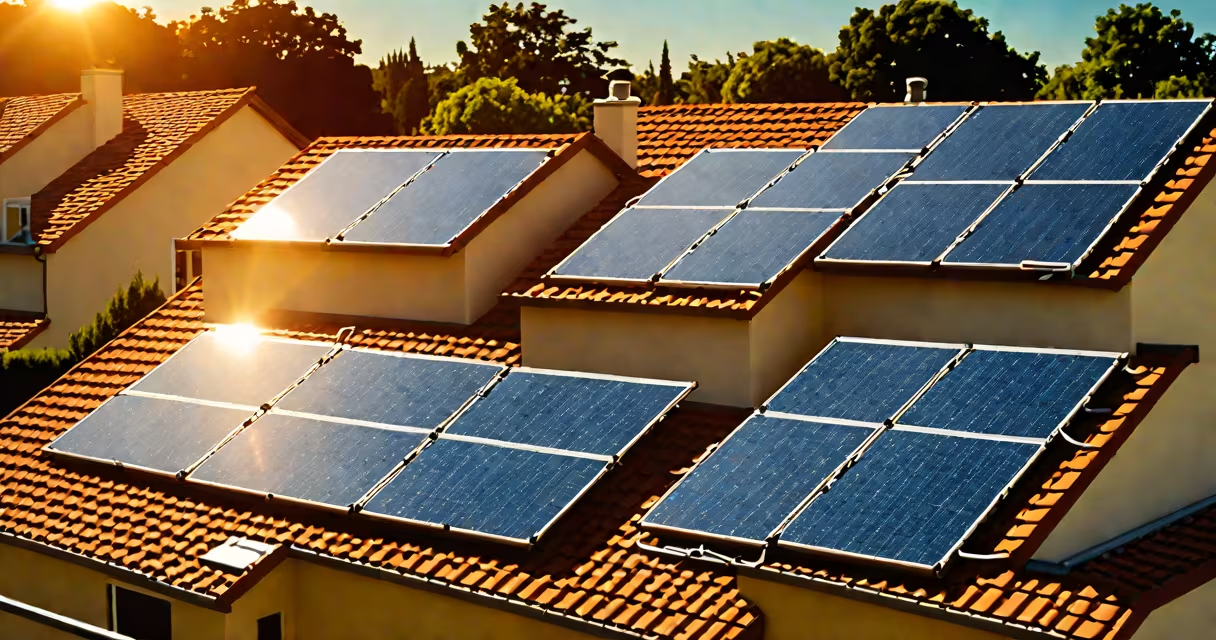
Installing solar panels on your home converts sunlight into electricity, reducing reliance on utility grids and lowering monthly energy bills. This process involves site assessment, equipment selection, permitting, and professional installation.
Solar power at home begins with photovoltaic (PV) panels mounted on rooftops or ground mounts. These panels absorb sunlight and convert it into direct current (DC) electricity. An inverter transforms DC into alternating current (AC), which powers household appliances. Excess energy can be stored in batteries or sent back to the grid through net metering.
The average U.S. homeowner installs a 6-kilowatt (kW) system, costing between $15,000 and $25,000 before incentives. After the federal Investment Tax Credit (ITC), which covers 30% of installation costs, out-of-pocket expenses drop to roughly $10,500 to $17,500. Systems typically pay for themselves within 8 to 12 years through energy savings.
When sunlight hits a solar panel's semiconductor material-usually silicon-electrons move, creating an electric current. Panels generate DC electricity, which flows to an inverter. The inverter converts DC to AC, matching the frequency and voltage used by homes and the grid.
During peak sun hours, excess electricity feeds into the grid via net metering. Utility companies credit homeowners for surplus power, reducing future bills. At night or during low production, homes draw from the grid, using accumulated credits.
For off-grid or backup power, battery storage systems like Tesla's Powerwall store energy. These require deeper system design and higher upfront costs but provide resilience during outages. Grid-tied systems without batteries remain the most common choice due to lower complexity and cost.
Residential solar systems fall into three main categories: grid-tied, hybrid (grid-tied with battery), and off-grid. Grid-tied systems connect to the utility network and are the most widely adopted. They offer immediate bill reduction and eligibility for net metering.
| System Type | Power Source | Battery Required? | Best For |
|---|---|---|---|
| Grid-tied | Sunlight + grid | No | Most homes; cost-effective |
| Hybrid | Sunlight + grid + battery | Yes | Areas with frequent outages |
| Off-grid | Sunlight + battery bank | Yes | Rural locations without grid access |
Key components include PV panels, inverters, racking systems, and monitoring software. Monocrystalline panels offer 20-23% efficiency and last 25+ years. Polycrystalline panels are less efficient but cheaper. Microinverters, installed per panel, improve performance in shaded areas compared to string inverters.
A 6-kW system typically uses 18-24 panels. Most installations require structural evaluation to confirm roof integrity. Local building codes and utility interconnection standards govern electrical safety and grid connection procedures.
Begin with a site assessment. A solar provider evaluates roof orientation, shading, and structural load. South-facing roofs with minimal shade yield optimal results. Tools like satellite imagery and drone scans help identify obstructions such as trees or chimneys.
Next, obtain permits from local authorities. The process takes 2-6 weeks depending on jurisdiction. Permits ensure compliance with the National Electrical Code (NEC) and local fire safety standards. Utility approval is required for grid interconnection.
Installation usually takes 1-3 days. Workers secure mounting rails, attach panels, wire components, and commission the system. Final inspection by city or county officials confirms safety and code adherence. Once approved, the utility activates net metering.
After activation, monitoring apps show daily production and consumption. A typical 6-kW system generates 7,200 kWh annually-enough to offset 80% of the average U.S. household's usage (10,600 kWh/year).
Many assume solar panels work only in sunny climates. But Germany, with less annual sunlight than Arizona, leads Europe in solar adoption. Modern panels generate usable power on cloudy days and at low light levels. Snow-covered panels still produce electricity when exposed to sunlight.
Another myth: solar systems require constant maintenance. In reality, panels need cleaning only every 1-2 years. Most manufacturers offer 25-year warranties on performance and materials. Inverter replacement occurs around year 15, often covered under extended service plans.
I once observed a 5-kW system in Portland, Oregon, producing 5,800 kWh in a year-despite 130 rainy days. The system met 75% of the home's needs. This illustrates that solar power at home remains viable in temperate regions.
Financing options include cash purchase, loans, leases, and power purchase agreements (PPAs). Cash buyers benefit from full tax credits and long-term savings. Loans allow ownership with monthly payments. Leases and PPAs require no upfront cost but limit savings and ownership rights.
Energy savings depend on local electricity rates. In California, where rates exceed $0.30/kWh, solar systems save $1,200 annually. In Texas, with rates near $0.12/kWh, savings are $480/year. The return on investment varies regionally.
After installation, monitor system output monthly. Track production against weather patterns and seasonal changes. Most systems maintain 80% efficiency after 25 years. Upgrades may include adding batteries or expanding capacity.
Research shows solar power at home reduces carbon emissions by 3-4 tons annually per 6-kW system. That's equivalent to removing two cars from the road each year. The U.S. Department of Energy reports that solar energy is now the cheapest electricity source in history, averaging $0.03/kWh in utility-scale projects.
Getting solar power at home requires planning, research, and coordination-but the long-term benefits in cost savings, energy independence, and environmental impact make it a practical choice for millions of households.