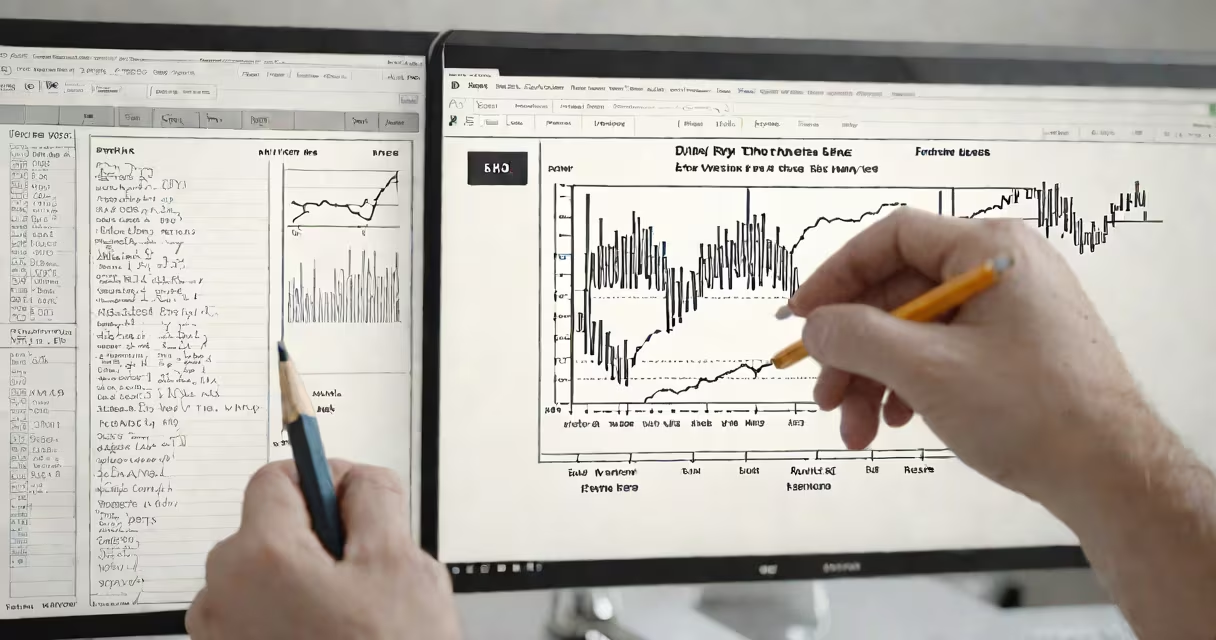
Day trading futures involves buying and selling derivative contracts for commodities, indices, or financial instruments within a single trading session to profit from short-term price movements. Traders close all positions before market close to avoid overnight risk.
Futures contracts are standardized agreements to buy or sell an underlying asset at a set price on a future date. Day traders enter and exit these contracts within hours, capitalizing on volatility and tight spreads. Unlike stocks, futures require margin accounts and are traded on regulated exchanges like CME Group or ICE.
Successful day trading requires discipline, real-time data access, and a clear strategy. Traders use technical analysis, order flow tools, and risk controls to manage exposure. A single misstep-like failing to place a stop-loss-can erase gains from multiple winning trades.
Futures contracts are traded on centralized exchanges. Each contract specifies the quantity, delivery month, and settlement method. For example, one E-mini S&P 500 futures contract (ES) represents $50 times the index value. If the S&P 500 is at 5,000, the contract is worth $250,000.
Day traders use use-typically 10:1 to 20:1-to control large positions with small capital. A $10,000 account can control a $200,000 position. This amplifies both profits and losses. A 1% move against the position results in a 10% loss of equity.
Execution happens through electronic platforms like NinjaTrader, Tradovate, or Interactive Brokers. Orders are routed to exchange matching engines. Market orders execute instantly at current prices; limit orders only fill at specified levels. Slippage-the difference between expected and actual execution price-can occur during high volatility.
Day traders rely on specific tools to make decisions. Real-time charts with volume profiles, order book depth, and time-and-sales data help identify momentum shifts. For example, a sudden spike in sell orders at a resistance level may signal a reversal.
Technical indicators such as moving averages, RSI, and Bollinger Bands are applied to 1-minute or 5-minute charts. A trader might enter a long position when the 9-period EMA crosses above the 21-period EMA on the ES contract, confirming upward momentum.
Effective risk management is non-negotiable. Most successful traders follow a 1% rule: no single trade risks more than 1% of the account balance. A $10,000 account limits each trade to $100 in potential loss. This prevents catastrophic drawdowns.
Traders choose contracts based on liquidity, volatility, and personal strategy. Major categories include:
| Type | Underlying Asset | Liquidity (Avg Daily Volume) | Typical Day Trade Range |
|---|---|---|---|
| Index | S&P 500 (ES) | ~300,000 contracts | ±0.5% per session |
| Commodity | Crude Oil (CL) | ~250,000 contracts | ±2% per session |
| Interest Rate | 10-Year Treasury Note (ZN) | ~150,000 contracts | ±0.25% per session |
| Foreign Exchange | Euro FX (6E) | ~80,000 contracts | ±0.75% per session |
High-volume contracts like ES and CL offer tight bid-ask spreads and minimal slippage. Low-volume contracts increase execution risk. For example, trading a less liquid agricultural contract like soybean meal (SM) can result in wider spreads and delayed fills.
On a typical trading day, the ES contract opens at 4,300.00. A trader using a 5-minute chart notices a bullish engulfing pattern after a pullback. The 9 EMA crosses above the 21 EMA. Entry: buy at 4,305.00 with a 10-point stop-loss (4,295.00).
The trade hits a 15-point gain (4,320.00) within 20 minutes. The trader exits early to lock in profit. Net gain: 15 points × $50 = $750. Risk: 10 points × $50 = $500. Profit-to-risk ratio: 1.5:1.
This trade aligns with a strategy focused on momentum and breakeven protection. The trader avoids holding past 3 PM Eastern, when volatility drops and spreads widen.
Day trading futures is often mistaken for swing trading or investing. Swing traders hold positions for days to weeks, relying on macroeconomic trends. Investors buy assets for long-term growth, ignoring daily noise.
Another confusion: futures trading vs. options trading. While both are derivatives, options give the right to buy or sell at a set price. Futures obligate the holder to take delivery unless closed out. Options have time decay; futures don't.
A critical distinction: day trading futures is not gambling. It requires measurable edge, consistent process, and continuous review. According to the CFTC, 80% of retail traders lose money in futures-often due to poor risk management, not market inefficiency.
I once entered a long position in crude oil (CL) futures during a news-driven rally. The price spiked on an unexpected OPEC+ production cut announcement. I bought at $75.20 with a 50-cent stop-loss.
Price moved quickly. I hit my stop-loss at $74.70. But the market reversed sharply, and the contract settled at $76.10. I lost $500 on a losing trade-but missed a $900 gain because I didn't adjust my stop.
That experience taught me: trailing stops are essential. Fixed stops fail during rapid moves. I now use changing stops based on ATR (Average True Range) to adapt to changing volatility.
Regulated brokers like Interactive Brokers, TD Ameritrade, and Tradier offer futures trading. Accounts require minimum capital-$25,000 for pattern day trading under FINRA rules. Traders must meet Know Your Customer (KYC) and anti-money laundering checks.
Platforms vary in functionality. NinjaTrader offers advanced charting and automated strategy testing. Interactive Brokers provides low fees and direct market access. Some platforms charge $1-$3 per contract for execution, which adds up quickly in high-frequency trading.
For beginners, paper trading is essential. Use simulated accounts to test strategies without risking capital. Many platforms offer free demo environments with real-time data.
Robinhood does not support futures trading. Its platform is limited to stocks, ETFs, and options. Futures require clearinghouse membership, margin rules, and regulatory oversight beyond Robinhood's scope.
Before placing your first trade: