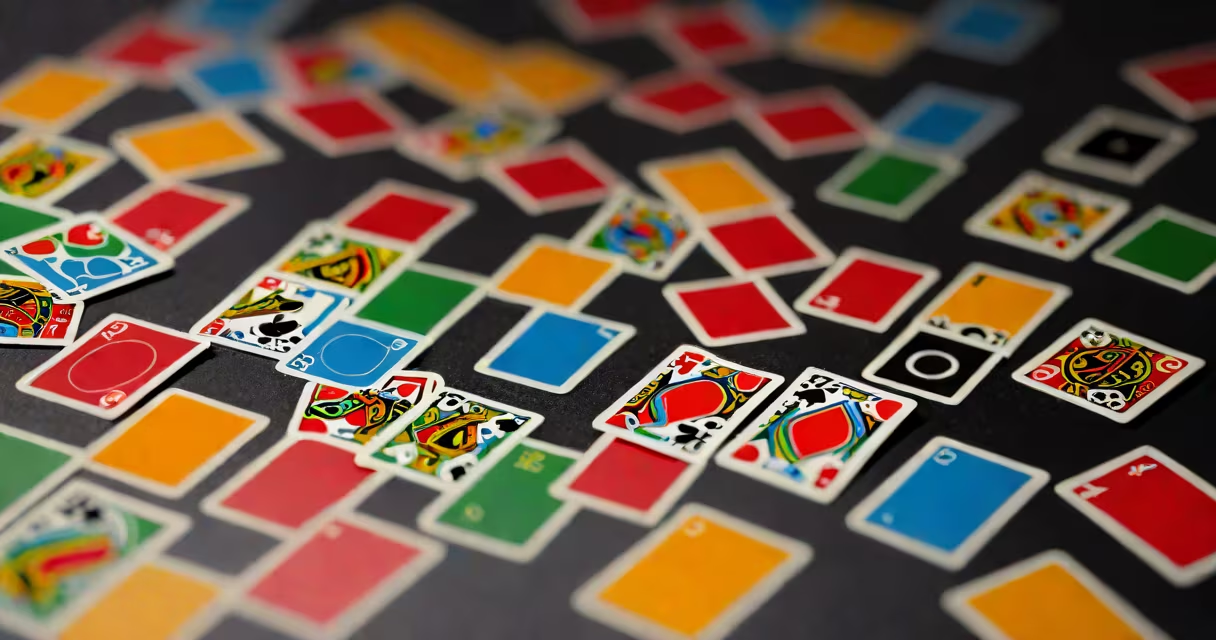
Uno is a shedding-type card game where players aim to get rid of all their cards before others by matching colors, numbers, or symbols. The game ends when one player plays their last card and shouts "Uno!"
Players take turns matching the top card of the discard pile by color, number, or symbol. If a player cannot match, they draw one card from the deck. Special action cards-Skip, Reverse, Draw Two, and Wilds-alter gameplay by changing direction, forcing opponents to draw, or allowing color changes.
The game begins with each player receiving seven cards. The top card from the deck is flipped face-up to start the discard pile. Players go clockwise unless a Reverse card changes direction. A player wins by playing their final card and announcing "Uno."
Uno operates on a simple rule set: match the top card's color, number, or symbol. If you have a matching card, you must play it. If you don't, you draw one card from the deck. If the drawn card is playable, you may play it immediately.
For example, if the discard pile shows a red 7, you can play any red card or any 7 regardless of color. You can also play a Wild card to change the color to whatever you choose.
If you're holding only one card, you must say "Uno" aloud. Failing to do so means you must draw two cards from the deck if caught. This rule prevents players from hiding their near-win status.
Uno uses 108 cards divided into four colors: red, blue, green, and yellow. Each color contains numbered cards (0-9), action cards (Skip, Reverse, Draw Two), and wild cards (Wild, Wild Draw Four).
| Card Type | Effect | Number per Color |
|---|---|---|
| Number Cards (0-9) | Match by number or color | 2 per number (except 0: 1 per color) |
| Skip | Next player loses a turn | 1 per color |
| Reverse | Reverses turn order | 1 per color |
| Draw Two | Next player draws two cards and skips their turn | 1 per color |
| Wild | Changes the current color to any chosen color | 4 total |
| Wild Draw Four | Changes color and forces next player to draw four cards | 4 total |
Wild Draw Four cards are the most useful. They allow you to change the color and force the next player to draw four cards. However, if challenged and proven to have a matching color card, the player who played it must draw four instead.
According to Hasbro, the official manufacturer, Wild Draw Four cards are subject to challenge in competitive play. A player can call out the move if they suspect the card was played illegally. If the challenger is correct, the original player draws four cards. If incorrect, the challenger draws six.
Many players assume that playing a Wild Draw Four card is always safe. It is not. If a player holds a card of the current color, they can challenge the Wild Draw Four. The challenge must happen immediately after the card is played.
Another common error is failing to say "Uno" when down to one card. If a player forgets and another player catches them, they must draw two cards. This rule applies even if the player says "Uno" later-it must be said before the next player acts.
A lesser-known rule: if a player draws a card that allows them to play immediately, they may do so. For example, drawing a red 7 while the discard pile is blue 3 lets you play the red 7 right away. This is often missed in casual games.
Start with four players: Alice, Bob, Carol, and Dave. Each gets seven cards. The top card is a blue 5.
This sequence shows how actions chain, colors shift, and timing matters. The game ends when a player empties their hand.
Uno is popular in homes, classrooms, and social gatherings. It teaches basic strategy, color recognition, and quick decision-making. The game lasts 10-20 minutes, making it ideal for short sessions.
According to the American Psychological Association, games like Uno improve executive function in children aged 6-12. The need to plan moves, anticipate opponents' actions, and manage risk supports cognitive development.
Uno is also used in team-building exercises. Companies report improved communication and cooperation during group play. The game's simplicity allows people of all ages and skill levels to participate equally.
Some believe that Wild Draw Four cards can be played anytime-even if you have a matching color card. This is false. The card can only be played if you have no cards of the current color. Playing it otherwise violates the rules.
Another myth is that the game ends immediately when someone plays their last card. It doesn't. The player must say "Uno" before the next player takes their turn. If they fail, they draw two cards.
Finally, many think that Reverse cards only reverse direction. They also reset the turn order. If the game is going clockwise and a Reverse is played, it becomes counterclockwise. The effect continues until another Reverse is played.
I once hosted a family game night where my nephew played a Wild Draw Four on a green 3. His cousin challenged him because he held a green 7. The challenge was valid-the nephew had to draw four cards. We paused to review the rule. After that, everyone remembered it better.