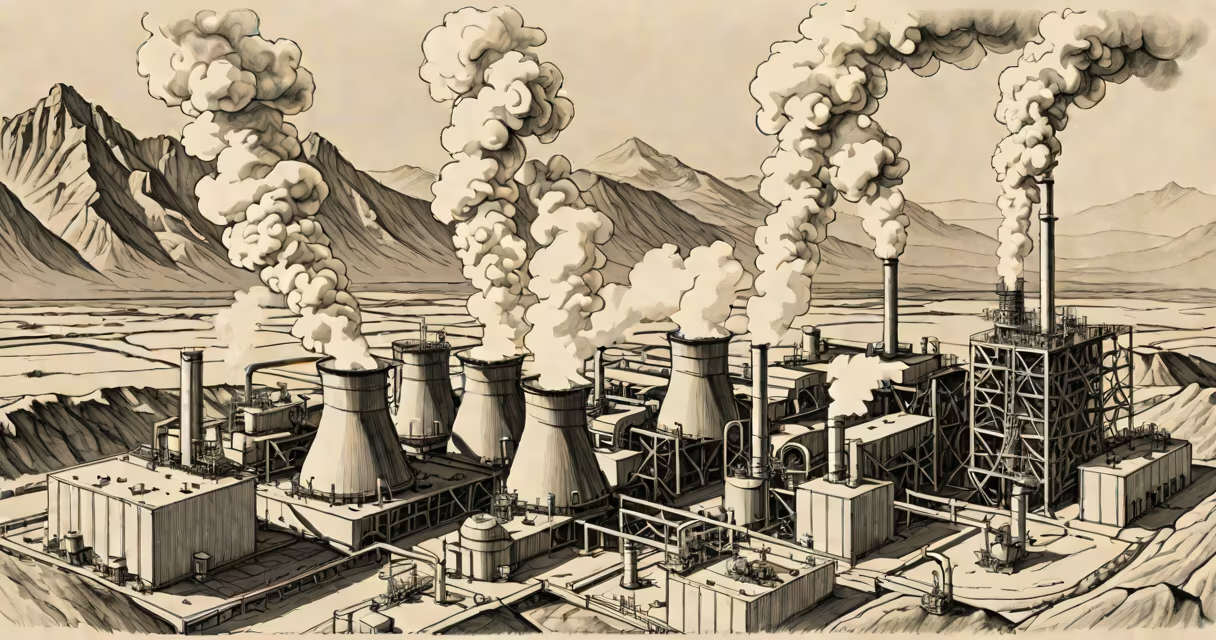
Geothermal plants produce electricity by using steam or hot water drawn from deep beneath the Earth's surface to spin turbines connected to generators. This process converts natural underground heat into usable electrical energy without burning fuel.
These plants rely on heat stored in rocks and fluids below the crust, typically found near tectonic plate boundaries or volcanic regions. The heat drives water into steam, which powers turbines. Unlike solar or wind, geothermal operates continuously, providing stable baseload power.
Most geothermal plants use either dry steam, flash steam, or binary cycle systems. Dry steam plants use natural steam from underground reservoirs. Flash steam plants pump high-pressure hot water into lower-pressure tanks, causing it to flash into steam. Binary cycle plants transfer heat from geothermal fluid to a secondary fluid with a lower boiling point, such as isobutane, which then vaporizes and spins the turbine.
Geothermal energy begins deep underground, where temperatures rise with depth due to radioactive decay in the mantle. In areas with high geothermal gradients-like the western United States, Iceland, or Indonesia-water seeps into fractured rock and heats up to form pressurized steam or hot water.
Wells drilled 1,000 to 3,000 meters deep access these reservoirs. The hot fluid flows upward through pipes due to pressure. In flash steam plants, the fluid enters a separator where pressure drops suddenly, turning liquid into steam. The steam travels to a turbine, spinning blades connected to a generator. After passing through the turbine, the steam cools and condenses into water, which is reinjected into the ground to maintain reservoir pressure.
Binary cycle plants don't release steam into the atmosphere. Instead, geothermal fluid transfers heat to a secondary working fluid with a boiling point below 100°C. This fluid vaporizes, drives the turbine, and is then cooled and recycled. This method allows operation at lower temperatures, expanding viable locations beyond high-heat zones.
Each system type suits different geological conditions and temperature ranges. The choice affects efficiency, environmental impact, and site selection.
| Type | Operating Temperature Range | How It Works | Example Location |
|---|---|---|---|
| Dry Steam | ≥180°C | Directly uses natural steam from underground reservoirs to turn turbines. | The Geysers, California (largest geothermal complex in the world) |
| Flash Steam | 180-370°C | Pumps high-pressure hot water into low-pressure chambers, causing flash evaporation into steam. | Many plants in Nevada and Italy's Larderello field |
| Binary Cycle | 57-180°C | Transfers heat from geothermal fluid to a secondary fluid (e.g., isobutane) that boils at low temperatures. | Idaho National Laboratory test site; growing use in Japan and Europe |
Flash steam plants dominate global capacity because they handle high-temperature resources efficiently. Binary cycle systems are increasingly common in moderate-temperature settings, offering lower emissions and reduced water loss.
Geothermal plants are most prevalent in regions with active tectonics. The Ring of Fire-stretching around the Pacific Ocean-hosts over 60% of the world's known geothermal resources. Countries like the U.S., Indonesia, the Philippines, and Kenya lead in installed capacity.
The U.S. has over 3.7 gigawatts (GW) of geothermal capacity, mostly in California and Nevada. The Geysers complex alone produces enough electricity for nearly 1 million homes. In Iceland, geothermal supplies 25% of national electricity and heats 90% of homes.
Unlike solar and wind, geothermal plants operate 24/7. A typical plant runs at 90% capacity factor-higher than coal (56%) and solar (25%). This reliability makes them ideal for replacing fossil-fuel baseload generation.
Many assume geothermal plants emit large amounts of greenhouse gases. In reality, their lifecycle emissions average 38 grams of CO₂ per kilowatt-hour-lower than natural gas (490 g/kWh) and comparable to wind (12 g/kWh).
Another myth is that geothermal plants require drilling deep wells everywhere. While drilling is necessary, modern directional drilling reduces surface disruption. Most plants cover less than 1 hectare per megawatt of capacity-smaller footprint than solar farms.
A lesser-known fact: reinjection of spent fluid maintains reservoir pressure and prevents land subsidence. At The Geysers, reinjection since the 1980s reversed declining steam production and stabilized output.
The Geysers, located in Sonoma County, began operations in 1960. It's the largest geothermal field in the world, with 22 power plants generating 725 megawatts (MW) of electricity.
Initially, steam was extracted directly from natural reservoirs. By the 1980s, steam pressure dropped. Operators responded by injecting treated wastewater from nearby cities into the ground. This replenished the reservoir and restored steam flow.
Today, the system injects over 100 million gallons of water annually. The result: stable output despite decades of operation. The Geysers now supply power to over 700,000 homes and reduce regional carbon emissions by 1.5 million tons yearly.
When I visited the site in 2022, the sight of steam venting from hundreds of pipes under a clear blue sky underscored how quietly efficient this technology is. No flames, no noise-just continuous, clean power.
While both are renewable, geothermal and solar differ in consistency and land use. Solar panels generate power only during daylight hours and depend on weather. Geothermal plants run continuously, regardless of time or season.
Solar farms require large land areas-about 5 acres per megawatt. Geothermal plants use far less space. A 100 MW geothermal plant may occupy just 10-15 acres, including well pads and infrastructure.
Geothermal plants work by converting Earth's internal heat into electricity through steam or fluid-driven turbines. They offer consistent, low-emission power with minimal land use. Their long-term viability depends on responsible resource management and reinjection practices.
With global demand for clean baseload energy rising, geothermal represents a proven, scalable solution. As technology improves-especially in enhanced geothermal systems (EGS)-its reach could expand beyond tectonic zones into regions previously deemed unsuitable.