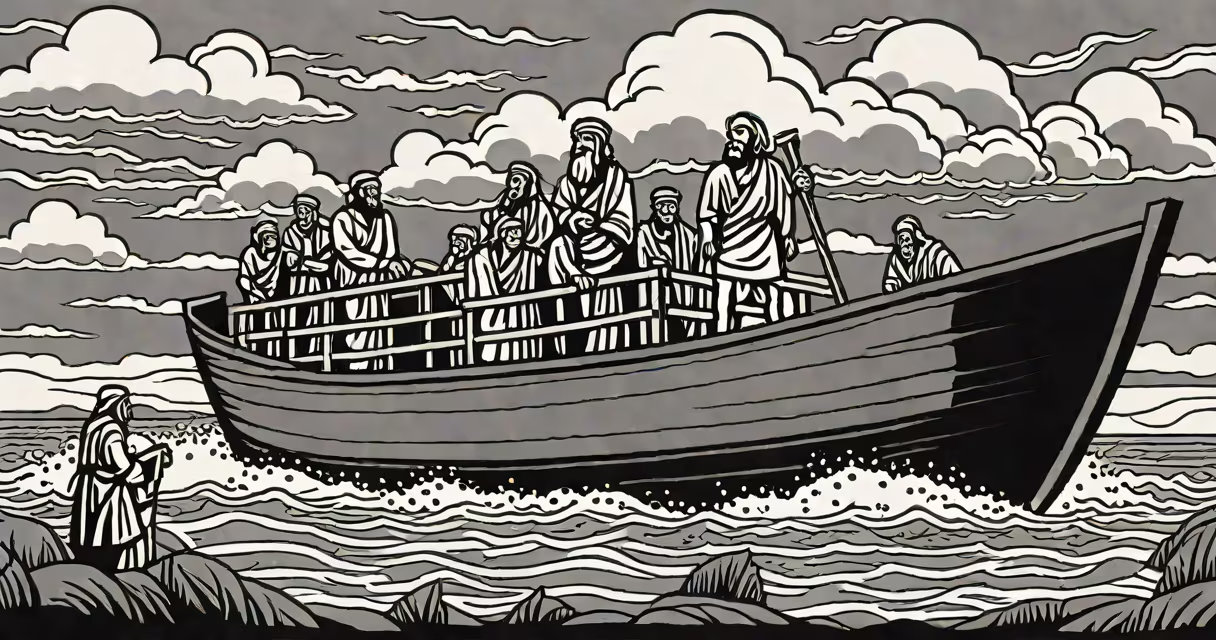
Hebrews 11:7 meaning describes how Noah, warned by God about a flood he had not yet seen, acted in faith by constructing an ark to save his family, proving that true faith leads to obedient action.
The verse appears in the New Proof's "Hall of Faith" passage, where the author uses historical figures to illustrate the nature of faith. Noah is presented not as a man of supernatural strength or political power, but as someone who trusted God's word despite no visible evidence of danger. His actions were not based on immediate proof, but on belief in a promise he had not witnessed.
According to the NIV translation, "By faith Noah, when warned about things not yet seen, in holy fear built an ark to save his family." This sentence captures the core of Hebrews 11:7: faith precedes sight. The warning came from God, not from observable weather patterns or scientific data. Yet Noah responded with deliberate, costly labor-building a vessel large enough to hold animals and his household, likely over many years.
Hebrews 11 is a chapter dedicated to defining faith as "confidence in what we hope for and assurance about what we do not see" (Hebrews 11:1, NIV). Verse 7 is the first example in a sequence that includes Abraham, Moses, and others whose lives were shaped by trust in God's unseen promises.
Noah's story is rooted in Genesis 6-9. God told Noah that He would destroy the earth with a flood because of human wickedness. The text says God instructed Noah to build an ark out of gopher wood, with specific dimensions: 300 cubits long, 50 cubits wide, and 30 cubits high (Genesis 6:14). That's roughly 450 feet long-larger than most ships of the ancient world.
Building such a structure in a time without industrial tools required immense effort. Noah didn't have blueprints or precedent. He had only God's command. His faith wasn't passive-it demanded physical labor, financial sacrifice, and social isolation. Neighbors likely mocked him as a fool for constructing a boat in a dry land.
Hebrews 11:7 meaning centers on three components: divine warning, personal obedience, and future protection. These elements form a pattern seen throughout Scripture.
This sequence-warning, action, salvation-is repeated in later biblical narratives. For example, Abraham left his homeland without knowing his destination (Hebrews 11:8), and Moses chose to suffer with God's people rather than enjoy the pleasures of Egypt (Hebrews 11:25).
Many assume Noah's faith was simply about believing in a flood. But the deeper meaning lies in the cost of obedience. Faith in Hebrews 11 is not passive acceptance-it demands transformation.
A common error is equating faith with emotional certainty. But Hebrews 11:7 shows that faith is demonstrated through behavior. Noah did not feel safe while building the ark. He had no guarantee the flood would come. Yet he continued.
Another misconception is that Noah's righteousness came from being perfect. The Bible says he was "blameless among the people of his time" (Genesis 6:9, NIV), but that doesn't mean sinless. His faith was not earned by perfection-it was expressed through action.
For example, the book of Ezekiel calls Noah a "righteous man" who saved himself by his righteousness (Ezekiel 14:14). But the focus in Hebrews is not on Noah's moral standing-it's on his response to God's word.
Assuming Noah was 500 years old when God gave him the command (Genesis 5:32), and the flood occurred when he was 600 (Genesis 7:6), he had 100 years to prepare. That timeline suggests the ark was not built overnight.
Using average construction rates from ancient Mesopotamia, building a 450-foot vessel would take approximately 15-20 years with a team of 50 workers. This means Noah spent decades working on the project, facing ridicule, enduring skepticism, and managing resources.
His faith wasn't a single decision-it was sustained over time. The act of building became a daily testimony to God's authority. As Hebrews 11:7 states, "By faith Noah... built an ark to save his family." The verb "built" is in the past tense, indicating completion-but the process was ongoing.
Hebrews 11:7 meaning applies beyond ancient history. It challenges modern readers to ask: What am I building in faith? Not necessarily a literal boat, but commitments-relationships, careers, spiritual disciplines-that require patience and trust.
For example, someone might be called to start a nonprofit in a community with little support. They may lack funding, volunteers, or public recognition. But if they act on a vision they believe God has given them, they are living out Noah's model.
Even small acts of obedience-showing up for a difficult conversation, forgiving someone who hurt you, giving money to a cause you don't fully understand-reflect the same spirit. Faith is not about certainty. It's about responding to a call, even when the outcome is unknown.
As the author of Hebrews writes, "Without faith it is impossible to please God, because anyone who comes to him must believe that he exists and that he rewards those who earnestly seek him" (Hebrews 11:6, NIV).
Understanding Hebrews 11:7 meaning helps clarify that faith is not a feeling. It's a choice to act on what you believe-even when the world sees it as foolish.
When we consider "as was meaning," we recognize that the past is not just history-it's a mirror. Noah's life wasn't recorded to glorify him. It was preserved so we could learn how to live by faith.