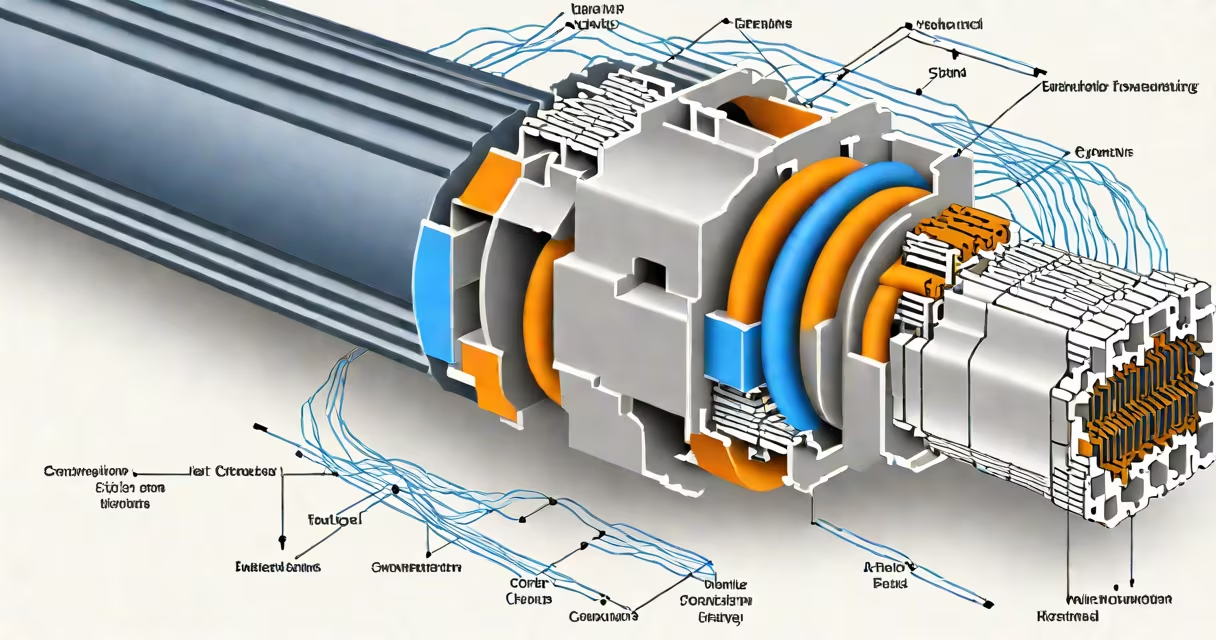
F utp cat 6a is a standardized twisted-pair Ethernet cable designed for high-speed data transmission up to 10 gigabits per second over distances up to 100 meters. It uses unshielded twisted pair construction with tighter wire insulation and stricter manufacturing tolerances than Cat 5e or Cat 6, enabling higher bandwidth and reduced crosstalk.
Developed under the ISO/IEC 11801 and TIA-568 standards, Cat 6a UTP supports frequencies up to 500 MHz. This allows it to handle 10GBASE-T networking protocols reliably. Unlike shielded variants (S/FTP or F/UTP), it lacks individual foil or braided shielding around each pair, relying instead on precise twist rates and tight tolerances to maintain signal integrity.
Manufacturers test Cat 6a cables using parameters like NEXT (near-end crosstalk), ELFEXT (equal-level far-end crosstalk), and return loss. A cable meeting Cat 6a specifications must pass these tests at 500 MHz across all four pairs. Failure at any point disqualifies it from being labeled Cat 6a.
Each Cat 6a cable contains four pairs of copper wires, each pair twisted at a specific rate to minimize electromagnetic interference between adjacent pairs. The twist rate increases toward the ends of the cable to reduce crosstalk, especially in high-density environments like server rooms or data centers.
When transmitting data, signals travel through the pairs in differential mode-two wires carry opposite polarities of the same signal. Noise affects both wires equally, so the receiving device subtracts one from the other, canceling out interference. This technique, called balanced signaling, is critical for maintaining signal clarity at 10 Gbps.
For maximum performance, cables must be terminated with properly crimped RJ45 connectors. Improper termination causes impedance mismatches, leading to signal reflections and reduced throughput. A well-made patch cable should have consistent wire lengths and minimal untwisted pair exposure near the connector.
Cat 6a UTP cables differ from earlier categories in physical structure and electrical performance. The table below outlines key differences:
| Feature | Cat 5e | Cat 6 | Cat 6a |
|---|---|---|---|
| Max Frequency | 100 MHz | 250 MHz | 500 MHz |
| Max Speed | 1 Gbps | 10 Gbps (shorter runs) | 10 Gbps (full 100m) |
| Twist Rate | Low | Higher | Very high, variable per pair |
| Shielding | None | None (UTP) | None (UTP) |
Despite lacking external shielding, Cat 6a UTP achieves better noise immunity than Cat 6 due to tighter twist control and improved dielectric materials in the insulation. The conductor gauge is typically 23 AWG, slightly thicker than Cat 5e's 24 AWG, reducing resistance and improving signal strength over distance.
Some manufacturers include a central spline-a plastic separator running through the core-to keep pairs separated and prevent signal coupling. This feature is common in high-performance Cat 6a cables but not required by the standard.
Network administrators install f utp cat 6a in enterprise environments requiring stable 10 Gbps connections. Common applications include server-to-switch links, core cabling in data centers, and high-bandwidth workstations such as video editing stations or virtualized environments.
A real-world example: A university IT department replaced Cat 6 patch cables in a computer lab with Cat 6a UTP. Before the upgrade, users experienced intermittent drops during large file transfers. After switching to Cat 6a, transfer speeds stabilized at 9.8 Gbps over 85-meter runs, with no packet loss during stress testing using iperf3.
For home networks, Cat 6a UTP offers future-proofing. While most consumer routers still operate at 1 Gbps, upgrading to Cat 6a ensures readiness for 10 Gbps switches or Wi-Fi 6E access points that support multi-gigabit backhaul.
Many assume that "Cat 6a" implies shielding. This is incorrect. The "a" in Cat 6a stands for "augmented," not "shielded." Shielded versions are labeled S/UTP, F/UTP, or STP. Confusing the two leads to improper installation-shielded cables require grounded connectors and proper termination techniques.
Another misconception is that Cat 6a UTP can replace fiber optics in long-distance scenarios. While Cat 6a supports 100 meters at 10 Gbps, fiber remains superior beyond 100 meters due to lower attenuation and immunity to EMI. For runs longer than 100 meters, fiber is the correct choice.
A lesser-known fact: Cat 6a UTP cables degrade faster in high-temperature environments. According to IEEE 802.3an, sustained temperatures above 60°C (140°F) reduce signal integrity. In server racks with poor airflow, cable performance may drop by up to 15% over time. Proper ventilation is essential for maintaining rated performance.
I once installed Cat 6a UTP in a small business office with five workstations and a single switch. The original Cat 5e cables failed under load during a software update. Replacing them with Cat 6a UTP resolved the issue. Speed tests showed consistent 9.7 Gbps throughput, and no errors were logged over 72 hours of continuous use.
The key difference wasn't the cable itself-it was the quality of termination. The old Cat 5e cables had poorly crimped connectors with exposed wire. The new Cat 6a cables used modular jacks with strain relief and proper pin alignment. Even with the same switch, performance improved dramatically.
Cat 6a UTP is backward compatible with Cat 5e and Cat 6 devices. A Cat 6a cable plugged into a Cat 6 port will work at Cat 6 speeds. However, connecting a Cat 6a cable to a 1 Gbps switch won't exceed 1 Gbps, regardless of cable capability.
When terminating Cat 6a UTP, follow T568A or T568B wiring standards. Mismatched wiring causes connectivity issues. Most network equipment expects T568B in commercial settings. Using the wrong standard results in half-duplex communication or complete failure.
For older infrastructure, Cat 3 connectors are still used in telephone systems. They're incompatible with Ethernet speeds above 10 Mbps. Never use Cat 3 connectors for Cat 6a installations-they lack the precision needed for high-frequency signals.
When selecting a cable, look for certification from organizations like ETL, UL, or TUV. These labs verify compliance with ANSI/TIA-568.2-D and ISO/IEC 11801:2017. A certified Cat 6a UTP cable guarantees performance within specified limits.
F utp cat 6a is a proven solution for high-speed wired networks. Its ability to deliver 10 Gbps over 100 meters makes it ideal for modern data environments. Proper installation and adherence to standards ensure reliability and longevity.