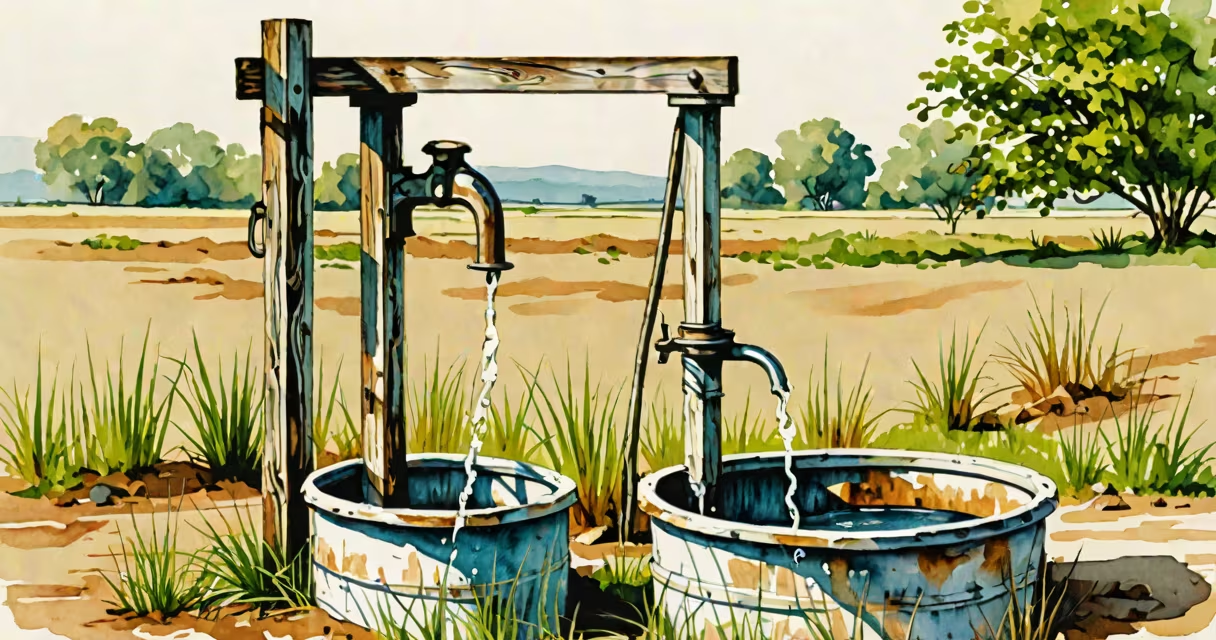
Well water is untreated groundwater extracted from beneath the Earth's surface through a drilled or dug borehole, typically used for domestic drinking, cooking, and household purposes in areas without public water systems.
Unlike municipal water supplied by cities, well water originates from aquifers-porous rock layers or soil formations that store and transmit water. These aquifers recharge slowly through rainfall and snowmelt, making their water quality highly sensitive to nearby land use and geology.
According to the U.S. Environmental Protection Agency (EPA), approximately 15 million Americans rely on private wells for drinking water, with nearly half of those wells located in rural or remote regions. This makes understanding well water critical for health and safety.
Water enters a well through fractures or permeable layers in bedrock or sediment. A pump installed at the bottom lifts the water to the surface, where it flows into a home's plumbing system. The process begins when precipitation seeps into the ground and moves downward until it reaches the saturated zone-the water table.
Once the water reaches the well screen-a perforated pipe placed at the aquifer level-it is drawn upward by a submersible or jet pump. The pump's power determines how quickly water is delivered, with typical residential systems producing between 5 and 20 gallons per minute.
For example, a family in rural Pennsylvania relying on a 200-foot-deep well reported a consistent flow rate of 12 gpm, sufficient for daily household needs including showers, laundry, and dishwashing. However, flow rates drop during droughts due to declining water tables.
Well water contains dissolved minerals such as calcium, magnesium, iron, and manganese. While some minerals support human health, excessive levels can cause scaling in pipes, staining of fixtures, and unpleasant taste or odor.
More concerning are microbial and chemical contaminants. Coliform bacteria, including E. coli, indicate fecal pollution and can originate from failing septic systems, animal waste runoff, or poor well construction. The CDC reports that 1 in 10 private wells tested in the U.S. shows bacterial contamination, often linked to seasonal storms or flooding.
Nitrates are another major concern. High nitrate levels in well water-above 10 mg/L-pose serious health risks, especially for infants under six months. Nitrate exposure can lead to methemoglobinemia, or "blue baby syndrome," which reduces oxygen transport in blood. The EPA sets the maximum contaminant level (MCL) for nitrates at 10 parts per million (ppm).
| Contaminant | Source | EPA MCL (ppm) | Risk Level |
|---|---|---|---|
| Nitrates | Fertilizers, septic systems | 10 | High for infants |
| Coliform bacteria | Animal waste, poor well seal | 0 (not allowed) | Immediate health threat |
| Lead | Pipes, solder, old plumbing | 15 | Neurotoxic, especially in children |
| Arsenic | Natural deposits, industrial runoff | 10 | Cancer risk with long-term exposure |
A non-obvious fact: well water can change composition seasonally. During heavy spring rains, nitrate concentrations often spike due to fertilizer leaching. In dry summers, water hardness increases as mineral concentration rises from reduced dilution.
Many assume well water is "natural" and therefore safe. But nature doesn't filter pollutants. A well in a farming region may appear pristine but carry high nitrate levels from nitrogen-based fertilizers applied upstream.
Another misconception is that deep wells are inherently safer. While deeper aquifers are less likely to be affected by surface runoff, they can still be contaminated by geological faults or leaking underground storage tanks. A 2021 study in *Environmental Science & Technology* found that 12% of deep wells in agricultural zones exceeded nitrate standards due to lateral migration through fractured bedrock.
Some confuse well water with spring water. Spring water emerges naturally at the surface from an underground source and is often bottled. Well water is extracted via mechanical pumping and requires regular maintenance and monitoring.
Annual testing is recommended for all private wells. The National Ground Water Association (NGWA) advises testing for coliform bacteria, nitrates, pH, hardness, and arsenic. More complete tests include metals, volatile organic compounds (VOCs), and radionuclides.
I once tested my own well after noticing a metallic taste and yellowish tint in the water. Lab results showed iron levels at 1.8 ppm (above the EPA limit of 0.3 ppm) and nitrates at 14 ppm. After installing a reverse osmosis system and aeration filter, both values dropped to acceptable levels within two weeks.
Proper well construction prevents contamination. Wells should have a minimum 3-foot cap above ground, sealed casing, and a concrete apron sloped away from the structure. The EPA notes that 30% of well failures stem from inadequate sealing, allowing surface water to infiltrate the aquifer.
Well water is groundwater drawn from underground sources through private wells. It is not automatically safe and requires regular testing for bacteria, nitrates, and other contaminants. Understanding its risks ensures long-term safety for households relying on it.