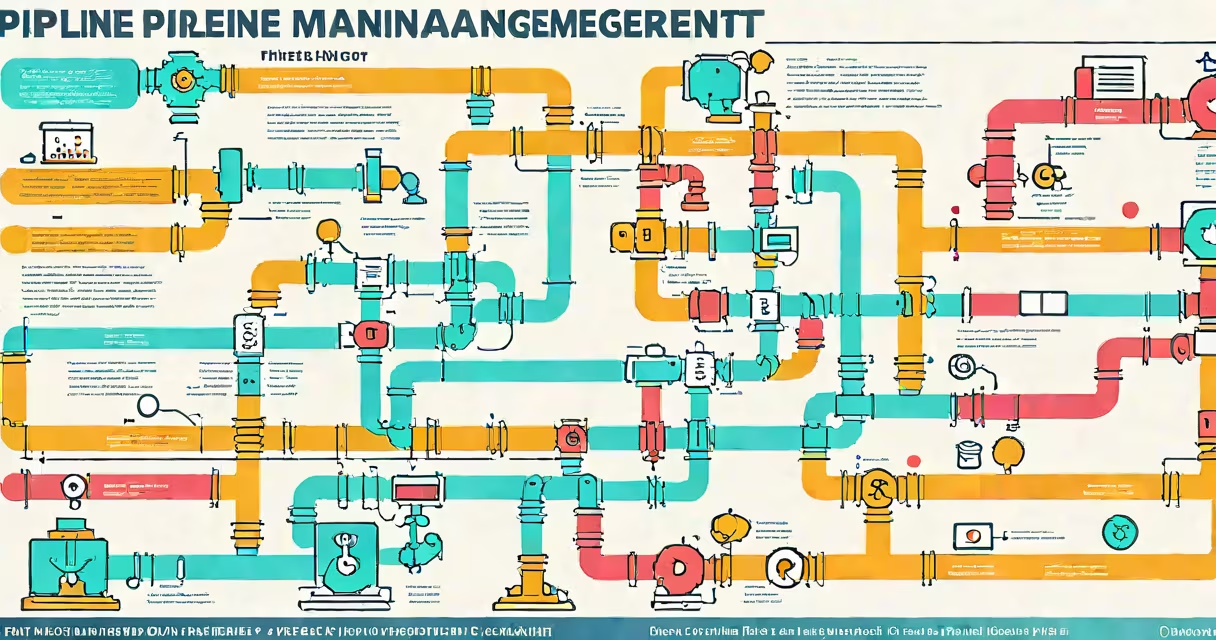
Pipeline management is the systematic oversight of a sequence of automated or semi-automated steps that move work-from idea to delivery-through defined stages. It ensures consistent execution, identifies bottlenecks, and enables teams to monitor progress, reduce errors, and improve throughput across software development, manufacturing, or business processes.
At its core, pipeline management applies structure to workflows that would otherwise operate in isolation. It defines the path work takes, assigns responsibility at each stage, and tracks outcomes. This approach prevents tasks from getting stuck, misrouted, or lost in transit-common issues in unmanaged processes.
For example, in software engineering, a pipeline manages code commits through testing, staging, and deployment. In construction, it tracks permits, material delivery, labor scheduling, and inspections. In both cases, the goal is to eliminate ambiguity and ensure predictable results.
Each pipeline begins with a trigger-such as a code push, a customer request, or a scheduled task. From there, work flows through predefined stages, often automated using tools like Jenkins, GitHub Actions, or Airflow. At each stage, conditions are checked: Does the test pass? Is approval received? Is inventory available?
If a condition fails, the pipeline halts and alerts the responsible team. This stops flawed outputs from advancing. For instance, if a software build fails unit tests, the pipeline stops before deployment, preventing bugs from reaching users. This is known as continuous integration/continuous delivery (CI/CD).
When successful, the pipeline advances the work and logs the outcome. These logs provide audit trails, which are essential for compliance and troubleshooting. A failed deployment in production can be traced back to the exact commit and stage where it broke-reducing mean time to resolution (MTTR).
Pipeline management systems rely on four foundational elements: triggers, stages, gates, and monitoring. Triggers initiate the flow. Stages represent distinct phases (e.g., build, test, deploy). Gates enforce decisions-like requiring a manager's sign-off before release. Monitoring tracks performance metrics such as cycle time, failure rate, and throughput.
There are three primary types of pipelines based on function:
| Type | Use Case | Example Tools | Real-World Output |
|---|---|---|---|
| Software CI/CD | Automated code deployment | Jenkins, GitLab CI, CircleCI | Code changes go live in under 10 minutes after review |
| Business process | Order fulfillment, HR onboarding | Workday, Zapier, ServiceNow | New employee access granted within 3 hours of hire |
| Data processing | ETL workflows, analytics reporting | Airflow, AWS Glue, dbt | Daily sales reports generated automatically at 6 AM |
One non-obvious distinction: not all pipelines require automation. A manual pipeline-such as a hiring approval chain involving multiple stakeholders-still benefits from pipeline management. The difference lies in visibility and accountability. Even if humans perform steps, documented stages prevent delays and clarify ownership.
Many assume pipeline management is only for tech teams. That's incorrect. A marketing team running a campaign launch-where creative assets, approvals, budget allocation, and channel deployment must align-also uses pipeline principles. The absence of code doesn't negate the need for structure.
Another misconception: pipelines are rigid. In reality, they're designed to adapt. A software team may have a five-stage pipeline during peak release cycles but collapse it to three stages during maintenance windows. Flexibility is built into most modern pipeline tools via changing configuration.
Some confuse pipeline management with project management. They're related but distinct. Project management focuses on scope, timeline, and resource planning across a single initiative. Pipeline management oversees recurring workflows across many projects. For example, a company may run 50 software releases per month-each managed as a project-but the deployment process itself is governed by a single, unified pipeline.
In my experience, a retail client reduced order fulfillment time by 40% after implementing a pipeline for their returns process. Before, returns were handled manually-each case logged in spreadsheets, routed via email, and delayed by unclear handoffs. After defining stages (receive, inspect, refund, update inventory), assigning owners, and setting automated reminders, the average return was processed in 24 hours instead of 7 days.
The tool they used wasn't complex-just a shared spreadsheet with conditional formatting and notifications. But the act of defining the pipeline made responsibilities clear. Team members knew when to act. Managers saw where delays occurred. The result wasn't just speed-it was fewer errors and higher customer satisfaction.
This mirrors findings from the Project Management Institute (PMI), which reports that organizations using structured workflow systems see a 30% improvement in operational efficiency. Similarly, McKinsey & Company notes that companies with standardized process pipelines achieve faster time-to-market, especially in regulated industries like healthcare and finance.
Define pipeline management as a discipline-not just a tool. It's about creating clarity in complexity, ensuring that every step matters, and that progress is visible, measurable, and accountable.