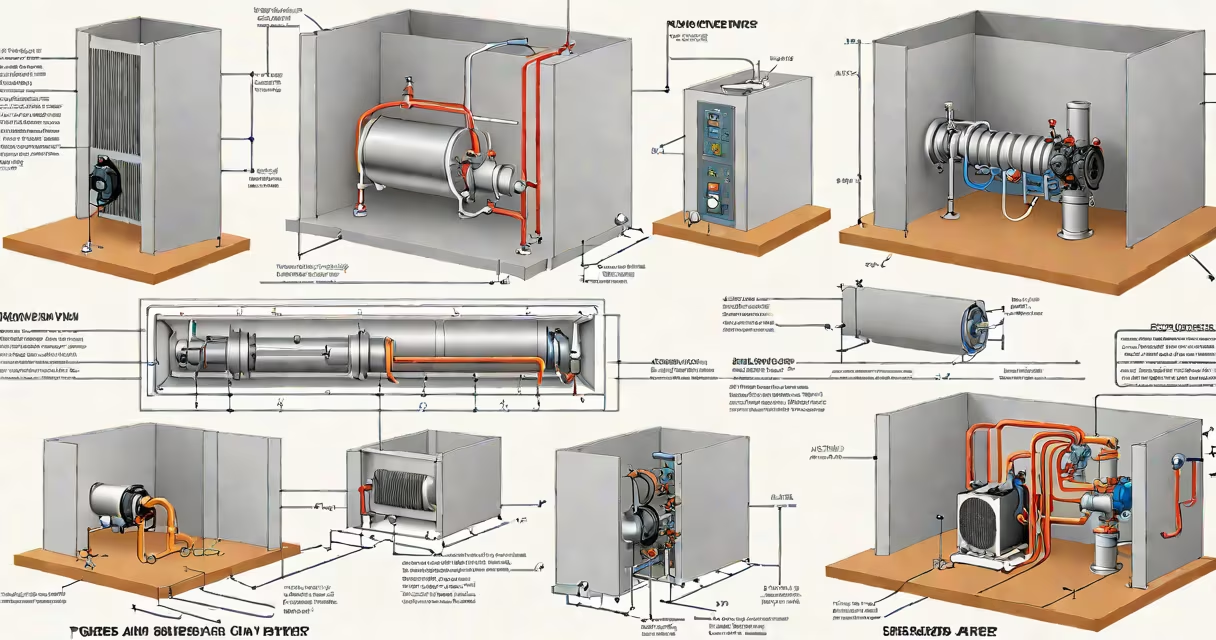
Baseboard heat uses electric resistance elements in metal casings along walls to warm rooms directly, while forced air systems distribute heated air through ducts using a furnace or heat pump. Baseboard heat delivers warmth locally; forced air heats entire homes uniformly via centralized distribution.
Baseboard heat operates by passing electricity through resistive wires inside metal fins. As current flows, the wires heat up and transfer thermal energy to the surrounding air. This warm air rises, creating convection currents that gradually raise room temperature. Units are installed along interior walls, typically under windows, where cold drafts enter. They activate independently per zone, allowing individual room control.
Forced air systems rely on a central furnace or heat pump to generate warm air, which then travels through a network of ducts. A blower fan pushes the heated air into supply vents located in floors, ceilings, or walls. Return grilles pull cooler air back to the furnace to be reheated. This cycle continues until the thermostat reaches the set temperature. Because the system centralizes heating, it can maintain consistent temperatures across multiple rooms.
Baseboard heaters draw power directly from household circuits. Most models run on 120V or 240V electricity. When the thermostat detects a drop below the set point, it completes the circuit, activating the heating element. The process is silent and requires no moving parts. However, because each unit runs independently, multiple thermostats are needed for multi-room control.
Forced air systems integrate with a central furnace or heat pump. Gas furnaces burn fuel to heat a metal heat exchanger, which warms incoming air. Electric furnaces use resistance coils. Heat pumps reverse refrigeration cycles to extract heat from outdoor air-even in winter-and transfer it indoors. Once warmed, air moves through insulated ducts at high velocity. The blower motor ensures rapid distribution, often raising indoor temperature within 10 minutes of startup.
A single forced air system can manage an entire house with one thermostat. Zone control requires additional dampers and thermostats, adding complexity and cost. Baseboard systems offer simpler zoning but require more electrical capacity and higher utility bills during prolonged use.
| Feature | Baseboard Heat | Forced Air |
|---|---|---|
| Heat Source | Electric resistance | Gas, electric, or heat pump |
| Distribution Method | Convection (natural airflow) | Fan-driven ducts |
| Thermostat Control | Per room (individual) | Central (whole-home) |
| Installation Cost | Low ($100-$200 per unit) | High ($5,000-$12,000 average) |
| Operating Cost (per hour) | $0.15-$0.30 (electricity) | $0.08-$0.20 (gas); $0.10-$0.25 (electric) |
Electric baseboard heaters come in standard and low-profile models. Some include built-in fans to speed up convection. Others feature adjustable covers to regulate airflow. High-end versions include smart thermostats and remote monitoring. All operate at 100% efficiency-every watt of electricity becomes heat-but they do not produce cooling.
Forced air systems vary by fuel type. Gas furnaces achieve 80-98% AFUE (Annual Fuel Utilization Efficiency), meaning 80-98% of fuel energy becomes usable heat. Electric furnaces are 100% efficient but cost more per unit of heat. Heat pumps can deliver 200-300% efficiency by moving heat rather than generating it. They work well in moderate climates but struggle below 20°F (-6°C).
Modern systems include variable-speed blowers, programmable thermostats, and filters that capture allergens. Ductwork must be sealed and insulated to prevent heat loss. Poorly maintained ducts can reduce efficiency by up to 30%, according to the U.S. Department of Energy.
Baseboard heat remains common in older apartments and rental units, especially in colder regions like New England and the Midwest. Its simplicity makes it ideal for retrofits. Landlords favor it because it's easy to install and maintain. Tenants benefit from localized control-turning off heat in unused rooms reduces costs.
Forced air dominates new construction and suburban homes. It supports integrated cooling via central AC, which baseboard systems cannot provide. Homeowners value uniform comfort and quiet operation. In humid climates, forced air systems dehumidify indoor air during cooling cycles, reducing mold risk.
Consider climate. In places like Minneapolis, where winter averages dip below -10°F (-23°C), gas-powered forced air systems outperform electric baseboard heaters in both cost and reliability. A 2023 study by the National Renewable Energy Laboratory found that homes using gas furnaces spent 40% less on heating than those relying solely on electric baseboard units.
Energy usage differs. A typical 1,500-watt baseboard heater running 8 hours daily consumes 12 kWh per day. At $0.18/kWh, that's $2.16/day or $64.80/month. A gas furnace with 90% AFUE heating a 2,000 sq ft home uses about 50,000 BTU/hour. At $1.20 per therm (100,000 BTU), monthly costs average $45-$60 depending on insulation and weather.
Many assume baseboard heat is cheaper to run. That's false in most cases. While baseboard units cost less upfront, their operating expenses exceed those of gas-powered forced air systems. Electricity prices are roughly three times higher per BTU than natural gas, according to the U.S. Energy Information Administration.
Another misconception: forced air systems are noisy. Modern units with variable-speed blowers and sound-dampened housings operate quietly. Noise levels average 40-50 dB, comparable to a library. Older models may be louder, but upgrades reduce noise by 50% or more.
Some believe baseboard heat warms rooms faster. In reality, forced air systems reach target temperatures quicker due to higher airflow volume. A test by Consumer Reports showed a forced air system raised room temperature from 65°F to 72°F in 8 minutes. Baseboard heaters took 22 minutes for the same change.
I once replaced baseboard heaters in a 1970s apartment with a mini-split heat pump system. The original electric baseboards consumed $180/month in winter. After switching to a ductless heat pump with a 3.5 SEER rating, monthly costs dropped to $75. The system also cooled the apartment in summer-a feature baseboard units lack.
Baseboard heat provides targeted warmth with minimal installation effort but high long-term energy costs. Forced air systems offer whole-home comfort, better efficiency with gas or heat pumps, and integration with cooling. Choose based on climate, budget, and whether you want cooling capability.