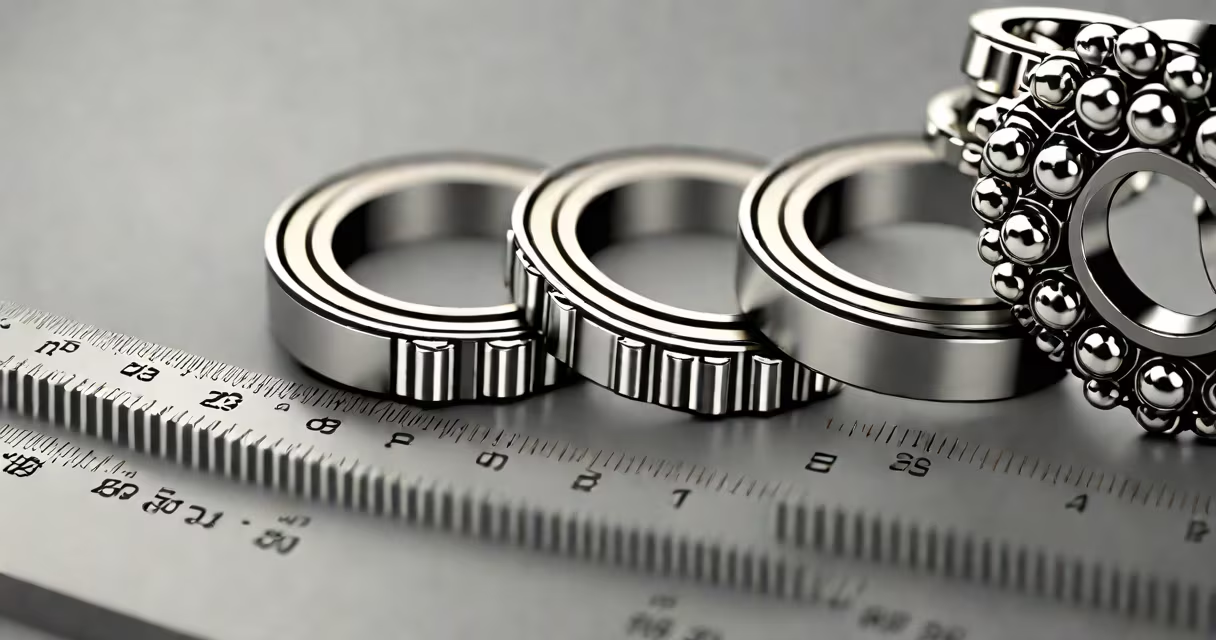
A ball bearing size chart is a reference tool that lists standardized dimensions-inner diameter, outer diameter, and width-for ball bearings used in machinery and mechanical systems. These charts ensure accurate selection and replacement of bearings across industries like automotive, manufacturing, and robotics.
Ball bearings reduce friction between rotating parts by using small steel balls that roll between two concentric rings. The size chart defines the exact physical parameters needed to fit a bearing into a shaft or housing. Without correct sizing, components fail prematurely due to misalignment, excessive wear, or seizure.
The most common format uses metric units (millimeters), though imperial sizes (inches) appear in older equipment. A single bearing's size is described by three numbers: bore (inner diameter), outer diameter, and width. For example, a 6204 bearing has a 20 mm bore, 47 mm outer diameter, and 14 mm width.
Each dimension in a ball bearing size chart follows international standards set by ISO and ANSI. The bore size determines how tightly the bearing fits on a shaft. A 20 mm bore means the inner hole must match a 20 mm shaft diameter. If the shaft is larger or smaller, the bearing won't seat properly.
Outer diameter and width are measured externally. The outer diameter must fit snugly into a housing or mounting bracket. Width affects axial load capacity-the wider the bearing, the more force it can handle along the axis of rotation.
For example, a 6205 bearing has a 25 mm bore, 52 mm outer diameter, and 15 mm width. This size is frequently used in electric motors and conveyor rollers. Using a different size-even by 0.1 mm-can cause binding or vibration during operation.
Ball bearings come in several types, each with distinct size ranges based on application. The most widely used is the deep groove ball bearing, which supports radial and light axial loads. Its size chart includes models from 6000 series (e.g., 6003, 6004, 6005) to 6300 series (e.g., 6306, 6308).
| Type | Bore Range (mm) | Typical Use Cases |
|---|---|---|
| Deep Groove (6000 series) | 6 - 30 | Small motors, fans, bicycle hubs |
| Angular Contact (7000 series) | 10 - 60 | High-speed spindles, machine tools |
| Self-Aligning (22000 series) | 25 - 120 | Large conveyors, mining equipment |
| Thrust Ball (8000 series) | 15 - 50 | Vertical shafts, turntables |
Size charts often include tolerances. For example, a 20 mm bore may have a tolerance of ±0.01 mm. This ensures interchangeability across manufacturers. ISO 199:2015 defines these tolerances, and reputable suppliers follow them strictly.
Some bearings use prefix codes. A 6204-2RS bearing indicates a deep groove design with rubber seals on both sides. The "2RS" denotes sealed protection against dust and moisture. Sealed bearings are common in harsh environments and require slightly larger outer diameters than open versions.
Manufacturers rely on ball bearing size charts to specify components during design. Engineers select bearings based on load, speed, and space constraints. A mismatched size leads to early failure. For example, a 6204 bearing used in a 20 mm shaft will function correctly-but a 6205 will not fit.
When replacing a worn bearing, mechanics use the size chart to verify compatibility. A bearing removed from a lathe spindle must match the original's dimensions. Even a 0.5 mm difference in outer diameter can prevent proper installation.
One non-obvious fact: size charts do not list weight. A 6204 and 6205 may differ by less than 1 mm in outer diameter, but their weights vary due to material density and cage design. Weight matters in high-speed applications where imbalance causes vibration.
In a warehouse conveyor system, a roller bearing failed after 18 months of continuous use. The original bearing was labeled as 6205-2RS. The maintenance team consulted a ball bearing size chart to confirm the specs:
They cross-referenced this with a supplier catalog and ordered a replacement from a certified vendor. The new bearing matched all dimensions exactly. After installation, the conveyor resumed operation without vibration or noise.
Using the wrong size-such as a 6206 (30 mm bore)-would have required modifying the shaft and housing, increasing downtime and cost. The size chart prevented this error.
People often assume that all ball bearings with the same bore size are interchangeable. This is false. Two bearings with a 20 mm bore may differ in outer diameter, width, or load rating. A 6204 and a 6304 both have 20 mm bores, but the 6304 has a larger outer diameter (52 mm vs. 47 mm) and greater load capacity.
Another mistake is confusing bearing size with shaft size. The bore size matches the shaft diameter, but the shaft itself may be machined to a specific tolerance class (e.g., H7). A 20 mm bore bearing requires a 20 mm shaft with a tolerance of ±0.013 mm to avoid looseness or binding.
Some users think that larger bearings are always stronger. Not true. A 6205 has higher radial load capacity than a 6204, but a 6305 has even greater capacity. Load ratings depend on internal geometry, not just size. Always consult the changing load rating (C) listed in manufacturer catalogs.
I once replaced a seized bearing in a vintage milling machine. The original was marked "6203" but had no dimensions printed. I pulled out my phone, opened a trusted online size chart, and verified the specs: 17 mm bore, 40 mm outer diameter, 12 mm width. I ordered a replacement from a supplier that met ISO 199 standards. The fit was perfect. The machine ran smoothly again within two hours.
Always double-check the bearing model number. Some manufacturers use proprietary naming. A "6203" from one brand may differ slightly from another's version. Stick to reputable sources like SKF, NSK, or Timken for consistent sizing.
Ball bearing size charts are essential for selecting, replacing, and designing mechanical systems. They provide exact dimensional data to ensure reliability, efficiency, and safety. Always use a verified chart from a recognized standard or supplier to avoid costly errors.