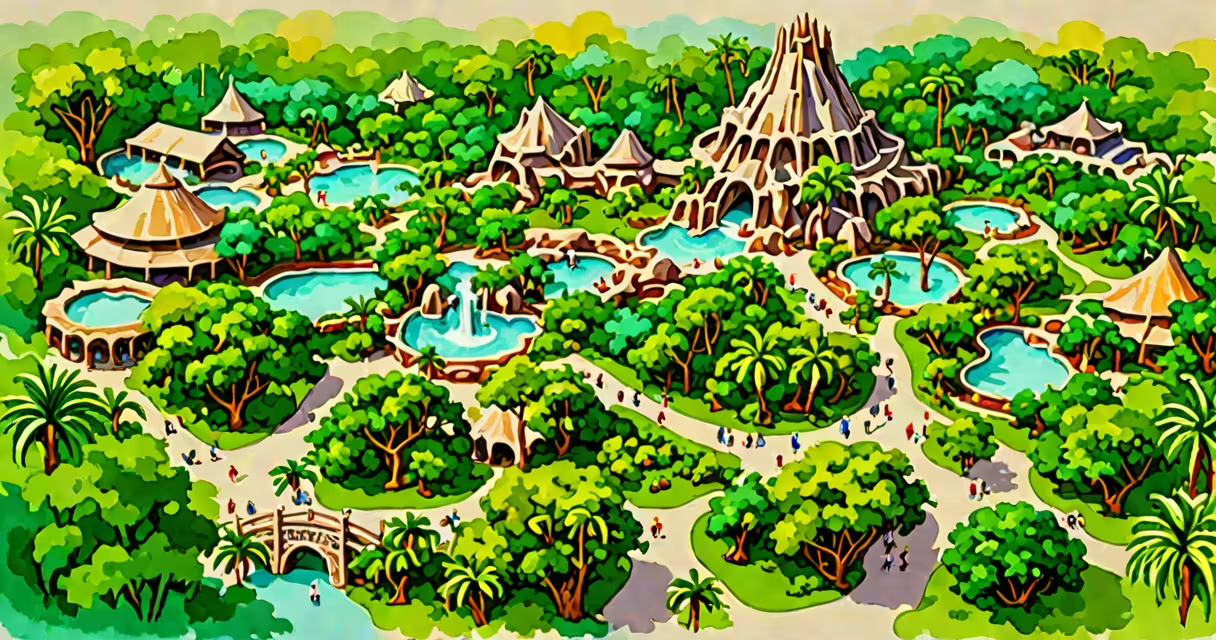
Animal Kingdom Florida is a theme park located within the Walt Disney World Resort in Bay Lake, Florida, designed around wildlife conservation, storytelling, and immersive experiences inspired by Earth's ecosystems. It opened on April 22, 1998, and is the fourth theme park built at the resort.
The park blends entertainment with education, using elaborate sets, animatronic animals, and live shows to simulate environments ranging from African savannas to the jungles of Pandora. Unlike traditional amusement parks, Animal Kingdom emphasizes nature, biodiversity, and environmental stewardship as core themes.
It is home to over 2,000 animals across 160 species, including elephants, giraffes, and orangutans, many of which are part of breeding programs managed by the Disney Conservation Fund. The park's layout follows a narrative arc: guests enter through the "bush" of Africa, move into the "jungle" of Asia, then explore the mythical world of Pandora-the land of Avatar.
Animal Kingdom uses a technique called "themed environment design," where every element-from lighting and sound to plant life and signage-supports a fictional world. This approach minimizes the sense of being in a theme park and maximizes the illusion of travel.
For example, the entrance to the park features a massive tree known as the Tree of Life, which stands 145 feet tall and contains 325 carved animals. The tree is not just a visual landmark-it serves as a central hub with multiple pathways leading to different lands. Each area has distinct music, scents, and architectural styles to reinforce the setting.
Disney's Imagineers developed the park's concept based on research from the Smithsonian Institution and the National Geographic Society. According to National Geographic, the park's designers consulted with biologists and anthropologists to ensure cultural and ecological accuracy in the portrayal of regions like Sub-Saharan Africa and Southeast Asia.
The park is divided into five major areas, each representing a different biome or fictional world:
| Lands | Key Features | Notable Attractions |
|---|---|---|
| Africa | Wildlife habitats, Maasai village, safari-style transport | Safari Off Road Adventure, Kilimanjaro Safaris |
| Asia | Jungle temples, waterfalls, bamboo forests | Expedition Everest, Kali River Rapids |
| Pandora - The World of Avatar | Floating mountains, bioluminescent flora, Na'vi culture | Avatar Flight of Passage, Na'vi River Process |
| Discovery Island | Conservation-themed exhibits, educational shows | Walt Disney's Enchanted Tiki Room (reimagined), Festival of the Lion King |
| Frontierland | Western frontier aesthetic, mining towns, old-world charm | Dinosaur ride, The Many Adventures of Winnie the Pooh |
Kilimanjaro Safaris, one of the most popular attractions, takes guests on a guided tour through simulated savanna terrain. The ride lasts approximately 20 minutes and features real animals such as lions, zebras, and hippos. According to Disney Parks Blog, the attraction was designed with input from wildlife experts to mimic real safari conditions while maintaining guest safety.
Another standout is Expedition Everest, a roller coaster that combines a Himalayan mountain myth with a high-speed track. The ride includes a 130-foot drop and a crash scene involving a Yeti. Despite its thrill factor, the attraction maintains thematic consistency with the surrounding Asian field.
Animal Kingdom is primarily used for leisure tourism, family vacations, and educational field trips. It attracts visitors from over 100 countries annually, with an average of 1.5 million guests per year during peak seasons.
Its focus on conservation sets it apart from other theme parks. The park hosts the Disney Conservation Fund, which has contributed over $100 million since 1995 to global wildlife initiatives. Projects include protecting snow leopards in Central Asia and restoring coral reefs in the Pacific.
Visitors often use the park as a base for multi-day stays at nearby resorts. The park's proximity to Disney's Animal Kingdom Lodge allows guests to stay in a resort styled after East African villages, complete with real wildlife viewing opportunities near the hotel's waterhole.
Many assume Animal Kingdom is primarily a zoo. While it does house real animals, it is not a traditional zoo. The animals are displayed in habitat-based enclosures rather than cages, and the park prioritizes guest experience and narrative immersion over exhibit labeling or scientific detail.
Another misconception is that the park lacks thrill rides. In reality, it offers four major roller coasters: Expedition Everest, Rock 'n' Roller Coaster Starring Aerosmith (located in Hollywood Studios), Dinosaur, and the recently updated Test Track (also in Epcot). However, Animal Kingdom's rides emphasize story and environment over pure speed or height.
A lesser-known fact: the Tree of Life is not static. It changes color nightly during the "Tale of the Tree" show, where projected images of animals and stories from different cultures appear on its surface. The show runs from dusk until 10 PM daily and is free to attend.
I visited Animal Kingdom in January 2023 during a family trip. We arrived at 8:30 AM and rode Kilimanjaro Safaris first. The vehicle moved slowly through the savanna, and we saw a lioness sleeping under a tree, a herd of impalas grazing, and a baby hippo playing in the water. The guide narrated facts about each species, blending entertainment with education.
Later, we explored Pandora - The World of Avatar. The ride "Avatar Flight of Passage" required a 45-minute wait, but the queue line included interactive elements like a Na'vi language lesson and a holographic map of the floating Hallelujah Mountains. Once aboard, the motion simulator placed us on a banshee's back, flying through glowing forests. The sensory details-smell of pine and wet earth, wind effects, and 3D visuals-created a convincing illusion of flight.
Afterward, we attended the "Festival of the Lion King" show in the Oasis area. The performance combined acrobatics, music, and puppetry to tell Simba's story. A single show ran for 45 minutes and drew a crowd of over 1,000 people. The energy in the audience was palpable-families clapped along, children sang the songs, and adults smiled at the familiar lyrics.
Animal Kingdom Florida is more than a theme park-it's a living tribute to Earth's biodiversity and human imagination. Its blend of storytelling, conservation, and immersive design makes it a unique destination among Florida's attractions. the quiet wonder of the Tree of Life, the park delivers a layered experience that lingers long after you leave.