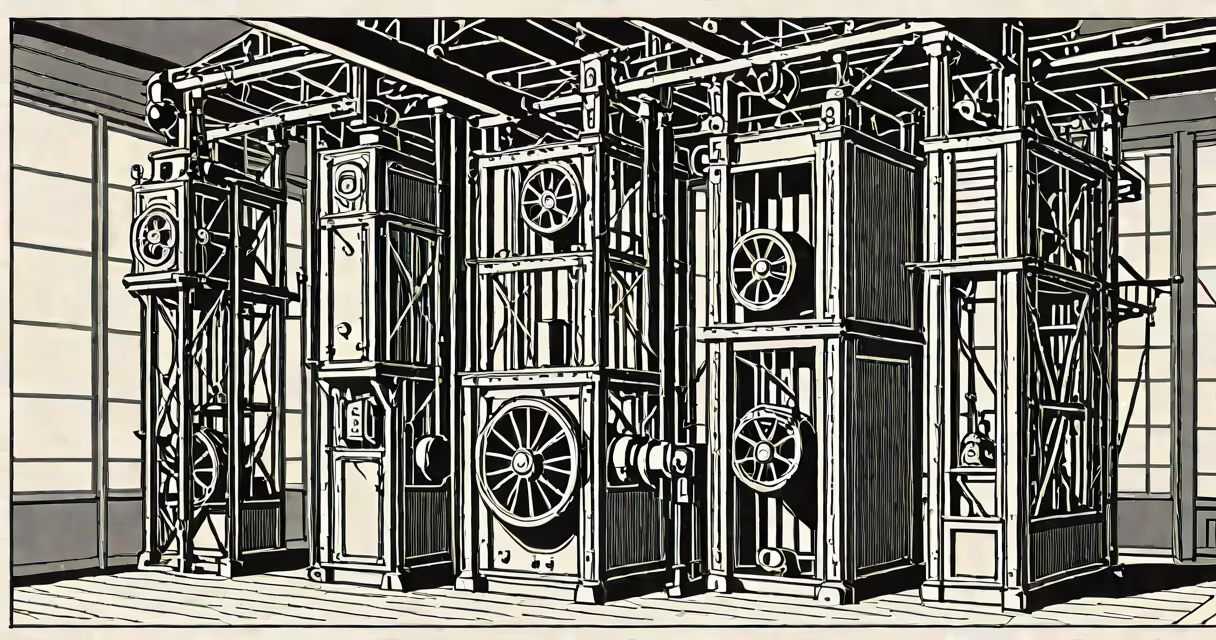
The elevator was invented by Elisha Graves Otis in 1852, who introduced a safety braking system that prevented free-fall in case of cable failure. This innovation made passenger elevators viable for tall buildings.
Before Otis, hoists and lifts existed but were dangerous. They relied on ropes or chains that could snap, leading to fatal drops. Otis's breakthrough wasn't the idea of vertical movement-it was making it safe. He demonstrated the device at the 1854 New York World's Fair, standing on a platform while an assistant cut the rope. The brake engaged instantly, stopping the fall. The crowd roared.
While Otis didn't create the first lifting mechanism-ancient Greeks used winches and pulleys-the modern elevator as a public transit system began with him. His company, Otis Elevator Company, later became a global leader in vertical transportation. By 1868, the first commercial passenger elevator was installed in a New York City department store.
Modern elevators operate using a motor-driven system that moves a cab along vertical tracks. A counterweight balances the car's weight, reducing energy use. The system relies on cables, pulleys, and a control panel that manages floor requests and door operations.
At the core is the safety brake. Otis's original design used spring-loaded arms that engaged when tension dropped suddenly-indicating a cable break. Today's systems use electronic sensors and electromechanical brakes that respond in milliseconds. These fail-safes prevent accidents even during power outages.
For example, the Empire State Building's elevators carry over 10 million passengers annually. Each ride involves 120 feet of travel at speeds up to 1,000 feet per minute. All movements are monitored by computerized dispatch systems that minimize wait times and maximize efficiency.
Elevators fall into several categories based on function, speed, and installation method. The most common types include:
| Type | Use Case | Speed Range | Key Feature |
|---|---|---|---|
| Hydraulic | Low-rise buildings (up to 6 floors) | 0.1-0.3 m/s | Uses fluid pressure; quiet but slow |
| Machine Room Less (MRL) | Residential and small offices | 0.3-1.0 m/s | Motor in the shaft; saves space |
| High-Speed Traction | Tall buildings (over 20 floors) | 1.0-10.0 m/s | Uses steel ropes and counterweights |
Hydraulic elevators dominate low-rise structures due to their simplicity and low maintenance. MRL models are popular in modern apartments because they eliminate the need for a dedicated machine room. High-speed traction elevators, like those in the Burj Khalifa, reach speeds of 10 meters per second-faster than a sprinter.
A lesser-known fact: Otis did not patent the idea of a safety brake. He patented the *method* of actuating it via a falling mass. This technical specificity allowed his company to defend its patents in court. The legal distinction helped solidify Otis's dominance in the industry.
Many assume the elevator was invented in the 20th century. That's incorrect. Otis's safety brake was patented in 1861 (U.S. Patent #32,446), and his first working model debuted in 1852. The first passenger elevator opened in 1857 at the Haughwout Department Store in New York City.
Another confusion: people often credit Thomas Newcomen or James Watt with inventing the elevator. Newcomen developed the atmospheric engine in 1712, which powered early mine pumps. Watt improved it later. Neither designed a lift for people. Their work contributed to industrial machinery, not vertical transport.
Even the term "elevator" is a misnomer in origin. The word comes from Latin *elevare*, meaning "to raise." But early devices were called "hoists," "lifts," or "dumbwaiters." The term "elevator" entered common use in the late 1800s, popularized by Otis's marketing team.
When I visited the Eiffel Tower in 2019, I rode the original 1889 hydraulic elevators. They moved slowly-about 0.5 meters per second-but felt stable. The operator manually controlled the descent. I noticed the cables were exposed, running through a metal cage. It was a reminder that modern safety features weren't available then.
Today, elevators enable cities to grow upward. Without them, skyscrapers wouldn't exist. The Chrysler Building (1930) and the Petronas Towers (1998) both rely on advanced elevator systems. In Tokyo, the Ginza Line subway uses elevators to connect platforms with street level-a necessity in a city with dense population and limited ground space.
Urban planning now integrates elevator access as a standard requirement. The Americans with Disabilities Act (ADA) mandates that all public buildings have accessible elevators. This rule applies to schools, hospitals, and shopping centers. Over 90% of U.S. public buildings now comply.
Understanding who invented the elevator reveals more than a single inventor. It shows how engineering solves real-world problems. Otis didn't just build a machine-he enabled a new way of living. His safety brake turned a risky tool into a daily necessity.