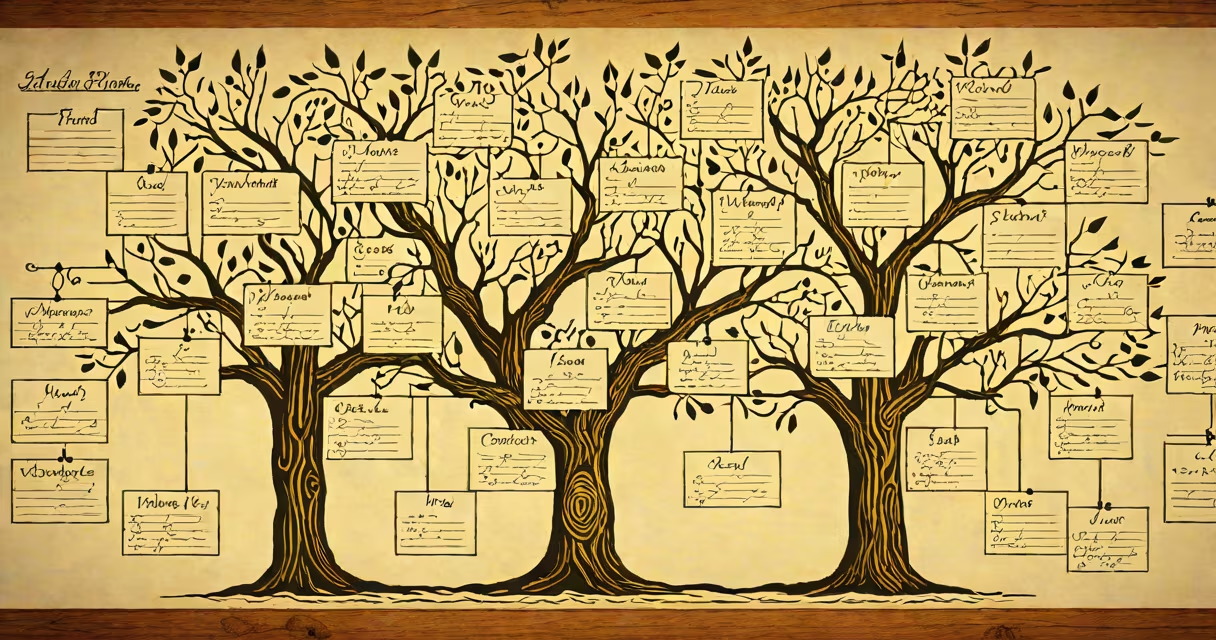
Family ancestry refers to the documented lineage of individuals through blood relations, tracing their descent from past generations to uncover origins, migration patterns, and cultural heritage. It combines genetic data, historical records, and oral traditions to reconstruct personal and collective histories.
Ancestry is not just a list of names and dates-it's a living record of where people come from, shaped by geography, war, migration, and social change. For example, someone with roots in southern Italy may trace their ancestry to Sicilian villages displaced during the 19th-century emigration wave, linking modern identity to centuries-old agricultural communities.
Family ancestry relies on three core methods: documentary research, genetic testing, and oral history. Documentary research uses public archives-such as U.S. federal censuses from 1790 onward or UK parish registers dating back to the 16th century-to verify relationships across time. These records include names, ages, occupations, and residences, enabling researchers to build timelines.
Genetic testing, available through companies like AncestryDNA and 23andMe, analyzes DNA markers to estimate ethnic origins and identify biological relatives. A person with 25% Irish ancestry, for instance, may discover they share a common ancestor with others who have similar marker profiles in Ireland's County Kerry, even if no written record exists.
Oral history fills gaps where documents are missing. In many African American families, for example, slavery disrupted formal records. Oral narratives passed down through generations-such as stories of a grandmother escaping via the Underground Railroad-become important clues in building ancestry profiles. According to the National Archives, over 40% of African American ancestry projects rely on interviews due to the destruction of slave schedules in the Civil War.
Family ancestry manifests in several forms, each serving different purposes:
| Type | Primary Source | Use Case | Example |
|---|---|---|---|
| Patrilineal | Male-line records (e.g., surnames) | Tracing military service, inheritance rights | A man tracing his surname "O'Connor" to 12th-century Irish chieftains via church records |
| Matriarchal | Female-line records (e.g., maternal grandparents) | Identifying inherited health conditions | Tracking breast cancer risk through maternal lineage in a family with multiple cases |
| Cultural | Traditions, language, food practices | Preserving ethnic identity | A family maintaining Yiddish songs and Passover rituals despite being born in New York City |
| Genetic | DNA analysis | Reuniting adoptees with biological families | A woman adopted in 1980 finds her birth parents through a DNA match on Ancestry.com |
Patrilineal ancestry is often emphasized in Western legal systems because surnames were historically passed through male lines. However, this overlooks matrilineal contributions-especially in cultures where inheritance follows mother's side, such as among the Minangkabau people of Indonesia, where property passes through women.
Many assume family ancestry equals family history, but the two differ. Family history includes events, stories, and lived experiences-like a great-grandfather's process from Poland to Chicago in 1912. Family ancestry focuses on biological connection and lineage, asking: "Who are my direct ancestors?" rather than "What did they do?"
Another misconception is that ancestry determines destiny. While knowing your roots can inform health risks-such as increased likelihood of sickle cell anemia in West African ancestry-ancestry does not predict behavior, intelligence, or success. The American Society of Human Genetics states that genetic ancestry accounts for less than 10% of individual traits, emphasizing environmental and social factors.
Some confuse ancestry with ethnicity. Ethnicity involves shared culture, language, and national origin-such as identifying as Mexican-American. Ancestry is about biological descent. A person may be ethnically Japanese but genetically traceable to Korean ancestors through mitochondrial DNA, showing that ethnicity and ancestry don't always align.
Consider Maria Lopez, a 38-year-old teacher in Austin, Texas. She wants to understand her family ancestry after learning her father had a rare heart condition. She begins by collecting documents: her grandfather's 1948 immigration form from Jalisco, Mexico, listing his birthplace as San Juan de los Lagos. She cross-references this with 1930 Mexican censuses and discovers her great-great-grandmother was listed as a midwife in the same town.
She then takes a 23andMe test. Results show 78% Indigenous American, 18% European, and 4% African ancestry. The company's database identifies 122 potential relatives sharing segments of DNA linked to the Sierra Madre Occidental region. One match, a woman in Guadalajara, shares a segment of chromosome 11 linked to a known founder mutation associated with cardiomyopathy.
With this data, Maria consults a genetic counselor. They confirm her elevated risk and recommend early screening. Her ancestry didn't cause the illness-but it helped detect it earlier. This illustrates how ancestry informs health decisions, not destiny.
Understanding your family ancestry helps you see beyond the present. It connects you to people who lived through plagues, wars, and migrations. It reveals resilience, adaptation, and continuity. As historian David McCullough notes, "The past is not dead. It's not even past." Tracing ancestry is not about nostalgia-it's about clarity.