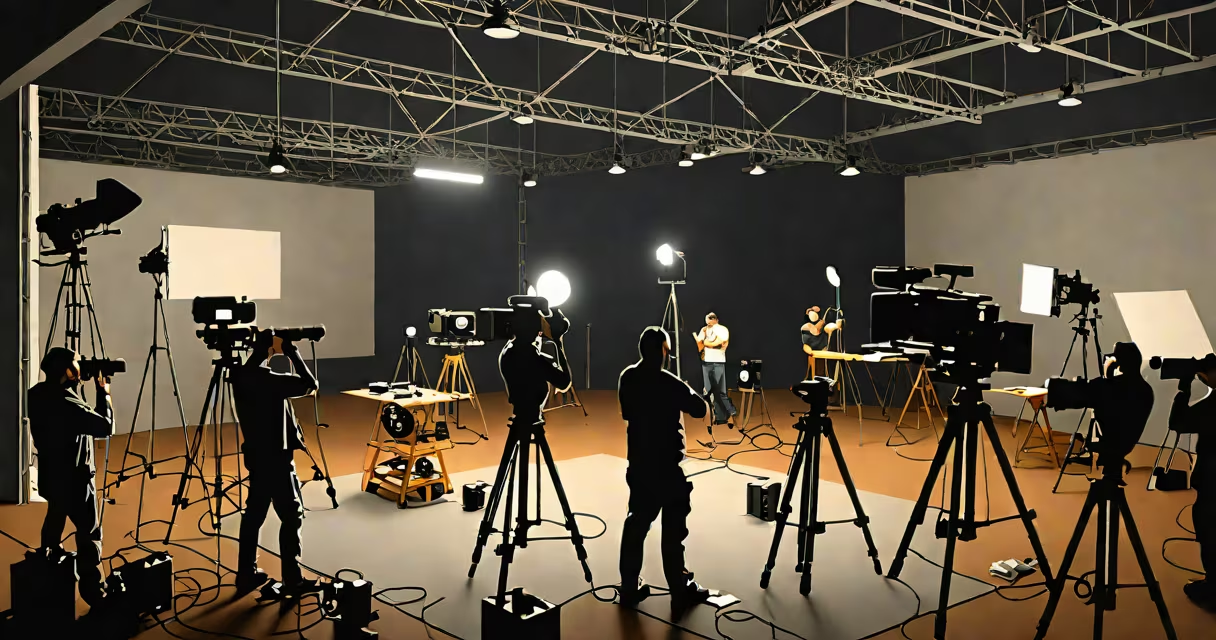
A movie production company manages the creation, financing, and delivery of a film from initial idea through final distribution. It coordinates all aspects of production, including casting, budgeting, shooting, editing, and marketing, ensuring a project moves from concept to screen.
These companies operate as the central hub for a film's lifecycle. They hire key personnel-directors, writers, producers-and secure funding through investors, studios, or streaming platforms. Without a production company, a film lacks organizational structure, financial oversight, and legal coordination.
Major studios like Warner Bros. and Sony Pictures are vertically integrated production companies. Independent firms such as A24 or Blumhouse Productions focus on niche genres and emerging talent. Both types handle the same core functions, though scale and reach differ.
Every film begins with a concept-a story idea, a screenplay, or a book adaptation. The production company evaluates market potential, secures rights, and hires a screenwriter or development team to refine the script. This phase includes pitch meetings with networks, distributors, or financiers.
Once a script is approved, the company assigns a producer to oversee logistics. The producer creates a detailed budget, hires a director, scouts locations, and casts actors. For example, A24 spent six months developing the script for *Everything Everywhere All At Once* before securing $15 million in funding and assembling a cast including Michelle Yeoh and Stephanie Hsu.
During filming, the production company manages daily operations. It provides insurance, handles permits, arranges travel and accommodations, and ensures compliance with labor laws. On-set challenges-such as weather delays or actor injuries-are resolved through contingency plans funded and approved by the company.
Production companies follow a structured workflow. The first stage is pre-production: scripting, casting, location scouting, and budgeting. The second is principal photography: actual filming. The third is post-production: editing, sound design, visual effects, and music composition.
Post-production is often the most complex phase. A single scene may require dozens of edits, color grading, and audio mixing. For *Dune* (2021), production company Legendary Entertainment spent over 18 months on post-production, using 2,000 visual effects shots across 150 scenes. The company coordinated teams in multiple countries to meet deadlines.
After final cut approval, the company handles distribution. Options include theatrical release, streaming platforms (e.g., Netflix, Amazon Prime), or international sales. A24 released *The Lighthouse* (2019) in limited theaters before acquiring global streaming rights via Hulu.
Production companies fall into three categories: major studios, independent producers, and hybrid entities. Major studios have in-house departments for every function-legal, accounting, marketing. They fund high-budget projects with guaranteed returns, such as Marvel Studios' *Avengers* films.
Independent companies operate with leaner teams and lower overhead. They often take creative risks. Blumhouse Productions, known for *Get Out* and *Insidious*, produces horror films under $10 million budgets. Their success relies on efficient workflows and viral marketing strategies.
Hybrid models blend independence with studio backing. For example, Apple TV+ partners with production companies like Reel One Entertainment to create original series. These partnerships allow creative control while sharing financial risk and distribution reach.
| Type | Budget Range | Example Projects | Primary Distribution Channel |
|---|---|---|---|
| Major Studio | $50M-$300M+ | *The Batman* (2022), *Barbie* (2023) | Theatrical, global streaming |
| Independent | $1M-$15M | *Nomadland* (2020), *A Star Is Born* (2018) | Festival circuits, limited release, streaming |
| Hybrid | $5M-$50M | *The Power of the Dog* (2021), *The Father* (2020) | Festival awards, premium streaming |
Many assume that a production company is synonymous with a film studio. While both produce content, studios own intellectual property and distribution channels. A production company may make a film but rely on a studio to distribute it. For example, *The Social Network* was produced by FilmDistrict but distributed by Columbia Pictures.
Another confusion: production companies don't typically own the final film's rights. Rights are negotiated during pre-production. A company may hold a license to distribute a film for five years, after which ownership reverts to the studio or financier. According to the Motion Picture Association, 68% of independent films are financed through equity deals where the production company retains partial ownership.
Some believe production companies only exist during filming. In reality, they remain active throughout a film's life cycle. Post-release, they collect box office revenue, manage licensing fees, and plan sequels or spin-offs. The success of *Stranger Things* stems from Netflix's long-term investment in the production company behind it, Monkey Massacre.
Consider *The Last of Us* (2023), adapted from the video game. HBO's production arm, HBO Originals, acquired the rights in 2018. Over two years, they developed the pilot script, hired Neil Druckmann (creator of the game) as showrunner, and secured $100 million in funding.
Casting began in early 2022. The production company selected Pedro Pascal and Bella Ramsey after 120 auditions. Location scouting covered Canada and the U.S. West Coast. Principal photography ran for 11 months across 40 shooting days.
Post-production took 10 months. Visual effects were handled by Industrial Light & Magic. Sound design used 42 unique audio layers per episode. Marketing launched six months before premiere, including trailers, social media campaigns, and influencer outreach.
The series premiered on HBO Max in January 2023. Within three weeks, it reached 1.2 million viewers per episode. The production company continues to license merchandise and explore a second season.
I once worked as a production assistant on a low-budget indie feature filmed in rural Oregon. The production company had a team of four: a producer, a director, a cinematographer, and me. We raised $75,000 through crowdfunding and local sponsorships. Shooting lasted 14 days. We used consumer-grade cameras and borrowed lighting gear from a community college.
Despite tight resources, the company maintained a daily schedule, tracked expenses in spreadsheets, and ensured all crew signed liability waivers. After editing, we submitted the film to 12 festivals. It won Best Narrative at the Portland International Film Festival. The experience confirmed that even small production companies must follow rigorous processes to succeed.
A production company is not a distributor. It does not sell tickets or stream content directly. It also is not a talent agency. It doesn't represent actors or negotiate contracts on their behalf. These roles are distinct and legally separated.
For example, a film's lead actor may be represented by Creative Artists Agency (CAA), while the film itself is produced by a company like Bad Robot. The production company handles the film's budget and timeline. The agency handles the actor's salary, tour commitments, and endorsement deals.
Understanding this separation prevents misalignment in credit, compensation, and ownership. As noted by the Writers Guild of America, "Confusing production roles leads to disputes over royalties and residual payments."
When you watch a movie, the credits list the production company first. That's not a formality-it's a legal requirement. The company is responsible for the film's existence, quality, and compliance with copyright law.