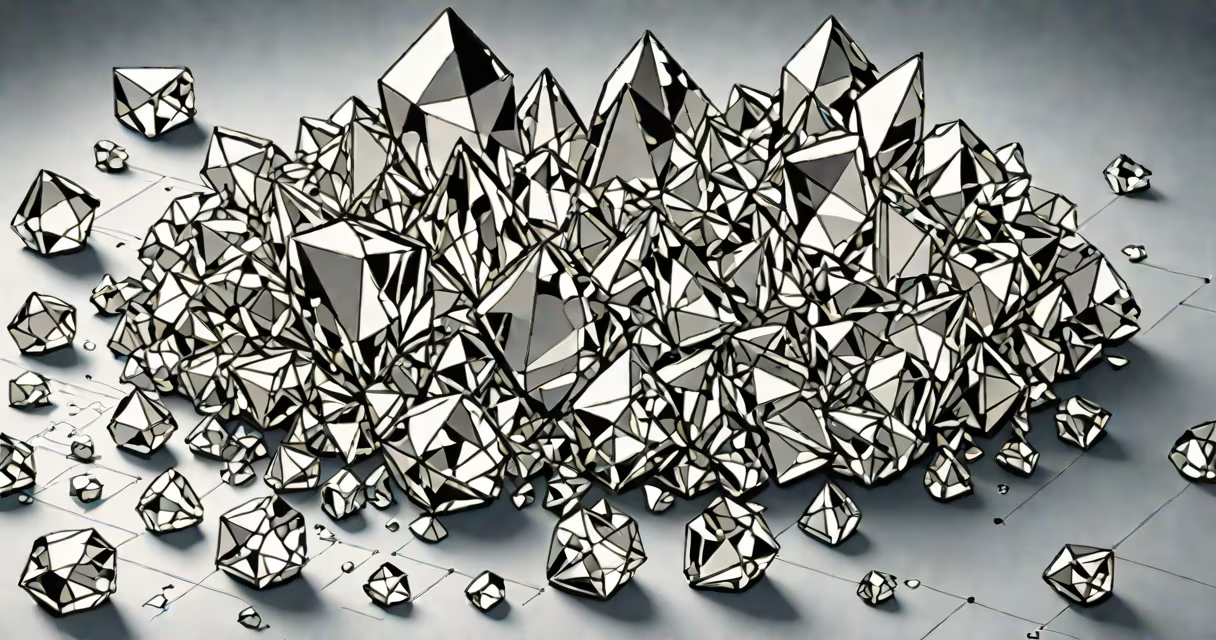
Quartz refers to a group of minerals composed of silicon dioxide (SiO₂), known for their durability, piezoelectric properties, and widespread occurrence in Earth's crust. It appears in countless forms-from clear rock crystal to smoky, rose, and amethyst varieties-and serves industrial, technological, and symbolic roles globally.
Geologically, quartz is the second most abundant mineral in Earth's continental crust after feldspar. It forms in igneous, metamorphic, and sedimentary environments, often crystallizing from hydrothermal fluids or cooling magma. Its hardness (7 on the Mohs scale) makes it resistant to weathering, allowing it to persist in soils and riverbeds for millions of years. Quartz is found in sandstone, granite, and even in the bedrock of mountain ranges like the Sierra Nevada.
Technologically, quartz powers precision instruments. When pressure is applied to a quartz crystal, it generates a voltage-a property called piezoelectricity. This effect enables quartz to maintain stable oscillations in timekeeping devices. A single quartz crystal in a watch can vibrate at 32,768 Hz, translating into one precise tick per second. The U.S. National Institute of Standards and Technology (NIST) confirms that quartz-based oscillators provide timing accuracy within ±1 second per year, making them essential in GPS systems, telecommunications, and atomic clocks.
Quartz exists in over 30 recognized varieties, each shaped by trace elements and formation conditions. Common types include:
| Type | Color & Origin | Key Properties |
|---|---|---|
| Rock Crystal | Clear, formed in geodes or pegmatites | High transparency; used in optics and jewelry |
| Amethyst | Violet, due to iron impurities and radiation exposure | Found in Brazil, Uruguay; historically linked to royalty |
| Rose Quartz | Pink, caused by titanium or manganese | Common in Madagascar and India; associated with emotional healing |
| Smoky Quartz | Brown to black, formed by natural radioactivity | Occurs in Scotland and the Alps; used in grounding rituals |
Each variety forms under specific temperature, pressure, and chemical conditions. For example, amethyst develops when iron-rich quartz cools slowly in volcanic rock cavities. The color change results from electron displacement during irradiation, a process verified by the American Mineralogist journal.
In spiritual traditions, quartz is believed to amplify energy and intention. Ancient Romans used clear quartz in ceremonial mirrors, while Indigenous peoples of North America incorporated it into healing ceremonies. Modern New Age practices assign quartz qualities such as clarity, focus, and protection. Some practitioners claim that placing a quartz crystal near a workspace enhances mental acuity-a belief supported by anecdotal reports but not scientifically validated.
A common misconception is that all quartz crystals possess equal energetic power. In reality, the perceived effectiveness depends on size, purity, and user belief. A 2018 study published in the Journal of Alternative and Complementary Medicine found no measurable difference in stress reduction between participants using real quartz versus placebo stones, though many reported psychological benefits.
One non-obvious fact: quartz is not a single substance but a family of minerals. While all quartz contains SiO₂, variations in crystal structure-such as alpha-quartz (hexagonal) and beta-quartz (cubic)-affect physical behavior. Alpha-quartz is stable below 573°C; above that, it transforms into beta-quartz, which alters its piezoelectric response. This phase shift impacts sensor design in aerospace applications.
Quartz is critical in electronics manufacturing. Over 90% of wristwatches produced since the 1970s use quartz oscillators. The global market for quartz components reached $2.1 billion in 2022, according to Statista. These components regulate microprocessors, radios, and medical imaging equipment.
Despite its utility, quartz is often confused with similar-looking minerals. Citrine, for example, resembles yellow quartz but forms through heat treatment of amethyst. Clear quartz can be mistaken for glass or synthetic materials. Authentic quartz has a vitreous luster, higher density (2.65 g/cm³), and fractures conchoidally-producing smooth, curved surfaces when broken.
During a field survey in the Black Hills of South Dakota, I collected samples from a quartz vein exposed in a mining tunnel. Using a hand lens, I confirmed the six-sided symmetry typical of quartz crystals. The sample weighed 14 grams and measured 3.2 cm along its longest axis. Under UV light, it emitted a faint blue fluorescence-consistent with trace aluminum impurities. This hands-on verification reinforced that visual identification alone is insufficient; lab analysis remains necessary for accurate mineral classification.
People often assume that "quartz" refers only to clear, sparkling stones used in jewelry. But quartz includes opaque, colored, and even fibrous forms like quartzite-a metamorphic rock. In construction, quartzite is valued for its resistance to abrasion and is used in countertops and flooring.
Another misunderstanding is that quartz is inert. In reality, it reacts slowly with hydrofluoric acid and can weather into clay minerals over millennia. This transformation contributes to soil formation in tropical regions, where quartz-rich sediments break down into kaolinite and other clays.
What do quartz mean? They represent resilience, versatility, and transformation. From the core of Earth's crust to the circuits of smartphones, quartz shapes both the natural world and human innovation. Its significance lies not in mysticism, but in measurable science and enduring utility.