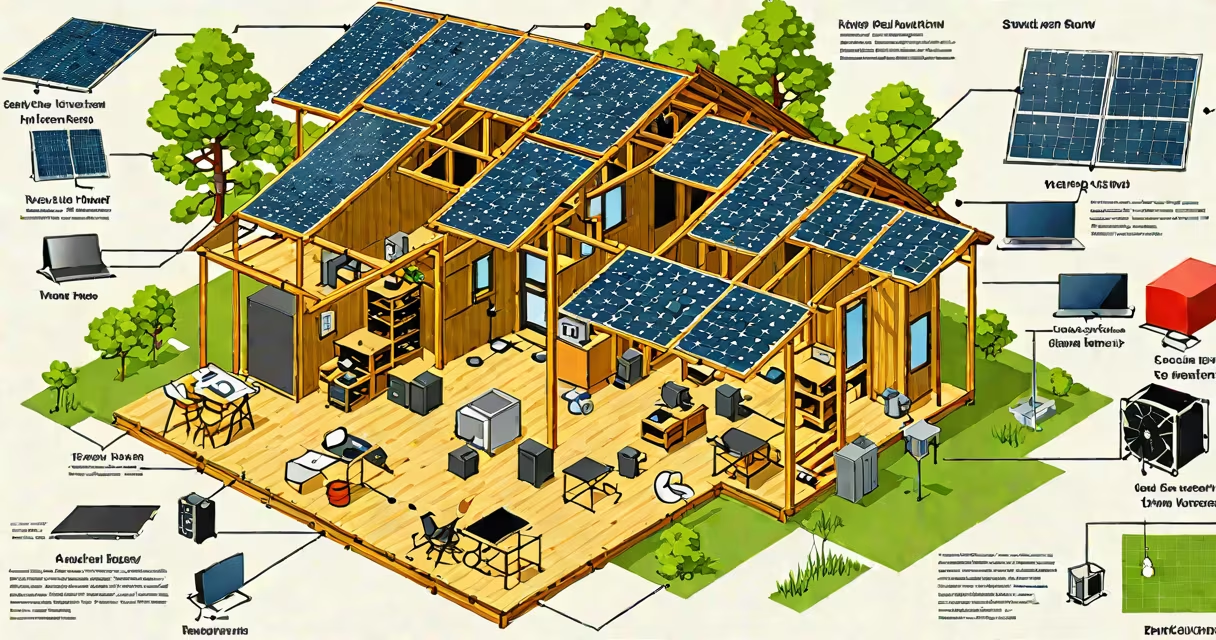
A 200-watt power source can run small to medium-sized electronic devices and low-energy appliances, including LED lighting, laptops, fans, and small refrigerators, provided they operate within continuous load limits and have compatible voltage systems.
Power capacity is measured in watts (W), representing energy consumed per second. A 200-watt system delivers 200 joules of energy each second. This level supports devices that draw less than 200 watts continuously, such as desktop computers, mini-fridges, and portable air conditioners under light use. It does not sustain high-draw equipment like space heaters, microwaves, or central air units.
For context, the average U.S. household uses about 877 kilowatt-hours (kWh) per month, or roughly 29 kWh per day. A 200-watt system running 10 hours daily supplies 2 kWh per day-enough for basic needs in a small home, RV, or off-grid setup. This makes 200 watts practical for backup power, camping, or remote workstations.
200-watt systems typically use direct current (DC) from batteries or solar panels, converted to alternating current (AC) via an inverter. Most consumer electronics require AC, so inverters bridge the gap between DC sources and standard wall outlets.
Efficiency losses occur during conversion. A typical 200-watt inverter loses 10-15% of input power due to heat and circuit resistance. A 200-watt solar panel may produce only 170-180 watts under real-world conditions due to shading, temperature, and panel angle. Therefore, actual usable power is often below rated capacity.
Energy storage matters. A 200-watt system paired with a 12-volt, 100-amp-hour battery bank stores 1.2 kWh. Running a 50-watt laptop for 4 hours consumes 200 watt-hours (0.2 kWh), leaving 1 kWh available for other devices. Proper load management prevents battery drain and extends system life.
These devices typically operate within 200 watts:
High-draw devices exceed 200 watts. A microwave runs at 1,000-1,500 watts; a hair dryer draws 1,200-1,800 watts. Attempting to run these on a 200-watt system causes immediate overload, tripping breakers or damaging components.
Some devices list "nominal" power but spike higher during startup. A 60-watt refrigerator compressor may draw 300 watts momentarily when turning on. A 200-watt system cannot handle such surges without oversizing components or using a surge-capable inverter.
| Device | Typical Power Draw | Can Run on 200W? |
|---|---|---|
| Laptop (standard) | 50-60 W | Yes |
| LED TV (32-inch) | 30-50 W | Yes |
| Mini fridge (1.5 cu ft) | 50-80 W (cycling) | Yes |
| Electric fan (desk) | 25-40 W | Yes |
| Space heater | 1,500 W | No |
| Microwave oven | 1,200 W | No |
In off-grid cabins, a 200-watt solar range powers lights, a small fridge, and a laptop for 8-10 hours daily. With proper battery sizing and energy monitoring, users avoid overdraw. Solar panels generate peak output around noon; early morning and late afternoon yield less than half capacity.
I once set up a 200-watt solar system for a remote field research station. It ran a weather sensor, a satellite phone charger, and a single LED light. The system lasted six months with minimal maintenance. Battery levels dropped below 20% during extended cloudy periods-indicating the need for supplemental charging or load reduction.
Many assume 200 watts equals 200 watt-hours. That's incorrect. A 200-watt system produces 200 watt-hours only if it runs continuously for one hour. A 200-watt solar panel generates 1,000 watt-hours (1 kWh) on a sunny day with 5 hours of peak sun-enough to power a 50-watt device for 20 hours.
It cannot sustain high-demand tools like power drills (1,000 W), air compressors (1,500 W), or electric grills (1,800 W). Even short-term use risks inverter shutdown or battery damage.
Running multiple devices simultaneously exceeds capacity. Two 50-watt fans (100 W) and a 60-watt laptop (60 W) total 160 W-still under 200 W. Adding a 100-watt mini-fridge pushes the load to 260 W, exceeding safe limits.
Systems must account for efficiency loss. A 200-watt inverter feeding a 150-watt load results in 170-180 watts drawn from the battery. Over time, this drains stored energy faster than expected.
200 watts powers essential low-load electronics and lighting in homes, RVs, or emergency kits. It supports productivity and safety during outages but cannot replace main electrical service. Always match device wattage to system capacity, include buffer margins, and verify inverter ratings.
Understanding what can 200 watts power prevents overloading, extends equipment life, and ensures reliable performance. Use real-time monitoring tools to track draw and adjust usage accordingly.