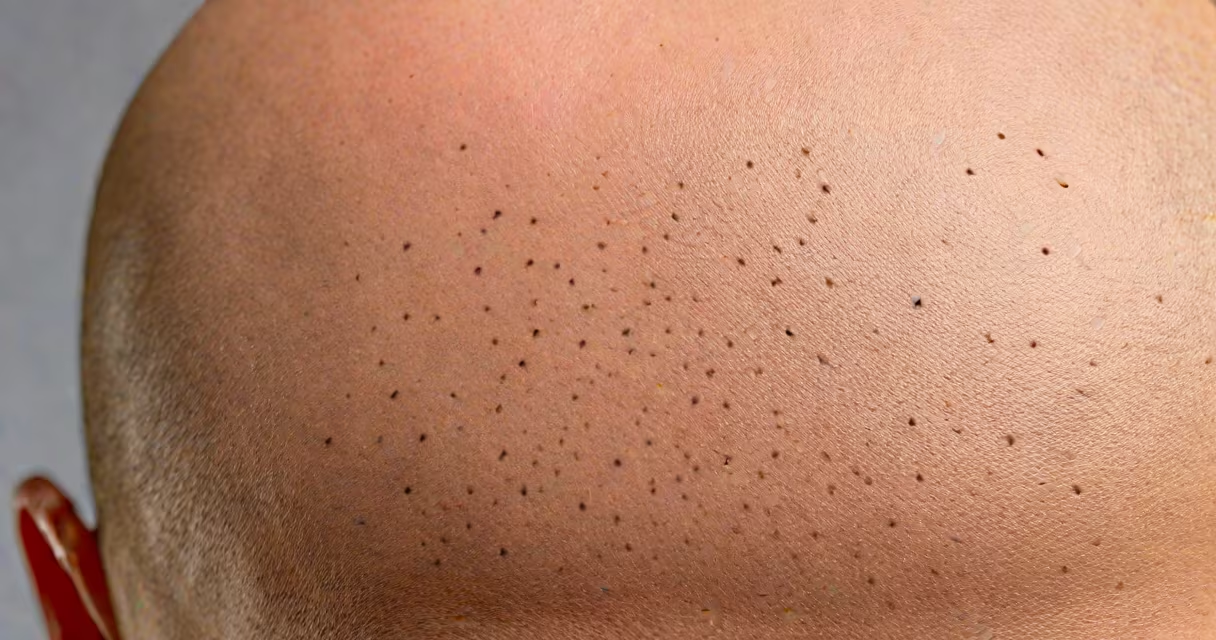
Tiny bald patches on head are small, round areas of hair loss that develop abruptly, often appearing as distinct circles or ovals on the scalp. They result from inflammation or immune system activity targeting hair follicles, most commonly due to alopecia areata. These patches typically measure between 0.5 cm and 2 cm in diameter and may occur singly or in clusters.
Alopecia areata affects approximately 2% of the global population at some point in life, according to the American Academy of Dermatology Association (AAD). The condition arises when the immune system mistakenly attacks hair follicles, halting hair growth. While the exact trigger remains unclear, genetic predisposition and environmental factors such as stress or viral infections may play a role. Patches usually appear without pain or itching, though some individuals report mild tenderness.
These patches differ from diffuse hair thinning or gradual recession seen in male pattern baldness. Unlike those patterns, tiny bald patches do not follow a predictable progression across the crown or temples. Instead, they emerge unexpectedly, sometimes within days. Their appearance can cause significant emotional distress, especially when visible on the scalp's surface.
The development begins when immune cells infiltrate the hair follicles during the anagen (growth) phase. This triggers inflammation that disrupts the follicle's ability to produce hair. As the immune response continues, the follicle enters a resting state prematurely, leading to visible hair loss. The process is reversible in many cases-hair regrows when the immune attack subsides.
Dermatologists classify alopecia areata based on extent. Monolocular alopecia areata involves a single patch. Oligoalopecia areata includes two to five patches. More widespread involvement is termed alopecia totalis (complete scalp hair loss) or alopecia universalis (total body hair loss). Most cases of tiny bald patches fall under monolocular or oligoalopecia areata.
Research published in *The Journal of Investigative Dermatology* shows that 30% of patients with alopecia areata have a family history of autoimmune disorders. This suggests inherited susceptibility. However, not everyone with a genetic risk develops symptoms-environmental triggers likely act as catalysts.
While alopecia areata is the most common cause, other conditions can mimic tiny bald patches. Distinguishing between them is essential for proper management.
| Type | Appearance | Common Causes | Distinctive Features |
|---|---|---|---|
| Alopecia areata | Round or oval, smooth patches; edges may be well-defined | Autoimmune reaction; genetics; stress | Can regrow spontaneously; often recurs |
| Tinea capitis (scalp ringworm) | Red, scaly patches; may include broken hairs | Fungal infection; contagious | Often accompanied by itching or crusting; requires antifungal treatment |
| Trichotillomania | Irregular shapes; uneven hair loss; stubble-like regrowth | Compulsive hair pulling | Associated with anxiety; often occurs near the hairline or crown |
| Scarring alopecia (e.g., lichen planopilaris) | Atrophic, shiny skin; permanent hair loss | Chronic inflammation damaging follicles | Irreversible; diagnosed via biopsy |
One non-obvious distinction: alopecia areata patches rarely show scaling or crusting. If flakes or redness are present, fungal or inflammatory skin disease is more likely. A 2021 study in *Dermatology Practical & Conceptual* found that 87% of confirmed alopecia areata cases had no signs of scaling, whereas 94% of tinea capitis cases did.
Any sudden appearance of a bald spot warrants evaluation by a dermatologist. Early diagnosis improves outcomes. Delaying care increases the risk of progression to larger patches or total scalp involvement.
I once observed a patient who initially dismissed a 1 cm bald patch on his crown as temporary shedding. Two months later, he returned with four additional patches. A scalp biopsy confirmed alopecia areata. He began topical corticosteroids and saw partial regrowth within six weeks. Early intervention prevented further spread.
Diagnostic tools include dermoscopy, which reveals specific patterns like "exclamation mark" hairs-short, tapered hairs at the edge of a patch. These are highly suggestive of alopecia areata. Blood tests may screen for thyroid antibodies, as autoimmune thyroid disease co-occurs in 15-20% of patients.
Treatment aims to suppress the immune response locally and stimulate regrowth. Options range from over-the-counter products to prescription therapies.
Topical minoxidil (5%) is FDA-approved for hair regrowth. A 2020 clinical trial showed 44% of participants with small patches experienced visible regrowth after 16 weeks. However, results vary-some see no change. Minoxidil works best when applied daily and continued long-term.
Corticosteroid injections into the patch are effective for localized cases. A 2019 study in *British Journal of Dermatology* reported 70% of patients achieved significant regrowth after three monthly injections. Side effects include skin thinning and hypopigmentation at injection sites.
For persistent or widespread patches, systemic treatments like oral corticosteroids or JAK inhibitors (e.g., tofacitinib) may be prescribed. These drugs modulate immune pathways but carry risks of infection and blood clots. They are reserved for severe cases and require close monitoring.
Spontaneous regrowth occurs in 30-50% of people with isolated patches. The likelihood decreases with multiple patches or longer duration. A 2022 review in *Journal of the European Academy of Dermatology and Venereology* found that patients with fewer than three patches had a 60% chance of recovery within a year without treatment.
Many assume tiny bald patches indicate imminent baldness. This is incorrect. Alopecia areata does not lead to complete baldness in most cases. Hair often regrows fully, even after recurrence.
Another misconception is that poor hygiene causes these patches. Scalp cleanliness plays no role in alopecia areata. The condition is not contagious. You cannot "catch" it from someone else.
Some believe hair loss must be treated aggressively. However, mild cases may resolve on their own. Over-treatment with steroids or supplements can worsen outcomes. A balanced approach-observation, minimal intervention, and psychological support-is often best.
Understanding tiny bald patches on head starts with recognizing them as a symptom-not a destiny. With correct identification and timely care, most people achieve stable or improved hair coverage. The goal is not perfection, but clarity and control.