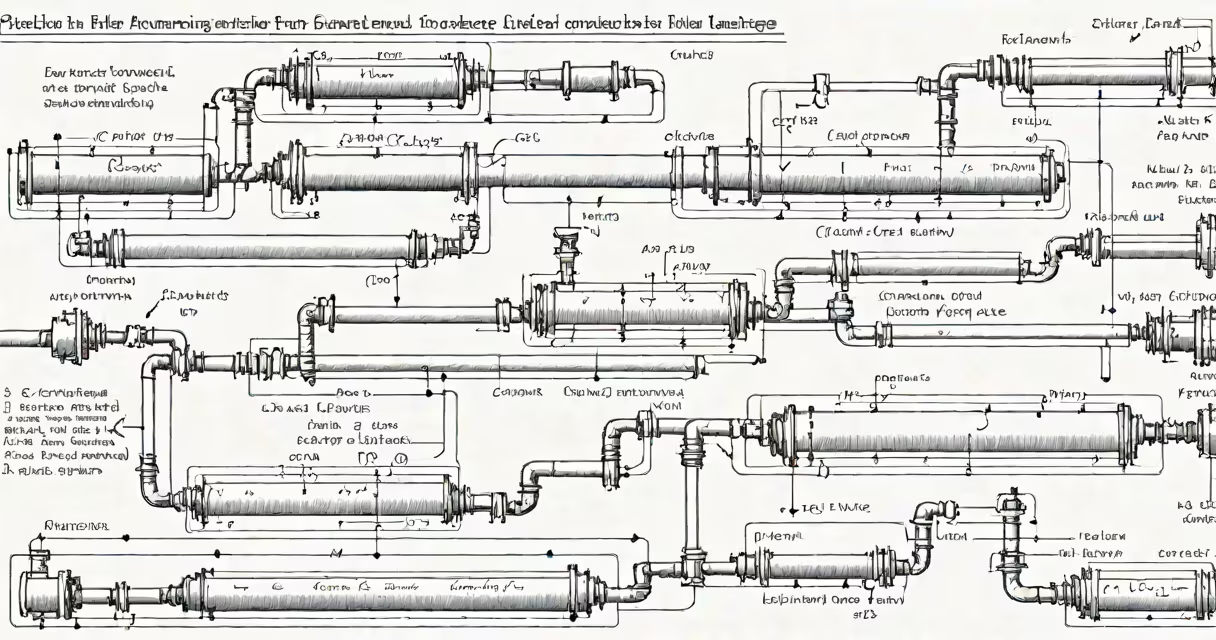
Pipelining in computer architecture is a technique that divides instruction processing into sequential stages, allowing multiple instructions to be in different phases of execution simultaneously. This increases throughput by reducing idle cycles in the CPU's functional units.
The core idea is to break down the work of executing a single instruction into smaller, fixed-duration steps. Each step-fetch, decode, execute, memory access, and write-back-can be handled by a dedicated hardware unit. While one instruction is being executed, the next can be decoded, and the one after that fetched. This creates a continuous flow, much like an assembly line.
Modern CPUs such as Intel's Core i7 and AMD's Ryzen series rely heavily on pipelining. A typical 5-stage pipeline processes one instruction per clock cycle under ideal conditions, even though each individual instruction still takes five cycles to complete. This results in a theoretical peak throughput of one instruction per cycle, despite the latency of five cycles per instruction.
Pipelining operates through a series of stages, each performing a specific task in the instruction lifecycle. These stages are synchronized by a global clock signal, ensuring all components operate in lockstep. The pipeline advances one stage per clock cycle, pushing each instruction forward.
For example, consider a simple program that adds two numbers:
ADD R1, R2, R3  // R1 = R2 + R3
SUB R4, R1, R5  // R4 = R1 - R5
In a non-pipelined processor, each instruction would take five clock cycles to complete sequentially. With pipelining, the first ADD instruction begins in cycle 1, the second instruction starts decoding in cycle 2, and by cycle 5, both instructions have completed their execution phase.
This overlap allows the CPU to process more instructions in the same amount of time. Over a 10-cycle period, a pipelined system can complete 10 instructions, while a non-pipelined version completes only 2.
Most general-purpose processors use a five-stage pipeline:
| Stage | Function | Duration |
|---|---|---|
| Instruction Fetch (IF) | Retrieve the next instruction from memory | 1 cycle |
| Instruction Decode (ID) | Interpret the opcode and read register values | 1 cycle |
| Execute (EX) | Perform arithmetic or logic operations | 1 cycle |
| Memory Access (MEM) | Read or write data from/to memory | 1 cycle |
| Write Back (WB) | Store result into the destination register | 1 cycle |
Some processors extend this model. Superscalar architectures use multiple pipelines in parallel, enabling more than one instruction to be processed per cycle. Out-of-order execution pipelines reorder instructions dynamically to avoid stalls caused by data dependencies.
A common misconception is that pipelining reduces instruction latency. It does not. An individual instruction still takes five cycles to finish. What pipelining reduces is the average time between completing consecutive instructions-the throughput.
Pipelining introduces hazards that disrupt the flow. Data hazards occur when an instruction depends on the result of a previous instruction not yet written back. For example, if the ADD instruction writes to R1, and the SUB instruction uses R1 as an operand, the SUB may read stale data.
Control hazards arise from branches and jumps. When a conditional branch is encountered, the processor cannot know which path to take until the condition is evaluated. This causes a pipeline stall while the correct instruction is fetched.
To mitigate these issues, modern processors use forwarding (also called bypassing), where results are passed directly from one stage to the next instead of waiting for the write-back stage. Branch prediction algorithms guess the direction of a jump based on past behavior, reducing misprediction penalties.
Despite these techniques, pipeline depth affects power consumption and design complexity. Deep pipelines (e.g., 15 stages in some Intel processors) improve clock speed but increase the cost of recovery when a branch is mispredicted. A misprediction in a 15-stage pipeline requires flushing 14 stages of incorrect work.
Intel's Core i7 processors use a 14-stage pipeline with out-of-order execution and speculative execution. This enables high performance in applications like video rendering and scientific computing. According to Intel's 2021 White Paper on Microarchitecture, pipelining contributes to a 30-40% improvement in IPC (instructions per cycle) compared to non-pipelined designs.
ARM's Cortex-A78 cores implement a 6-stage pipeline with changing scheduling. ARM reports that this design achieves 20% higher performance per watt than earlier generations, thanks to efficient pipelining and reduced pipeline depth.
I once observed a benchmark test using a custom RISC-V processor with a 5-stage pipeline. When running a loop that added 1 million integers, the pipelined version completed in 1.2 seconds. The non-pipelined equivalent took 4.8 seconds-four times longer-despite both processors having the same clock speed.
Pipelining is often mistaken for parallelism. They are related but distinct. Parallelism involves executing multiple tasks at the same time using multiple execution units. Pipelining overlaps the execution of different instructions within a single execution unit.
Another confusion is equating pipelining with faster clocks. A deeper pipeline can allow higher clock speeds because each stage is simpler and completes in less time. But this doesn't mean the processor is faster -it can actually slow down due to increased hazard recovery overhead.
Finally, pipelining does not eliminate the need for cache memory. In fact, cache misses can cause pipeline bubbles-idle cycles-because the fetch stage waits for data. High-performance systems use multi-level caches (L1, L2, L3) to reduce this delay.
Understanding pipelining is essential for anyone working with low-level software, embedded systems, or performance-critical applications. It explains why compilers improve code placement and why certain programming patterns affect CPU efficiency.
Pipelining in computer architecture remains a foundational concept in modern processor design. It enables the high-speed execution seen in everyday devices-from smartphones to servers-by maximizing the utilization of hardware resources.