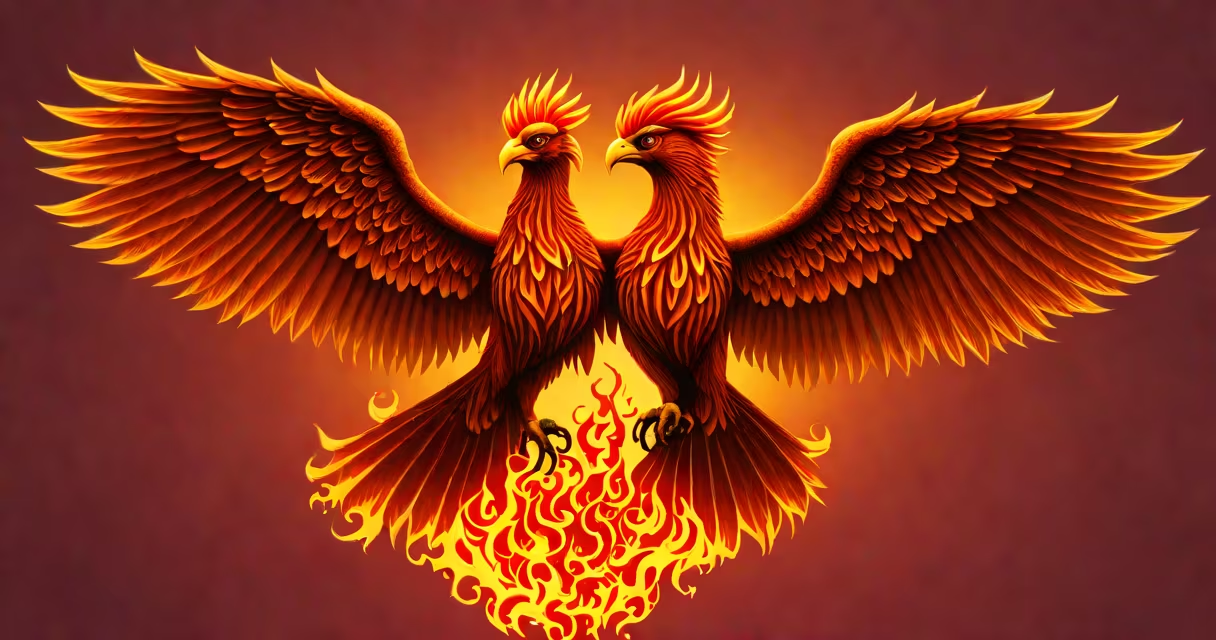
The phoenix bird meaning represents rebirth, immortality, and renewal through fire. This mythical creature is reborn from its own ashes after burning completely, symbolizing resilience, transformation, and eternal life across cultures.
Rooted in ancient traditions, the phoenix appears in Egyptian, Greek, Roman, and Chinese mythology. In each culture, it embodies the cycle of death and regeneration. The bird's fiery destruction and revival make it a useful metaphor for personal renewal, spiritual awakening, and overcoming hardship.
Its presence in religious texts, literature, and modern branding reflects enduring human fascination with transcendence. The phoenix is not merely a creature-it is a concept of transformation that persists across millennia.
The phoenix is described as a large, colorful bird-often red, gold, or orange-with a long tail and radiant plumage. It lives for 500 to 1,000 years before building a nest of aromatic wood, setting itself ablaze, and being consumed by fire. From the ashes, a new phoenix emerges, beginning the cycle anew.
This process is not random. The bird chooses the moment of its own destruction. Ancient writers like Pliny the Elder in *Naturalis Historia* (Book 10) described the phoenix as a solitary creature that returns to its birthplace to die and be reborn. Its lifespan and ritualistic self-immolation show a deliberate act of renewal.
Modern interpretations extend this idea beyond myth. Psychologists use the phoenix as a symbol of recovery from trauma, addiction, or mental health struggles. The bird's return from ashes mirrors the psychological concept of post-traumatic growth-where individuals emerge stronger after suffering.
The earliest known version of the phoenix appears in ancient Egypt, where the Bennu bird-a heron-like creature associated with the sun god Ra-was linked to creation and resurrection. The Bennu was believed to rise from the primordial waters each morning, echoing the daily rebirth of the sun.
Greek and Roman authors adapted the myth. In the *Historiae* by Diodorus Siculus (1st century BCE), the phoenix is said to appear once every 500 years, flying to Egypt's Heliopolis to lay an egg on the altar of the sun god. After the egg hatches, the bird burns itself and is reborn.
In East Asia, the phoenix (Fenghuang) is a composite creature-part bird, part dragon-with symbolic roles in Confucianism and Daoism. Unlike the Western phoenix, the Fenghuang is not destroyed by fire. Instead, it symbolizes harmony, virtue, and the ideal ruler. It appears during times of peace and prosperity, often paired with the dragon in imperial iconography.
A table comparing key versions:
| Culture | Origin Name | Rebirth Mechanism | Symbolic Role |
|---|---|---|---|
| Egyptian | Bennu | Rises daily from primeval waters | Sun deity, creation |
| Greek/Roman | Phoenix | Self-immolation and ash rebirth | Immortality, cyclical time |
| Chinese | Fenghuang | Not destroyed; symbol of grace and balance | Harmony, virtue, imperial power |
The phoenix remains a potent symbol in modern contexts. It appears in corporate logos-such as the Phoenix Group in the UK, which rebranded from a failed insurance company-to signal recovery and renewal. The bird's image is common in tattoos, representing personal healing or overcoming adversity.
It features in literature and film. In J.K. Rowling's *Harry Potter* series, Fawkes-the loyal phoenix belonging to Albus Dumbledore-demonstrates loyalty and resurrection. His tears heal wounds, and he dies only to return, reinforcing the theme of sacrifice and rebirth.
Academic research supports the psychological weight of the symbol. A 2018 study published in *Journal of Personality and Social Psychology* found that people who identified with the phoenix archetype reported higher resilience and lower fear of failure. The myth functions as a cognitive scaffold for coping with loss and change.
Many assume the phoenix is purely a Western symbol. In reality, the concept of a bird reborn from fire predates Greco-Roman tradition. The Egyptian Bennu and Chinese Fenghuang show that the idea of cyclical renewal through avian forms existed independently across continents.
Another error is equating the phoenix with the "immortal" in a literal sense. The bird doesn't live forever-it dies and is reborn. Its immortality lies in the cycle, not in endless existence. This distinction matters: the phoenix is not invincible, but persistent.
A lesser-known fact: the name "phoenix" may derive from the Greek word *phoinix*, meaning "date palm." Some scholars suggest the original term referred to a red-colored bird linked to the sun, possibly conflated with palm trees in early Mediterranean imagery. This etymology hints at a deeper connection between fire, fertility, and sacred plants.
In 2016, a woman named Maria lost her job, her home, and her partner within six months. She struggled with depression and felt trapped. During therapy, she began using the phoenix as a visual metaphor. She wrote a journal entry: "I am not dead. I am burning. And I will rise."
She got a new job in environmental design, moved to a small town, and started volunteering. Two years later, she launched a nonprofit helping others rebuild after crises. Her website features a phoenix logo with the tagline: "From ashes, we grow."
Maria's story illustrates how the phoenix bird meaning transcends myth. It becomes a lived narrative of survival and reinvention. Her experience aligns with research showing that symbolic metaphors improve mental health outcomes in trauma recovery.
The phoenix is sometimes confused with the *basilisk*, a serpent-like creature said to kill with a glance. Or with the *chimera*, a hybrid monster made of parts from different animals. These creatures represent danger and chaos, while the phoenix embodies controlled transformation and hope.
It's also distinct from the *salamander*, a mythical creature believed to survive fire. Salamanders were thought to live in flames, but they don't die and regenerate. The phoenix's self-destruction and rebirth are unique.
The phoenix bird meaning is not static. It evolves with culture, psychology, and personal experience. Whether seen in ancient scripture, a tattoo, or a brand's mission statement, it speaks to the universal desire to rise after falling.