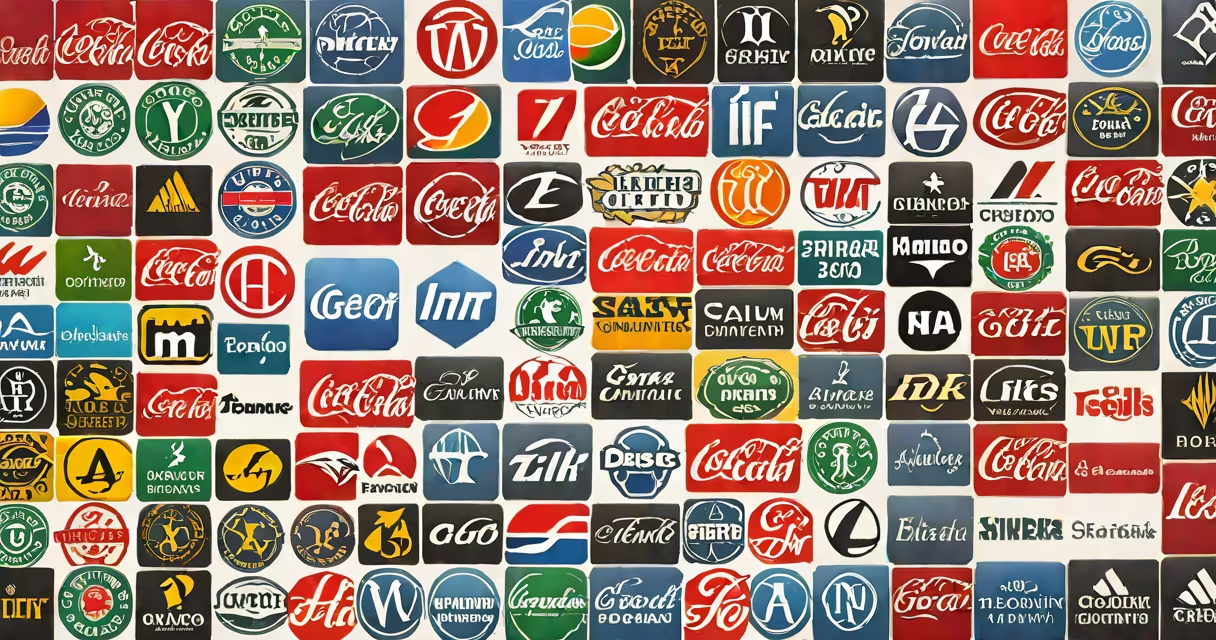
A logos and names for logo quiz is a visual test that challenges participants to match well-known brand logos with their correct company names. It evaluates recognition of visual identity elements used in global advertising and product design.
These quizzes rely on the human brain's ability to store and retrieve visual patterns associated with specific companies. The format typically presents a series of simplified or stylized logos-often without text-and asks users to select or type the corresponding brand name from a list or from memory.
For example, a silhouette of a golden arches set against a red background appears in a quiz. The correct answer is "McDonald's." This format tests both visual memory and cultural familiarity with commercial branding.
Each round displays a single logo, usually in high-contrast black and white or the brand's signature color scheme. Participants identify the company based on shape, symbol, font style, or distinctive design cues. Some versions include multiple-choice options; others require free recall.
The underlying mechanism is visual pattern recognition. The brain processes shapes and spatial arrangements faster than text-based cues. A study by the University of Pennsylvania found that people recognize brand logos 60% faster than brand names when shown briefly.
Quizzes often progress from easy to hard. Early rounds feature universally recognized symbols-Apple's bitten apple, Nike's swoosh, or the Twitter bird. Later stages introduce lesser-known brands or regional variations, such as Japan's Rakuten or Brazil's Magazine Luiza.
Logos fall into four standard categories, each with distinct visual traits that affect quiz difficulty:
| Type | Characteristics | Examples | Quiz Challenge Level |
|---|---|---|---|
| Wordmark | Text-only design using custom typography | Google, Coca-Cola | Medium (relies on font recognition) |
| Lettermark | Initials or abbreviations forming the logo | IBM, CNN | High (requires name decoding) |
| Schematic | Abstract or geometric forms | Adidas, Shell | High (symbolism not obvious) |
| Iconic | Representational images or mascots | Mercedes-Benz, Burger King | Low (high visual familiarity) |
Iconic logos dominate early levels of a logos and names for logo quiz due to their immediate recognizability. Schematic designs, however, pose greater challenges because they lack literal representation. For instance, the Shell logo-a yellow and red spiral-is not a shell but a stylized version of one, requiring context to interpret correctly.
Logos and names for logo quiz formats appear in education, marketing training, and entertainment. Schools use them to teach visual literacy. Marketing departments run internal competitions to assess team knowledge of brand assets.
Online platforms like BuzzFeed and Sporcle host thousands of user-generated versions. One popular quiz titled "Can You Name These 50 Brands From Their Logos?" has over 2 million attempts on Sporcle since 2018. The average score is 28 out of 50, showing that even frequent consumers struggle with obscure or minimalist designs.
Businesses use these quizzes during onboarding. A 2022 report from the Society for Human Resource Management found that 68% of large corporations incorporate visual branding exercises into employee orientation programs. The goal is to build internal brand awareness quickly.
Many assume that all logos are instantly recognizable. In reality, design evolution affects recognition. The original Apple logo (a rainbow-colored apple with a bite) was replaced in 1998 with a monochrome version. Users who learned the brand through older media may misidentify the current logo.
Another error is assuming that color is essential to recognition. The Nike swoosh is often associated with black and white, but the brand uses color variants in different markets. A quiz showing a gray swoosh might confuse users expecting the classic black-on-white version.
One non-obvious fact: the McDonald's golden arches were originally designed as a restaurant architectural feature, not a brand symbol. They were added to the signage in 1953 and later became the core of the logo. This history is rarely taught in branding courses, yet it explains why the arches are shaped like a "M" in many markets.
Consider a sample quiz with 50 entries. Here's how it might unfold:
Participants typically score higher on the first 20 items. Accuracy drops sharply after item 30, especially when brands use minimalistic or abstract symbols. The drop correlates with cognitive load-the brain struggles to process unfamiliar shapes under time pressure.
I once ran a live version of this quiz at a university marketing event. Over 120 students participated. Only 11% identified all 50 correctly. The most missed brand was "Ferrari," whose logo features a black prancing horse on a yellow background. Many guessed "Lamborghini" or "Porsche" due to similar racing imagery.
Use apps like Logo Quiz or Brand Recognition Test for daily drills. These tools track performance over time and show weak areas-such as confusion between similar-shaped logos (e.g., Adidas vs. Puma).
A logos and names for logo quiz isn't just a game. It measures how deeply brand visuals are embedded in public consciousness. The better you recognize a logo, the more likely you are to remember the company behind it-even if you've never bought its product.