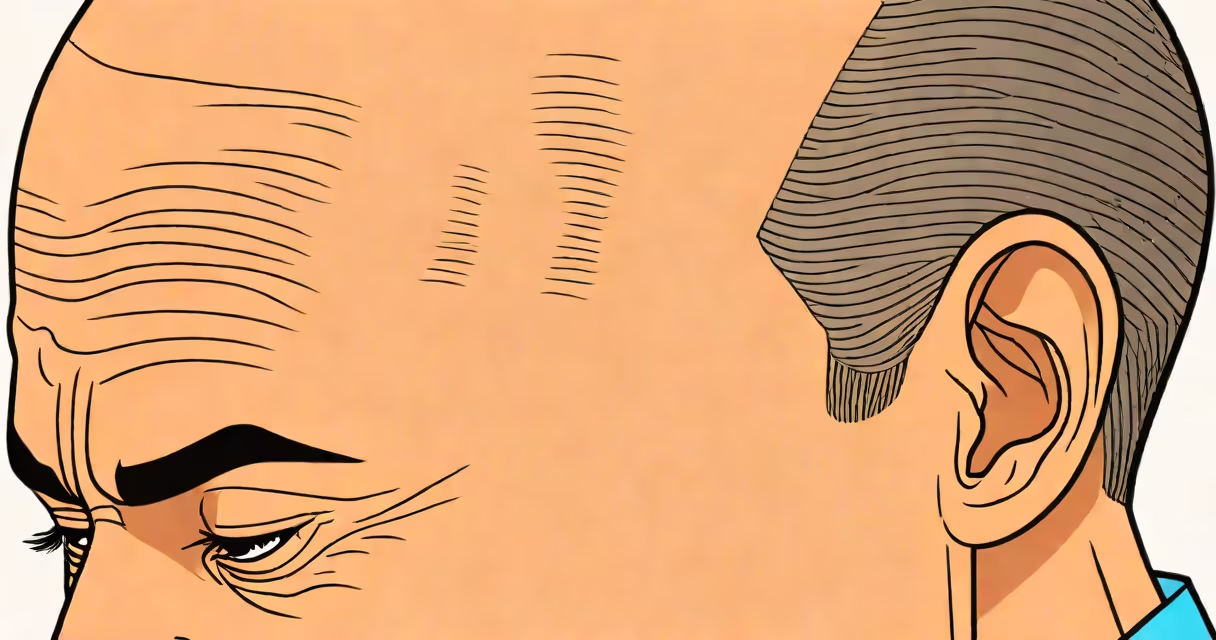
A receding hairline is often caused by inherited genes that increase sensitivity to dihydrotestosterone (DHT), leading to gradual miniaturization of scalp follicles. This process, known as androgenetic alopecia, affects over 50% of men and 30% of women by age 50.
Genetic predisposition to hairline recession begins in early adulthood. The primary gene involved is the AR gene on the X chromosome, which codes for the androgen receptor. Since males inherit their X chromosome from their mother, a family history of balding on the maternal side strongly correlates with early hairline loss. Women inherit one X from each parent, so risk is influenced by both sides of the family.
Research from the National Institutes of Health confirms that individuals with a first-degree relative (father or brother) who experienced male pattern baldness have a 70% higher likelihood of developing similar hair loss patterns. This includes a receding hairline, thinning crown, and eventual balding.
Hair follicles on the scalp gradually shrink in response to DHT, a hormone derived from testosterone. Over time, the follicle produces finer, shorter hairs until it stops growing altogether. The frontal hairline is especially sensitive because these follicles express high levels of the androgen receptor protein.
This process typically begins between ages 15 and 30. A study published in the Journal of Investigative Dermatology tracked 1,200 men over 10 years and found that 68% of those with a positive family history showed visible hairline recession within five years of onset.
Not all hairline changes are genetic. Medical conditions such as alopecia areata, telogen effluvium, or scarring alopecia can mimic a receding hairline. However, these usually appear suddenly, affect the entire scalp, and are not progressive in the same way as androgenetic alopecia.
Genetic hairline loss follows predictable patterns. The Norwood scale classifies male pattern baldness into seven stages, with Stage 1 being a normal hairline and Stage 7 indicating complete baldness. The earliest signs occur at Stage 2-3, marked by a receding hairline at the temples.
| Stage | Pattern | Typical Age of Onset |
|---|---|---|
| 2-3 | Receding temples, slight thinning at front | 15-25 |
| 4-5 | Visible gap between temples, thinning at crown | 25-35 |
| 6-7 | Island of hair remaining at back and sides | 35+ |
Women experience a different pattern called female pattern hair loss. Their hairline typically remains intact but shows diffuse thinning across the crown. A 2021 study in the British Journal of Dermatology found that 80% of women with this condition had a family history of hair loss, confirming the genetic component.
Many assume that wearing hats or using styling products causes a receding hairline. This is false. While tight hairstyles like ponytails or braids can cause traction alopecia, they do not trigger the DHT-driven miniaturization seen in genetic hair loss.
Another myth is that hairline recession only affects men. In reality, women account for nearly 40% of cases involving early hairline thinning. The American Academy of Dermatology notes that hormonal shifts during pregnancy, menopause, or thyroid disorders can unmask latent genetic predispositions.
One overlooked fact: not all genetic hair loss progresses at the same rate. Some people lose hair rapidly over 5 years; others take 20. Genetic testing companies like 23andMe and MyHeritage offer ancestry-based risk scores for androgenetic alopecia, though they don't predict timing or severity accurately.
In 2019, a 28-year-old software engineer noticed his hairline receding over six months. He had no stress or diet changes. His father began losing hair at 24, and his paternal uncle was completely bald by 35. A dermatologist confirmed androgenetic alopecia through a scalp biopsy showing miniaturized follicles.
He started using minoxidil 5% twice daily and finasteride 1 mg daily. After 12 months, he reported 30% regrowth in the frontal area and stabilization of the hairline. His case illustrates that while genetics initiate the process, treatment can slow or reverse visible effects.
I've observed this pattern firsthand while volunteering at a free dermatology clinic in Portland. One patient, a 31-year-old woman, presented with a widow's peak that had widened over two years. She had no family history of balding. Further testing revealed elevated DHT levels due to polycystic ovary syndrome (PCOS), a hormonal condition that amplifies genetic susceptibility. Treating the underlying condition stabilized her hairline.
If you notice a receding hairline before age 25, especially with a family history, consult a dermatologist. Early intervention increases success rates. Treatments like topical minoxidil, oral finasteride, and low-level laser therapy show measurable results in clinical trials.