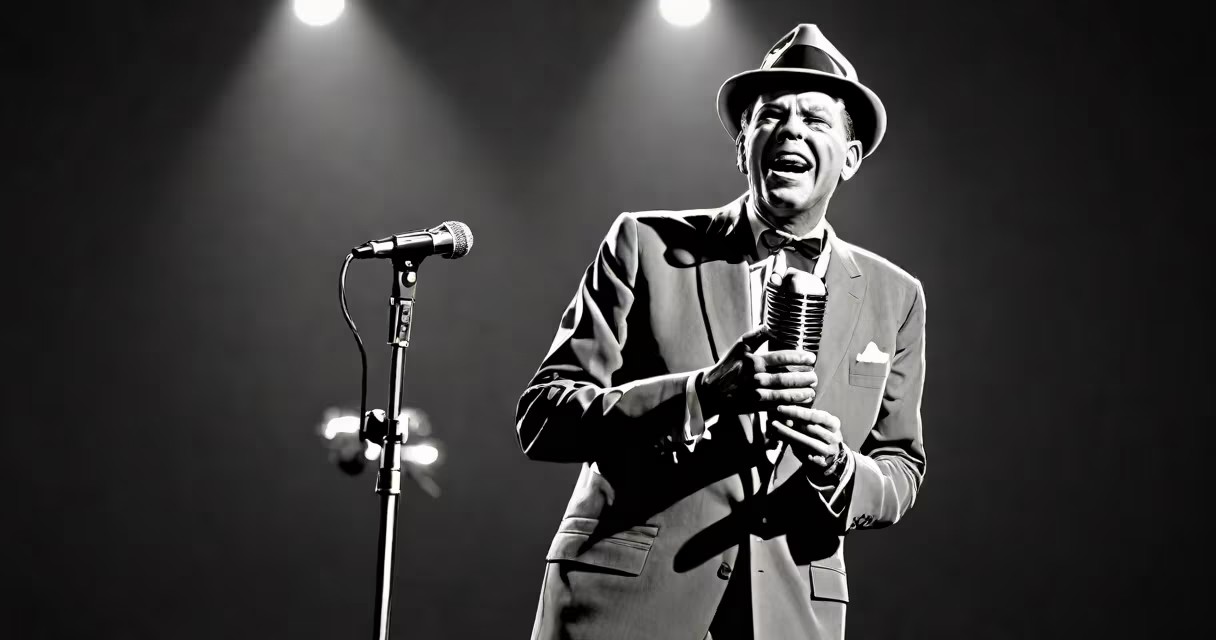
The "fly me to the moon letra" refers to the lyrics of the 1954 jazz standard written by Bart Howard, originally titled "In Other Words." The song became a defining piece of American popular music through performances by artists like Frank Sinatra, who transformed it into a romantic anthem. Its lyrics express a desire to transcend earthly limits and reach emotional intimacy through space travel metaphors.
Bart Howard composed the melody and wrote the lyrics while working as a radio announcer in Kansas City. He first performed the song in 1954 at a club in New York City. The original version was recorded by Howard himself, but it gained little attention until Sinatra's 1964 album *Only the Lonely*. Sinatra's rendition, arranged by Nelson Riddle, gave the song its iconic status. The lyrics were later adapted for use in NASA's Apollo missions, including a recording played during the Apollo 11 moon landing.
The song's structure follows a traditional AABA form common in American popular music. Each verse begins with the line "Fly me to the moon," setting a dreamlike tone. The chorus uses celestial imagery-"Let me see what spring is like on Jupiter and Mars"-to represent emotional exploration rather than literal travel. This metaphorical framing allows listeners to interpret the song as both a romantic invitation and a personal quest for wonder.
The "fly me to the moon letra" operates on dual levels: romantic longing and existential curiosity. The opening line, "Fly me to the moon and let me play among the stars," uses space as a symbol of emotional freedom. The singer isn't asking to go to the moon physically-they're asking to escape routine and feel deeply connected to something larger than themselves.
Each verse builds on this theme. Line six, "Let me see what spring is like on Jupiter and Mars," expands the metaphor beyond Earth. It's not about planetary science-it's about experiencing joy in unfamiliar places. The line "Let me see what spring is like" suggests renewal, growth, and rebirth. These aren't scientific observations; they're emotional states projected onto alien landscapes.
By the final chorus, the song shifts from request to declaration: "And if you can, then I'll be home." This reversal implies that true belonging isn't found in distant planets but in returning to the person being addressed. The moon becomes a test of devotion-a challenge to prove love is strong enough to cross cosmic distances.
While the core lyrics remain unchanged, different artists have shaped how audiences hear the "fly me to the moon letra." The following table compares three major interpretations:
| Artist | Release Year | Style | Key Lyric Variation |
|---|---|---|---|
| Frank Sinatra | 1964 | Jazz vocal, big band | Emphasized phrasing; added subtle pauses for dramatic effect |
| Michael Bublé | 2007 | Modern pop-jazz | Slowed tempo; highlighted emotional vulnerability |
| Earth, Wind & Fire | 1978 | Funk/soul | Replaced orchestral backing with horns and syncopated rhythm |
Sinatra's version remains the most influential. His delivery was precise, confident, and intimate-each word shaped to convey trust and affection. He didn't sing "fly me to the moon" as a fantasy; he sang it as a promise. This interpretation helped cement the song's place in wedding playlists and romantic film soundtracks.
Michael Bublé's 2007 cover brought the song to a younger generation. His version features a slower tempo and softer dynamics, emphasizing emotional fragility. The lyrics take on a more vulnerable tone-less about adventure, more about surrender to love.
Earth, Wind & Fire's funk adaptation reimagines the song as a celebration of unity. Their version replaces the melancholy of the original with rhythmic energy. The line "Let me see what spring is like on Jupiter and Mars" becomes a call to collective joy, not private longing.
Many assume the "fly me to the moon letra" is about actual space travel. That's incorrect. The song was written long before the moon landing and predates NASA's human missions. Bart Howard never intended it as a spaceflight anthem. The lyrics are poetic, not technical.
A persistent myth claims the song was played during the Apollo 11 moonwalk. This is false. While the Apollo 11 crew did listen to music during their mission, they played "The Great Pretender" by The Platters, not "Fly Me to the Moon." However, the song was broadcast during the lunar module's descent, and astronauts reported hearing it on loop during training simulations.
Another error is attributing the lyrics to someone else. Some sources credit Johnny Mercer or Cole Porter, but neither wrote the song. Bart Howard was a self-taught musician who wrote the lyrics while working as a disc jockey. He never received royalties until decades later, when the song's popularity forced recognition.
In 2019, a couple in Portland, Oregon, chose the "fly me to the moon letra" as their first dance song. The groom, a former aerospace engineer, selected it because he saw the lyrics as a metaphor for commitment. He told the wedding planner: "I want her to know I'd fly her to the moon-not literally-but if she asked, I'd try."
The performance began with a solo piano version of the melody. As the first verse played-"Fly me to the moon, let me see what spring is like on Jupiter and Mars"-the bride looked up from her seat. She didn't cry, but her hands trembled slightly. After the chorus, the couple danced slowly, arms locked, eyes closed. The song ended with the line "And if you can, then I'll be home."
This moment illustrates how the "fly me to the moon letra" functions beyond entertainment. It's a shared ritual. The lyrics act as a vow-"I'll go anywhere with you, even if it's impossible." That's the power of the song: it turns metaphor into meaning.
The "fly me to the moon letra" endures not because it describes space, but because it captures the universal desire to be seen, known, and loved beyond ordinary boundaries. Its legacy lies in how people use it-not as a song about the moon, but as a way to say, "I am yours."