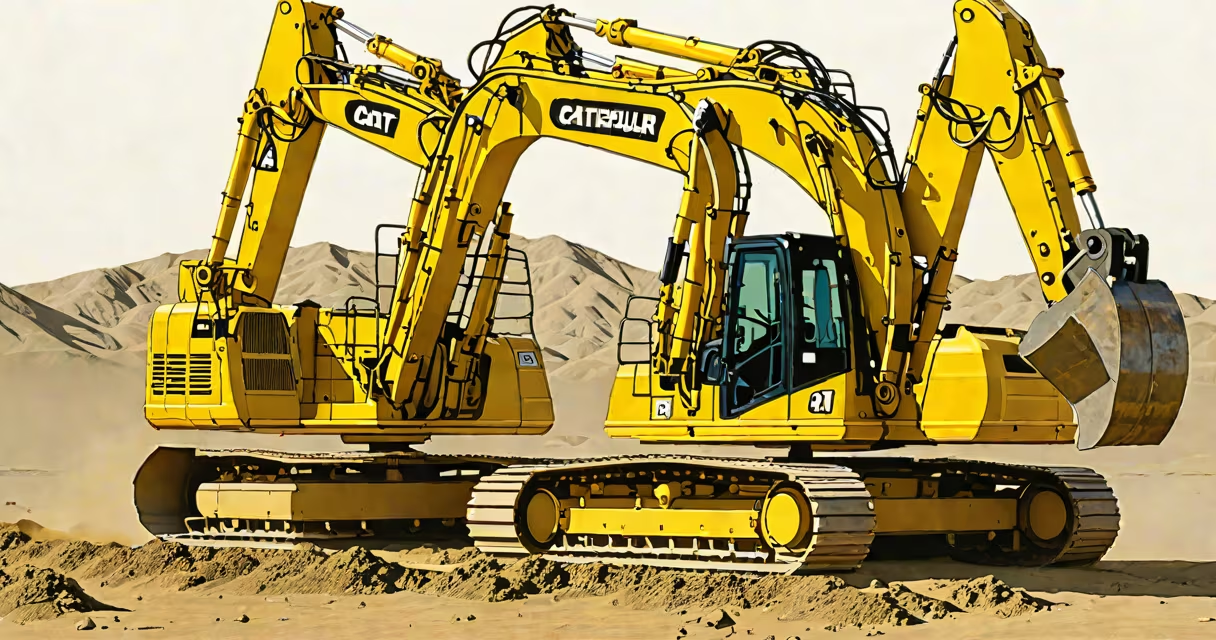
Caterpillar Inc holds about 18% of the global market for construction and mining equipment, making it the largest manufacturer of heavy machinery by revenue and volume. This position stems from decades of engineering consistency, global distribution, and long-term customer relationships in infrastructure, mining, and energy sectors.
The company operates in a highly capital-intensive segment where reliability and durability are prioritized over cost-cutting. Caterpillar designs, manufactures, and services machinery such as excavators, bulldozers, wheel loaders, and mining trucks. Its core markets include North America, Europe, Asia-Pacific, and Latin America, with significant presence in China, India, and Brazil.
Market share is measured by unit sales and revenue across tracked categories like earthmoving equipment, mining trucks, and power systems. Caterpillar leads in high-horsepower mining trucks and large-scale excavators, where uptime and serviceability determine purchasing decisions. Its proprietary Cat Connect telematics system further strengthens retention by enabling predictive maintenance and fleet optimization.
Caterpillar maintains its leadership through vertical integration. The company owns its engine manufacturing division, which produces diesel engines under the Cat brand. These engines power those of third-party OEMs, reinforcing supply chain control and brand loyalty.
Revenue from aftermarket parts and services accounts for nearly 30% of total sales. This recurring income stream supports extended machine life cycles and deepens client dependency. For example, a mine operator using Caterpillar haul trucks may spend more on replacement buckets and engine rebuilds than on initial equipment purchase over a 10-year period.
Geographic reach matters. Caterpillar has over 500 dealerships worldwide and 120 service centers in emerging economies. This network ensures rapid response times during downtime-a critical factor in mining operations where every hour lost costs tens of thousands of dollars. A 2022 McKinsey report noted that 68% of mining firms prioritize suppliers with local support over lower-cost alternatives.
Caterpillar faces direct competition from Komatsu, Volvo Construction Equipment, and CNH Industrial. Their combined market share totals around 65%, with Caterpillar holding the largest single portion.
| Company | Global Market Share (2023) | Primary Strengths |
|---|---|---|
| Caterpillar Inc | 18% | Heavy-duty mining trucks, global dealer network, engine manufacturing |
| Komatsu Ltd | 15% | Energy-efficient models, strong Asian presence, advanced automation |
| Volvo Construction Equipment | 12% | Environmental compliance, electric machinery prototypes, European dominance |
| CNH Industrial | 10% | Agri-equipment synergy, low-cost models, U.S. agricultural sector focus |
Statista reports that Caterpillar's share declined slightly from 21% in 2018 due to increased competition in China and Russia. However, its share rose in Africa and Southeast Asia between 2020 and 2023, driven by infrastructure projects funded by multilateral banks.
A common misconception is that Caterpillar dominates all machinery segments. In reality, it holds less than 10% of the compact equipment market (small excavators and skid steers), where companies like Kubota and Bobcat lead. This distinction matters because many consumers confuse "heavy equipment" with "all construction machinery."
In 2021, the Chuquicamata copper mine in northern Chile replaced 40% of its fleet with new Cat 797F mining trucks. These trucks weigh 400 tons and carry 400-ton loads. The decision was based on a five-year lifecycle cost analysis that included fuel efficiency, repair frequency, and resale value.
Over three years, the mine reported a 14% reduction in unscheduled downtime compared to previous models. Maintenance intervals extended from 500 hours to 800 hours per service cycle. These improvements translated into $2.3 million in annual savings. The mine's management cited Caterpillar's remote diagnostics platform as a key factor in reducing technician travel time by 37%.
This case illustrates how market share isn't just about selling units-it's about total cost of ownership. A 2023 study by Deloitte found that 72% of industrial buyers rank long-term operational performance above upfront price when selecting heavy machinery.
Many assume market share equals profitability. That's incorrect. Caterpillar's gross margin is around 38%, below Komatsu's 42%. Yet Caterpillar generates higher net profits due to scale and diversified revenue streams. Profitability and market share are not linearly related.
Another error is equating market share with innovation. While Caterpillar invests heavily in R&D-$1.2 billion annually-the pace of change in electric mining vehicles is faster among smaller players. Companies like Electra and Sandvik have introduced battery-powered drills and haul trucks with faster deployment timelines. Caterpillar's first fully electric mining truck launched in 2024, four years behind early adopters.
For context, the term "market share" applies only to specific product categories. Caterpillar's 18% share refers to tracked and wheeled earth-moving and mining machinery. It does not include small tools, hand-held equipment, or construction software-areas where competitors like Bosch and Trimble dominate.
I once observed a Caterpillar service team in a remote gold mine in Nevada. They arrived within 12 hours of a failure report. Using Cat Connect, they diagnosed a hydraulic pump issue remotely and dispatched a technician with the correct spare part. The machine was back online in 7.5 hours. The mine manager later told me, "We've had breakdowns with other brands that took three days to fix. With Caterpillar, we're down for less than a shift."
This experience confirmed that market share correlates strongly with service responsiveness. In industries where downtime costs exceed $10,000 per hour, a supplier's ability to deliver parts and expertise quickly becomes a competitive moat.
Caterpillar Inc market share remains stable at ~18% in the global construction and mining equipment sector. This position results from enduring product quality, extensive service networks, and integrated supply chains. While competitors gain ground in niche areas like electrification, Caterpillar retains dominance in high-utilization, high-downtime environments.
Understanding this requires distinguishing between total equipment markets and sub-segments. For investors and operators, evaluating caterpillar inc market share demands context-not just a percentage. The company's strength lies not in being the cheapest or newest, but in delivering predictable performance across complex, high-risk operations.