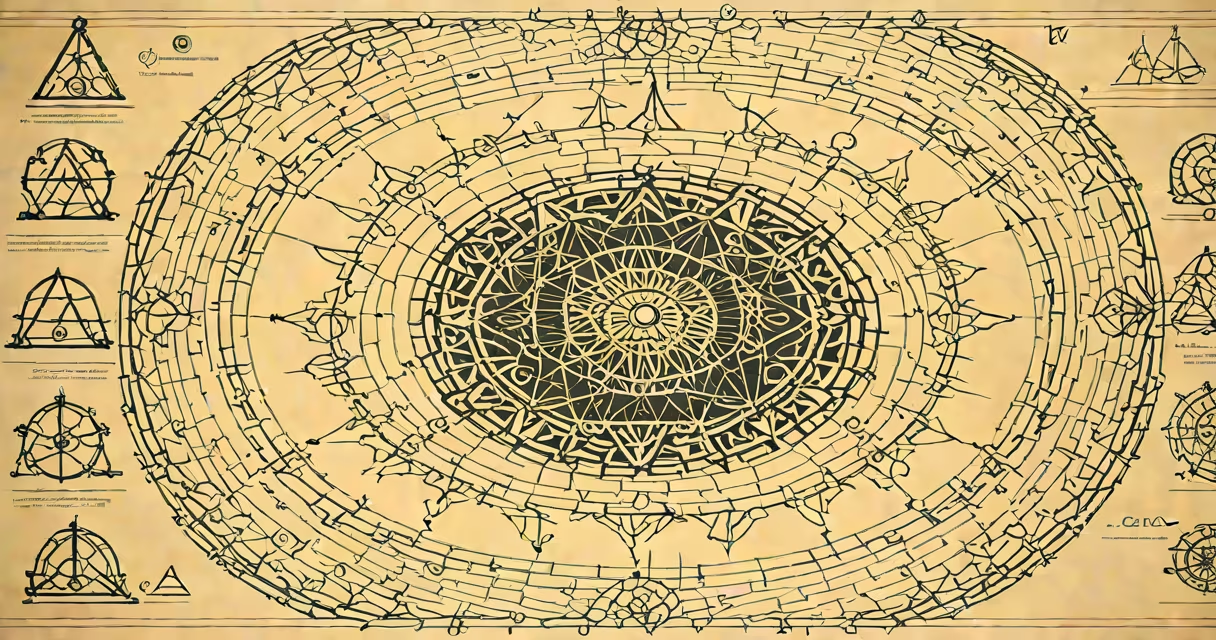
Alchemy symbols and their meanings are visual shorthand for elements, processes, and spiritual states used in medieval and Renaissance esoteric traditions. These symbols encoded chemical transformations, metaphysical journeys, and hidden knowledge passed through manuscripts and coded texts.
Alchemists used these signs not as decoration but as precise tools. Each symbol represented a substance, stage of transformation, or philosophical idea. The system emerged in the 12th century, drawing from Greco-Roman philosophy, Islamic science, and Christian mysticism. By the 16th century, alchemy had developed a standardized iconography used across Europe.
Modern practitioners still reference these symbols in ceremonial work, art, and symbolic psychology. Carl Jung studied them as archetypes of personal transformation. The Royal Society of Chemistry notes that many early chemical symbols evolved directly from alchemical notation.
Each alchemy symbol served multiple roles: as a label for a material, a descriptor of a process, or a metaphor for inner change. They were not arbitrary. Their forms often reflected the perceived nature of the subject-geometric shapes for stability, flowing lines for movement, and animal motifs for hidden qualities.
For example, the symbol for mercury (☿) combines a circle with a cross-representing the union of spirit (circle) and matter (cross). This dualism was central to alchemical thought: all physical change mirrored spiritual purification. The symbol's form reflects both the metal's fluidity and its role as a universal solvent.
These symbols were embedded in diagrams, recipes, and meditative exercises. A single manuscript might show a furnace with the symbol for sulfur (🔥) above it and the sign for gold (☉) below, indicating the goal: transforming base matter into the noble metal.
The following table outlines 12 foundational alchemy symbols, their original forms, and their meanings in context.
| Symbol | Name | Meaning | Historical Source |
|---|---|---|---|
| ☿ | Mercury | Universal solvent; major agent; mind and communication | Hermetic writings, 13th-century German manuscripts |
| ☉ | Sun | Gold; divine light; perfection; masculine principle | Paracelsus's *Liber de Natura* (1537) |
| ☽ | Moon | Silver; intuition; feminine principle; emotional area | Arabic alchemical treatises, translated by Gerard of Cremona |
| 🜂 | Earth | Stability; foundation; materiality; the physical world | Robert Fludd's *Utriusque Cosmi Historia* (1617) |
| 🜃 | Air | Thought; intellect; breath; subtle forces | Isaac Newton's unpublished alchemical notebooks |
| 🜄 | Water | Emotion; receptivity; purification; subconscious | Corpus Hermeticum, 2nd century CE |
| 🜅 | Fire | Passion; destruction; regeneration; spiritual energy | John Dee's *Monas Hieroglyphica* (1564) |
| 🜆 | Sulfur | Essence; soul; combustibility; spiritual fire | Geber's *Summa Perfectionis* (13th century) |
| 🜇 | Salts | Structure; preservation; bodily form; the material base | Paracelsus, *De Natura Rerum* (1537) |
| 🜈 | Lead | Base matter; ignorance; initial state of transformation | Anonymous 14th-century French alchemical codex |
| 🜉 | Iron | Strength; endurance; willpower; the warrior spirit | Arnold of Villanova's *Liber de Alchimia* |
| 🜊 | Quicksilver | Mercury in liquid form; duality; the philosopher's stone | Michael Maier's *Atalanta Fugiens* (1618) |
These symbols were rarely used in isolation. In the *Mutus Liber* (1677), a silent alchemical book with no text, images and symbols conveyed the entire process of spiritual transmutation. One plate shows a man holding a mirror (symbolizing self-knowledge) while standing between two doors-one labeled "Abyss" (🜄), the other "Light" (☉).
Many symbols were adapted into modern systems. The alchemical symbol for sulfur (🔥) influenced the design of the modern flame symbol for flammable materials. The Royal Society of Chemistry confirms that the current hazard symbol for flammability (a red flame) evolved from the alchemical sign for fire.
Alchemists did not merely seek to turn lead into gold. That outcome was symbolic. The real goal was *magnum opus*-the Great Work-spiritual enlightenment through inner transformation. The process of turning base metals into gold represented the purification of the soul.
Another myth is that alchemy was purely mystical. In reality, alchemists conducted experiments with glassware, distillation, and metal assays. Isaac Newton spent decades studying alchemy, not as fantasy but as a structure for understanding matter and force. His notebooks contain detailed calculations using alchemical symbols.
Some assume all alchemy symbols are derived from astrology. While there is overlap-sun for gold, moon for silver-the roots are deeper. The symbol for mercury (☿) predates astrological associations. It originated in Greek mythology as the messenger god, later adopted by alchemists for its ability to move between states.
Today, alchemy symbols appear in psychological models, art, and even branding. Carl Jung used them to map stages of individuation. His *Red Book* contains alchemical illustrations that depict the psyche's process toward wholeness.
I once attended a workshop in Zurich where participants drew their own alchemical diagrams based on personal challenges. One person used the symbol for salt (🜇) to represent the grounding they needed during a career shift. The symbol stood for structure, something they felt was missing.
These symbols remain useful in creative and therapeutic contexts. A therapist might use the symbol for fire (🜅) to discuss anger management, or water (🜄) for emotional regulation. The visual language offers a non-verbal way to explore complex internal states.
Understanding alchemy symbols and their meanings requires seeing beyond the surface. They are not relics of superstition but tools of perception-mapping the invisible dimensions of matter, mind, and spirit.