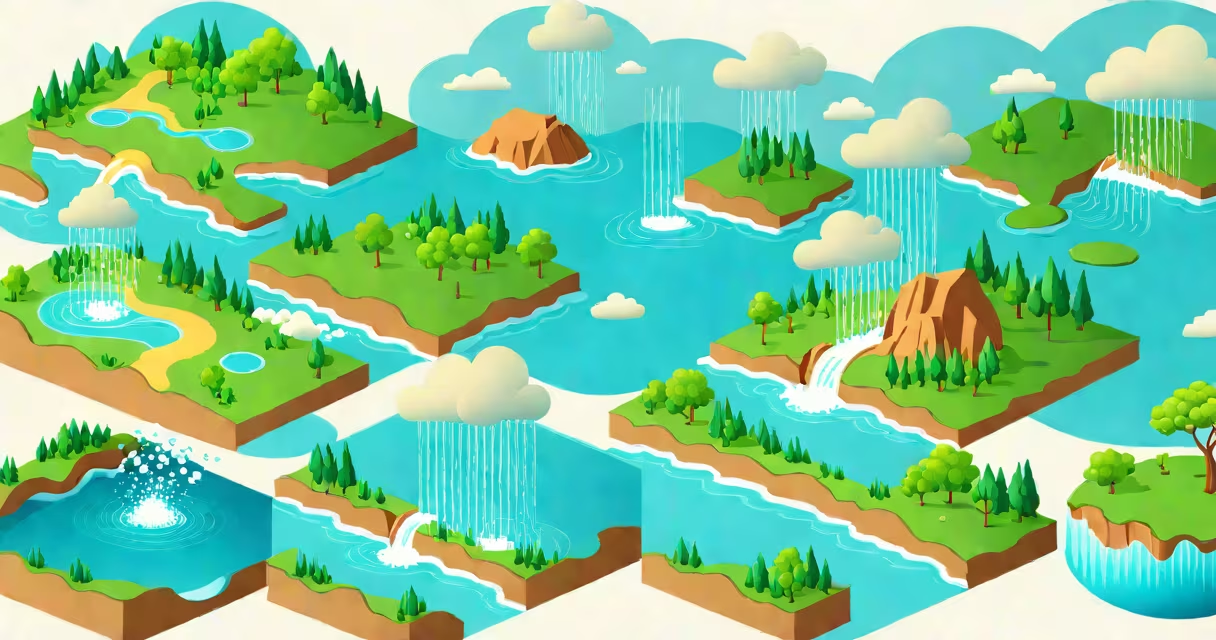
The 3 stages of the water cycle are evaporation, condensation, and precipitation. This continuous movement of water between Earth's surface and atmosphere maintains global water balance and supports ecosystems.
Water begins its process when solar energy heats liquid water from oceans, lakes, rivers, and soil. This causes evaporation-the phase change from liquid to vapor. Warm air rises, carrying water vapor upward. As altitude increases, temperature drops. When air cools below the dew point, water vapor condenses into tiny droplets around microscopic particles like dust or salt. These droplets cluster into visible clouds. Once cloud droplets grow large enough, gravity pulls them down as precipitation-rain, snow, sleet, or hail-returning water to Earth's surface.
Evaporation accounts for roughly 90% of atmospheric moisture. According to the U.S. Geological Survey, 86% of global evaporation occurs from oceans. Condensation typically happens at altitudes between 1,000 and 6,000 meters. Precipitation varies widely: tropical regions receive over 2,500 mm annually, while deserts average less than 250 mm. The entire cycle completes in days to years depending on location and climate conditions.
Each stage depends on the previous. Without evaporation, there would be no water vapor to form clouds. Without condensation, clouds wouldn't develop. Without precipitation, land-based ecosystems would dry out. Together, they create a closed-loop system where water is neither created nor destroyed-only transformed and relocated.
For example, during a summer afternoon in Florida, surface temperatures reach 32°C (90°F). Water from the Atlantic Ocean evaporates at a rate of approximately 1.5 mm per hour. Rising warm air carries this vapor upward. At 3,000 meters, temperatures drop to −5°C (23°F). Water vapor condenses into ice crystals and liquid droplets, forming cumulonimbus clouds. After several hours, droplets combine and fall as heavy thunderstorms-precipitation returning 50-100 mm of rain per storm.
Condensation doesn't require freezing. In warmer climates, such as the Amazon Basin, condensation occurs at temperatures above 10°C. Cloud formation relies on humidity levels exceeding 70%. When relative humidity reaches 100%, condensation becomes inevitable-even without cooling.
The 3 stages apply universally, but their timing and intensity differ based on geography and season. The following table outlines regional variations:
| Region | Primary Evaporation Source | Typical Condensation Altitude | Precipitation Type |
|---|---|---|---|
| Tropical Rainforest | Forests, rivers | 1,500-3,000 m | Rain |
| Arctic Tundra | Lakes, snowmelt | 500-1,500 m | Snow, sleet |
| Desert (e.g., Sahara) | Soil, sparse vegetation | 1,000-2,000 m | Rare; mostly dust storms |
| Coastal Mediterranean | Oceans, urban runoff | 2,000-4,000 m | Short bursts of rain |
Evaporation rates increase by 7% per 1°C rise in temperature, according to the Intergovernmental Panel on Climate Change (IPCC). This means warming climates intensify evaporation, altering rainfall patterns globally.
Many assume precipitation is the primary driver of the water cycle. In reality, evaporation initiates the process. Without evaporation, no water enters the atmosphere. Another error is thinking condensation only forms in cold air. It occurs when air cools to its dew point-regardless of absolute temperature. A warm, humid room can trigger condensation on a cold windowpane.
Some confuse the water cycle with groundwater flow. While groundwater is part of the larger hydrological cycle, it operates independently of the 3-stage model. Groundwater movement takes decades to centuries-far slower than atmospheric transport.
I once set up a classroom demonstration using a sealed jar, water, and a heat lamp. After 45 minutes, condensation formed on the lid. Within two hours, droplets fell back into the water. The experiment showed the cycle's self-sustaining nature. Students could see evaporation, condensation, and precipitation in under three hours-something that takes days in nature.
The water cycle regulates Earth's climate and enables agriculture, drinking water supplies, and biodiversity. NASA estimates that 97% of Earth's water is in oceans. The remaining 3% is freshwater, most locked in glaciers. The 3 stages ensure this limited supply is continuously recycled.
Disruptions to any stage cause ecological strain. Reduced evaporation due to droughts leads to lower cloud formation. Delayed condensation alters rainfall timing. Failed precipitation results in crop failure. The World Health Organization notes that 2 billion people lack access to safe drinking water-partly due to climate disruptions in the water cycle.